Executive Overview: Maximizing System Uptime & Diagnostic Precision
Maintaining a bone densitometer requires balancing strict radiation safety compliance with precise daily calibration protocols. Because Bone Mineral Density (BMD) tracking evaluates minor skeletal changes over several years, even slight hardware drift or optical misalignment can distort patient T-scores and lead to misdiagnosis.
For biomedical engineers, radiology department heads, and hospital maintenance managers, establishing a preventive maintenance (PM) schedule and quality assurance (QA) routine protects capital investments and ensures compliance with international healthcare regulations.
+-----------------------------------------------------------------------------------+
|                  DEXA QUALITY ASSURANCE & MAINTENANCE PIPELINE                    |
+-----------------------------------------------------------------------------------+
|  1. Daily Calibration       | Spine phantom scan & system baseline verification   |
|  2. Monthly Visual Check    | Emergency stop testing, cabling, & laser alignment  |
|  3. Semi-Annual Service     | Mechanical drive lubrication, detector voltage check|
|  4. Annual Radiation Safety | Leakage survey, exposure output, & IEC audit        |
+-----------------------------------------------------------------------------------+
1. Daily Quality Control (QC) & Spine Phantom Calibration
Daily calibration checks verify that the X-ray tube output, detector array sensitivity, and mechanical gantry positioning remain within tight factory tolerances.
The Standard Tissue-Equivalent Spine Phantom
-
Purpose: Emulates human lumbar spine vertebrae enclosed in tissue-equivalent hydroxyapatite blocks to provide a consistent physical baseline.
-
Daily Execution: Operators scan the phantom every morning before patient examinations.
-
Pass/Fail Thresholds:
-
Statistical Precision: The system automatically calculates the Coefficient of Variation. A properly calibrated central DXA system must maintain a CV% ≤ 1.0% for total BMD.
-
Drift Detection: If daily phantom readings deviate by more than ± 1.5%$ from the established baseline, the system automatically flags a calibration failure, blocking clinical scans until re-calibrated.
-
                      QUALITY CONTROL PLOT & DRIFT ANALYSIS
                                        |
       +--------------------------------+--------------------------------+
       |                                                                 |
Upper Control Limit (+1.5%)  -------------------------------------------------
Baseline BMD Target          =================== Mean Baseline ===============
Lower Control Limit (-1.5%)  -------------------------------------------------
                                |          |          |          |
                              Day 1      Day 2      Day 3      Day 4 (Pass/Fail)
2. Preventive Maintenance (PM) Checklist by System Subassembly
Biomedical service engineers must perform structured preventive maintenance every 6 to 12 months to avoid unplanned system downtime and expensive X-ray tube failures.
X-Ray Generator & High-Voltage Tube Assembly
-
Voltage & Current Calibration: Verify $kVp$ and $mA$ stability across both high and low energy pulses (40 kVp and 70/100 kVp).
-
Oil Leakage & Thermal Inspection: Inspect the oil-filled tube housing for insulation leaks or thermal degradation.
-
Beam Collimation Check: Confirm that the primary collimator restricts the X-ray beam precisely to the active area of the detector array, minimizing unnecessary scatter.
Detector Array & Optical Positioning Systems
-
Detector Balancing: Calibrate individual multi-channel cadmium telluride (CdTe) or digital detector arrays to prevent line artifacts across images.
-
Laser Diode Alignment: Ensure the positioning crosshair laser aligns with the mechanical origin (X – Y coordinate zero) within ± 1.0 mm.
Mechanical Gantry & Motion Controls
-
Drive Belt Tensioning: Inspect drive belts and lead screws responsible for longitudinal and transverse table movements. Loose belts cause motion jitter and image distortion.
-
Emergency Stop Interlocks: Test physical emergency stop buttons to ensure high voltage is immediately cut upon actuation.
3. Radiation Safety Standards & Regulatory Compliance
Although dual-energy X-ray absorptiometry uses low radiation doses compared to standard computed tomography (CT), facilities must adhere to international safety standards.
International Regulatory Frameworks
-
IEC 60601-1: Baseline standard governing general electrical safety and essential performance of medical equipment.
-
IEC 60601-1-3: Specific collateral standard for radiation protection in diagnostic X-ray equipment.
-
IEC 60601-2-28: Particular safety requirements for X-ray tube assemblies and high-voltage generators.
Operational Shielding & Distance Rules
-
Operator Distance Guidelines:
-
Pencil-Beam Scanners: Operator console should be positioned at least 1 meter away from the table axis.
-
Fan-Beam Scanners: Operator console should be positioned at least 2 meters away due to higher scatter radiation levels.
-
-
Room Shielding: Modern central DXA machines emit minimal scatter radiation. Standard drywall construction is usually sufficient, though a local radiation safety officer (RSO) must sign off on room layout plans.
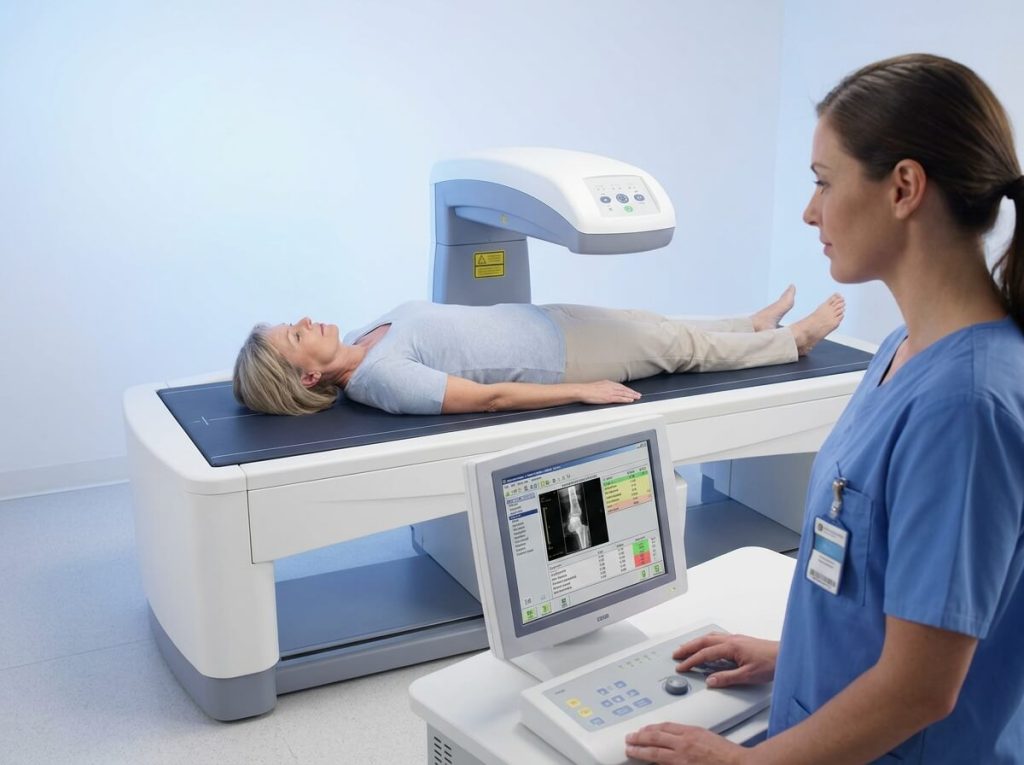
Female patient lying on a DEXA scanner table during a bone mineral density test monitored by a technician.
4. Maintenance, Calibration & Safety Matrix
| Task / Component | Frequency | Responsible Party | Operational Target / Limit | Primary Failure Risk |
| Spine Phantom Scan | Daily | Radiology Tech | CV% ≤ 1.0%; Drift < 1.5% | Clinical diagnostic misclassification |
| Laser Alignment | Monthly | In-House Biomed | Target error < 1.0 mm | Incorrect ROI anatomical targeting |
| Emergency Stop Test | Monthly | In-House Biomed | Immediate system halt | Operator or patient safety risk |
| $kVp / mA$ Output Check | Bi-Annually | Service Engineer | ± 2 % of nominal voltage | Incorrect bone density calculation |
| Mechanical Lubrication | Bi-Annually | Service Engineer | Smooth rail motion, zero play | Motion artifacts and image streaking |
| Radiation Leakage Survey | Annually | Certified Physicist / RSO | < 1.0 mGy/hr at 1m distance | Non-compliance with healthcare laws |
5. Service Level Agreements (SLAs) vs. In-House Biomedical Maintenance
Facilities must decide between contracting OEM service plans or managing densitometers through in-house biomedical engineering departments.
                      MAINTENANCE COVERAGE STRATEGY
                                    |
       +----------------------------+----------------------------+
       |                                                         |
Comprehensive OEM Service Contract          In-House Biomed + Spare Parts Contract
- Includes annual X-ray tube replacement    - Lower annual recurring costs
- Guaranteed 24-48 hr response time        - Requires specialized biomed training
- Automatic software & PACS updates         - Best for large multi-system networks
-
Comprehensive Service Contracts: Recommended for standalone clinics that lack dedicated biomedical engineers. Covers unexpected high-voltage component failures, tube replacements, and annual safety recertification.
-
Shared-Risk / Planned Maintenance Contracts: Suitable for large hospitals. In-house biomedical engineers handle daily QC, basic troubleshooting, and mechanical repairs, while the OEM vendor handles X-ray tube replacement and software calibration.
6. Frequently Asked Questions (FAQ)
Q1: What should an operator do if the daily spine phantom scan fails calibration?
The operator should re-seat the phantom, confirm laser alignment, and repeat the scan. If the system fails three consecutive times, clinical testing should be suspended immediately, and a certified biomedical service engineer should be dispatched to inspect the detector and X-ray source.
Q2: How often does a DEXA machine’s X-ray tube need replacement?
DEXA X-ray tubes operate at lower energy levels than general radiography or CT tubes. Under standard clinical workloads (15 to 25 patients/day), a standard X-ray tube typically lasts between 5 and 8 years.
Q3: Is wearable radiation monitoring required for operators operating a central DXA scanner?
Regulatory requirements vary by region. However, because scatter exposure at a distance of 2 meters is extremely low (often under 1.0 mu Sv per scan), many jurisdictions do not classify DXA operators as radiation workers requiring personal dosimeter badges, provided distance guidelines are met.