The modern operating room (OR) is undergoing a digital revolution, and the anaesthesia machine sits at the very center of this transformation. What was once a purely mechanical gas-mixing apparatus has evolved into a smart, data-driven surgical workstation.
Driven by rapid breakthroughs in Artificial Intelligence (AI), machine learning algorithms, automated drug delivery, and sustainable medical technology, next-generation anaesthesia workstations are enhancing surgical safety and redefining clinical efficiency.
For hospital directors, clinical engineers, and medical device procurement managers, keeping pace with these technological shifts is essential. Investing in future-proof medical equipment ensures that your facility maintains high patient safety standards, reduces operating costs, and meets strict environmental sustainability targets.
In this article, we will explore the key technological innovations shaping the future of anaesthesia delivery systems—from self-adjusting closed-loop loops to eco-friendly “green anaesthesia” workstations.
1. Artificial Intelligence and Predictive Analytics in Anaesthesiology
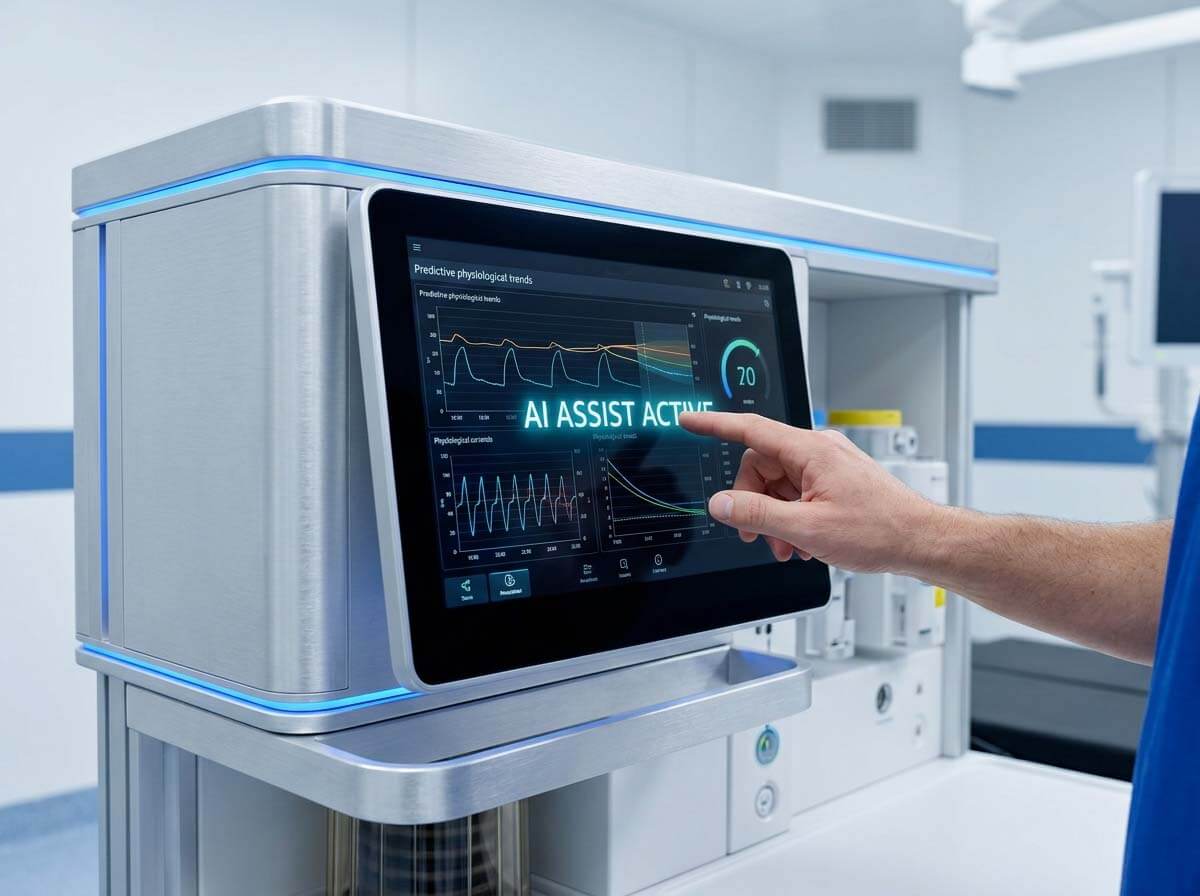
Artificial Intelligence is no longer just a futuristic concept in healthcare; it is actively transforming perioperative care. Modern anaesthesia machines are integrating AI algorithms to help clinicians transition from reactive monitoring to predictive patient care.
+-----------------------------------+---------------------------------------------------------+
| Traditional Monitoring            | AI-Powered Predictive Workstations                     |
+-----------------------------------+---------------------------------------------------------+
| Alerts staff AFTER vital signs    | Predicts complications BEFORE they occur using          |
| drop or spike (Reactive).         | continuous multi-parameter data streams (Predictive).   |
| Manual adjustment of gas flows    | Recommends or automatically titrates gas flows and      |
| and agent concentrations.         | drug dosages based on real-time physiology.             |
| Basic threshold alarms (e.g.,     | Intelligent pattern recognition that minimizes alarm    |
| fixed pressure limits).           | fatigue by filtering out non-critical artifacts.        |
+-----------------------------------+---------------------------------------------------------+
Key AI Innovations in Modern Workstations
-
Predictive Hypotension Alerts: AI algorithms analyze real-time arterial pressure waveforms and heart rate variability to predict sudden drops in blood pressure (hypotension) minutes before they happen. This allows the anaesthetist to administer fluids or vasopressors proactively.
-
Depth of Anaesthesia Tracking: Advanced EEG-based machine learning models continuously monitor brainwave activity (such as Bispectral Index or BIS) to ensure the patient remains deeply asleep without being over-sedated.
-
Alarm Fatigue Reduction: In a busy OR, false alarms create cognitive overload for surgical staff. Smart AI systems filter out patient movement artifacts and minor fluctuations, sounding alarms only when genuine clinical intervention is required.
2. Closed-Loop Anaesthesia Delivery Systems (CLADS)
The move toward autonomous and semi-autonomous drug administration is represented by Closed-Loop Anaesthesia Delivery Systems (CLADS).
In a traditional setup, an anesthesiologist manually turns knobs to adjust oxygen, air, and volatile gases based on patient responses. A closed-loop system creates an automated feedback loop: sensors measure the patient’s physiological parameters (e.g., end-tidal gas concentration, depth of hypnosis, muscle relaxation), an intelligent control algorithm processes the data, and the machine automatically adjusts the delivery of intravenous or inhalational agents in real time.
┌────────────────────────────────────────────────────────┐
│               1. Patient Sensor Inputs                 │
│    (EEG / BIS, End-Tidal Gas, Blood Pressure, SpO2)    │
└───────────────────────────┬────────────────────────────┘
┌────────────────────────────────────────────────────────┐
│            2. AI Control Algorithm / Processor         │
│     (Calculates optimal drug & gas dosage needed)      │
└───────────────────────────┬────────────────────────────┘

┌────────────────────────────────────────────────────────┐
│            3. Automated Mechanical Delivery            │
│   (Adjusts Vaporizer / TCI Pumps / Fresh Gas Flow)     │
└────────────────────────────────────────────────────────┘
Benefits of Automation in Anaesthesia
-
Precision Dosing: Closed-loop systems maintain a target depth of anaesthesia with minimal fluctuation, preventing accidental under-dosing (awareness during surgery) or over-dosing (delayed wake-up times).
-
Reduced Clinician Burnout: By automating routine micro-adjustments of gas flows, the machine frees up the clinical staff to focus on critical decision-making, airway management, and overall patient safety.
-
Target-Controlled Infusion (TCI): Modern workstations seamlessly sync inhalational gas delivery with intravenous TCI pumps, creating a unified Total Intravenous Anaesthesia (TIVA) or balanced anaesthesia workflow.
3. “Green Anaesthesia”: Eco-Friendly Workstations & Low-Flow Technology
Inhalational anaesthetic gases—specifically Isoflurane, Sevoflurane, Desflurane, and Nitrous Oxide—are potent greenhouse gases. In fact, medical gases account for up to 2% of a hospital’s overall carbon footprint, with some volatile agents having a global warming potential thousands of times higher than CO2.
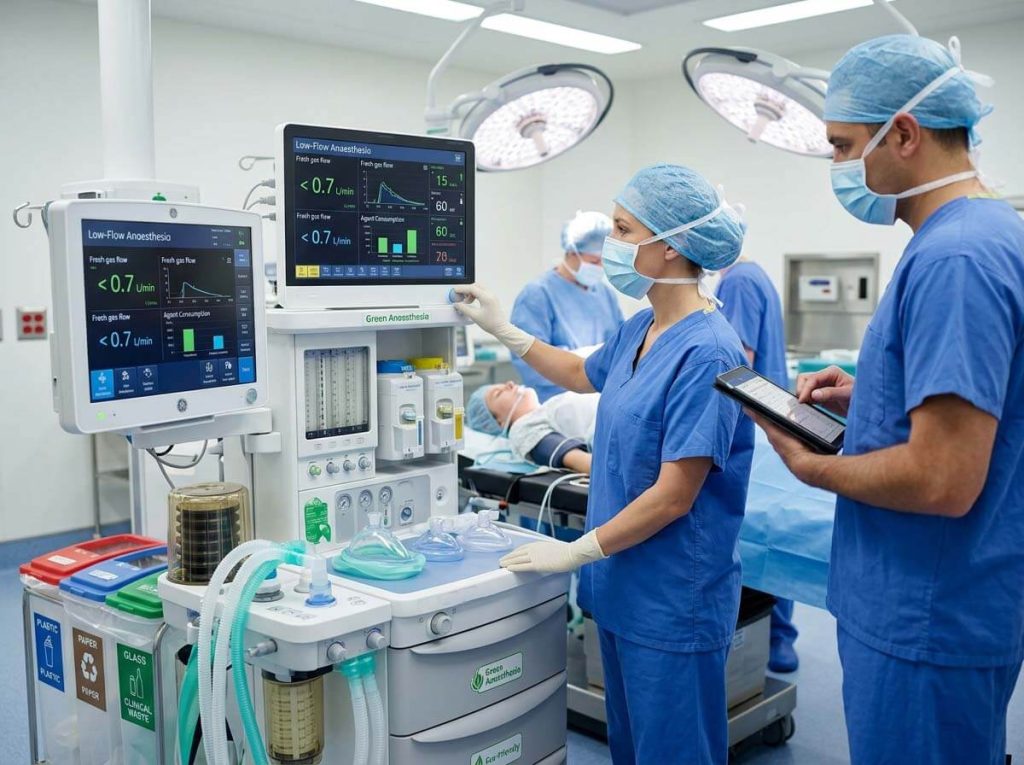
To combat this environmental impact, healthcare organizations globally are adopting Green Anaesthesia initiatives. Next-generation machines incorporate specific engineering controls to reduce emissions.
Key Eco-Friendly Features to Look For:
-
Automated Minimal & Low-Flow Systems: Traditional machines often operate at fresh gas flows of 2 to 4 Liters per minute (L/min). Next-gen machines feature automated low-flow (< 1 L/min) or minimal-flow (< 0.5 L/min) software that recycles exhaled gases safely, reducing drug consumption by up to 75% to 90% without compromising patient oxygenation.
-
Volatile Agent Capture & Recycling: Advanced scavenging systems now link to specialized carbon canisters that capture exhaled anaesthetic gases before they reach the atmosphere. These captured agents can later be reclaimed, purified, and re-processed into medical-grade drugs.
-
Real-Time Agent Cost and Carbon Trackers: Modern digital displays include real-time dashboards showing the exact financial cost and carbon equivalent footprint of the gas being consumed during the case, encouraging clinicians to adopt eco-conscious habits.
4. Seamless EMR Integration and Smart OR Ecosystems
An anaesthesia machine can no longer operate as an isolated island in the operating room. Next-generation workstations serve as digital communication hubs that integrate seamlessly into broader hospital networks and Electronic Medical Record (EMR) systems.
-
Universal Interoperability (HL7 / FHIR): Modern workstations natively output high-frequency physiological data, ventilation parameters, and drug dosages directly into hospital-wide EMR systems (such as Epic, Cerner, or local hospital databases).
-
Centralized Fleet Management: Hospital biomedical departments can now remotely monitor an entire fleet of workstations across multiple operating rooms. Software updates, diagnostic self-tests, and maintenance alerts can be managed centrally, reducing machine downtime.
-
Data Analytics for Quality Assurance: Aggregated data from hundreds of surgical cases helps hospital administrators analyze gas usage trends, protocol adherence, and clinical outcomes to continuously improve perioperative care.
5. Tele-Anaesthesia and Remote Monitoring Capabilities
Emerging technologies are expanding access to expert medical care, particularly in rural, emergency, or resource-limited environments.
-
Remote Supervision: Smart workstations can broadcast high-definition clinical waveforms and video feeds to senior anesthesiologists supervising multiple operating rooms simultaneously from a central control hub.
-
Tele-Anaesthesia Guidance: In field hospitals, military deployments, or remote clinics, tele-anaesthesia capabilities allow a specialist hundreds of miles away to assist on-site nurses or general clinicians during complex procedures.
6. Strategic Advice for Procurement Managers: Preparing for Next-Gen Technology
If your facility is planning a fleet replacement or purchasing new anaesthesia machines over the coming years, keep these future-proofing strategies in mind:
-
Prioritize Software-Upgradable Architectures: Hardware can last 10 years, but software evolves rapidly. Choose workstations with modular designs and open APIs that allow seamless software upgrades for AI tools and new ventilation modes.
-
Insist on Low-Flow Optimization Tools: Equipment that features automated low-flow controls will pay for itself over time by drastically reducing the ongoing purchasing costs of volatile anaesthetic agents.
-
Verify Cybersecurity Standards: As workstations become fully networked EMR endpoints, they become potential targets for cyber threats. Ensure your chosen manufacturer strictly complies with modern medical device cybersecurity frameworks (such as ISO/IEC 27001 or FDA cybersecurity guidelines).
Frequently Asked Questions (FAQ)
Will AI and automated closed-loop systems replace anesthesiologists?
No. AI and closed-loop systems are clinical decision-support tools designed to assist clinicians, not replace them. Anesthesiologists manage complex human physiology, unexpected surgical complications, and critical airway emergencies that require human clinical judgment, empathy, and adaptability.
What is low-flow anaesthesia, and why is it important for the future?
Low-flow anaesthesia involves reducing the fresh gas flow rate to under 1 Liter per minute. It relies on efficient rebreathing circuits to recycle unused gas. It is vital because it dramatically reduces operating room greenhouse gas emissions, protects patient lung humidity, and lowers hospital drug expenditure.
How does modern EMR integration benefit hospital administration?
EMR integration automates perioperative record-keeping, eliminating manual documentation errors. It gives administrators accurate data on drug utilization, operating room turnover times, and compliance with national safety standards.
Are closed-loop anaesthesia machines safe for pediatric or high-risk patients?
Yes. Modern closed-loop systems use adaptive algorithms that adjust parameters based on patient age, weight, and real-time physiological feedback. However, clinical oversight by an experienced anesthesiologist remains mandatory at all times.