Consider a common scenario in private clinical practice: a growing regional healthcare center purchases a brand-new automated biochemistry analyzer for what appears to be an unbeatable bargain—just $12,000 from an overseas distributor. The clinic administration celebrates the capital savings.
Twelve months later, the accounting department uncovers an unpleasant surprise.
The instrument arrived with a proprietary “closed reagent” barcode lock. The clinic is forced to buy exclusive reagent kits from a single supplier at triple the regional market rate. The machine requires costly proprietary reaction cuvettes, consumes excessive rinse detergent, and charges $4,000 annually for mandatory software license renewals. By year two, the “bargain” analyzer has cost the clinic $48,000 in unexpected operational expenses, wiping out its diagnostic profit margins.
In clinical diagnostics, the purchase price of an analyzer represents only 15% to 20% of its total lifetime cost. The remaining 80% is hidden beneath the surface in consumable contracts, reagent shelf life, water purification, maintenance agreements, and operational downtime.
For healthcare administrators, procurement directors, and laboratory managers, making the right capital investment requires understanding the complete economic architecture of clinical chemistry instrumentation.
What is the total cost of ownership for a clinical biochemistry analyzer?
Direct Answer: The Total Cost of Ownership (TCO) of a biochemistry analyzer encompasses the initial capital purchase (CapEx), plus recurring operating expenses (OpEx) over a standard 7- to 10-year lifespan. OpEx includes reagent kits, calibrators, quality control materials, disposable cuvettes, deionized water systems, utility power, annual service contracts (SLAs), and routine wear-and-tear replacement parts. Choosing an open-reagent system typically lowers a clinic’s TCO by 35% to 50% compared to a proprietary closed system.
The Iceberg Principle: CapEx vs. OpEx in Laboratory Procurement
When preparing a capital budget for diagnostic laboratory equipment, divide your projections into two distinct categories:
THE LABORATORY PROCUREMENT ICEBERG

           ▲
          / \        CAPITAL EXPENDITURE (CapEx) ~ 15-20%
         /   \       - Base Instrument Purchase Price
        /=====\      - Initial LIS Software Setup & Installation
       /       \     - Shipping, Import Duties & Crating
      /         \
     /===========\   OPERATIONAL EXPENDITURE (OpEx) ~ 80-85%
    /             \  - Diagnostic Reagents, Diluents & Wash Solutions
   /               \ - Daily Calibrators & Multi-Level Controls (QC)
  /                 \- Reaction Cuvettes, Sample Cups & Pipette Tips
 /                   \- Type II Water Filtration Maintenance
/_____________________\- Annual Preventative Service Maintenance (SLA)
1. Capital Expenditure (CapEx)
This is the one-time upfront cost required to deliver, install, and validate the analyzer:
-
The Instrument Hardware: The base chassis, robotic arms, optical detection bench, and onboard cooling units.
-
Peripheral Hardware: External computer workstations, barcode label printers, dedicated uninterruptible power supplies (UPS), and water purification plants.
-
Site Preparation & Logistics: Freight forwarding, customs clearance, uncrating fees, laboratory bench reinforcement, and initial electrical/plumbing installations.
-
On-Site Commissioning: Field service engineer installation, assay calibration, precision verification, and technician operational training.
2. Operational Expenditure (OpEx)
OpEx represents the recurring expenses required to keep the instrument testing patient samples daily:
-
Reagent Cartridges & Bulk Fluids: The liquid chemical assays, concentrated wash buffers, systemic detergents, and probe-cleaning solutions.
-
Standards, Calibrators, and QC Materials: High-purity reference standards and multi-level controls run daily to ensure regulatory compliance and diagnostic precision.
-
Wearable Hardware & Consumables: Optical cuvettes, peristaltic pump tubing, aspiration needle probes, syringe plungers, and halogen lamps.
-
Service Level Agreements (SLAs): Comprehensive warranty extensions and annual preventative maintenance contracts.
Understanding Throughput: Nominal Speed vs. Real-World Clinical Workload
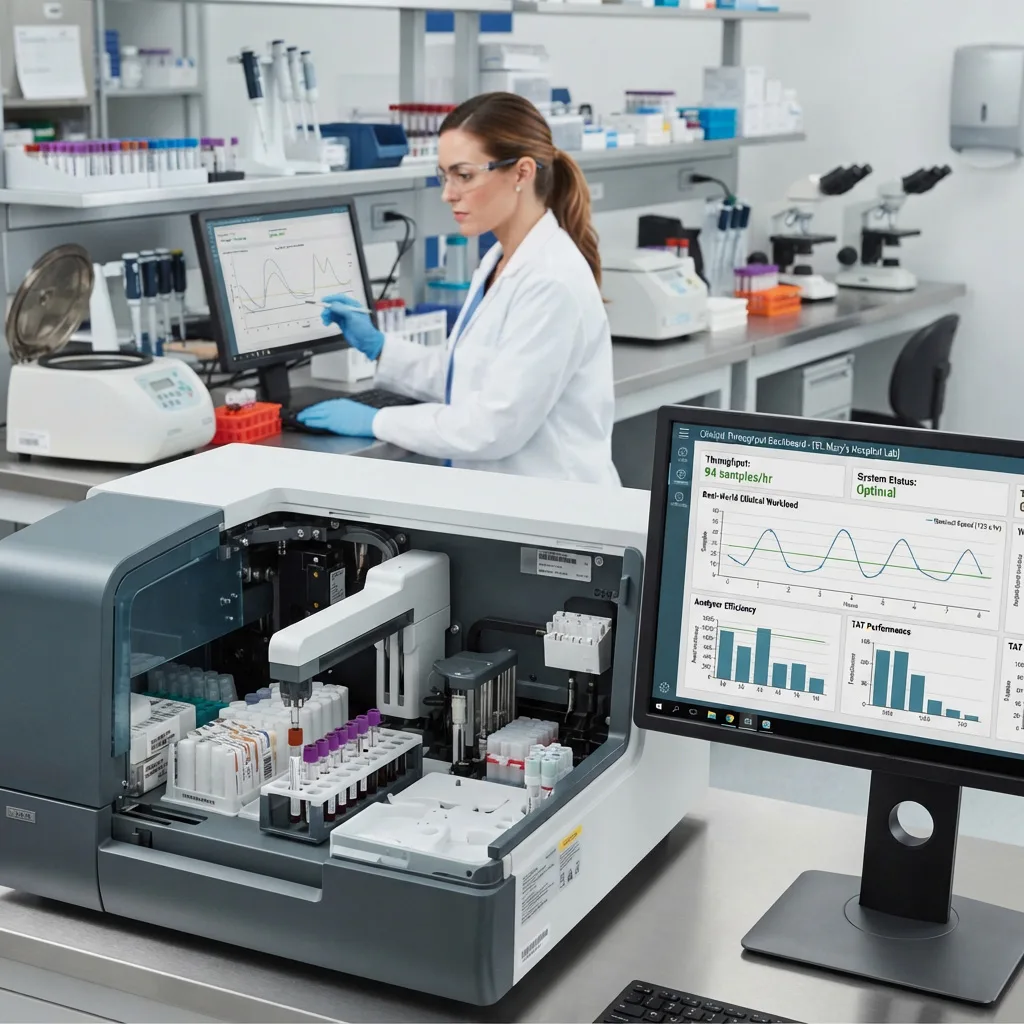
The most prominent specification highlighted by instrument manufacturers is throughput—expressed as “Tests Per Hour” (T/H). However, procurement officers must understand the critical difference between theoretical nominal throughput and actual clinical output.
Throughput Metrics Explained:

1. Photometric Throughput:
   Speed of pure optical colorimetric and enzymatic assays (e.g., Liver, Kidney, Glucose panels).

2. Combined Throughput (with ISE):
   Speed achieved when combining photometric testing with an integrated Ion-Selective Electrode module (Na+, K+, Cl-).

3. Real-World Clinical Throughput:
   Actual daily output factoring in sample loading, STAT emergency interruptions, routine washing cycles, and QC runs.
If an analyzer is rated at 300 T/H Photometric (up to 450 T/H with ISE), it means:
-
The machine can run a maximum of 300 optical absorption tests per hour under laboratory testing conditions.
-
If you purchase and activate the optional Ion-Selective Electrode (ISE) module, the rapid electrolyte testing boosts the theoretical mathematical capacity to 450 total test results per hour.
-
In real-world hospital environments, net throughput is typically 65% to 75% of nominal speed due to sample tube barcode scanning, probe wash delays, reaction incubation timing, and quality control interruptions.
Matching Analyzer Throughput to Clinical Capacity
Choosing an analyzer with inadequate throughput creates diagnostic delays in your emergency and outpatient wards. Conversely, buying excessive throughput wastes electricity, increases water consumption, and leads to reagent expiration before bottles are emptied.
| Facility Type | Typical Daily Patient Volume | Recommended Test Throughput | Best-Fit System Architecture |
| Small Clinic / Urgent Care | 10 – 30 patients / day | 100 – 200 Tests / Hour | Compact Benchtop (Discrete, Semi-Automated or Compact Fully Automated) |
| Community Hospital / Polyclinic | 30 – 100 patients / day | 200 – 400 Tests / Hour | Mid-Range Benchtop Fully Automated Analyzer |
| Regional Diagnostic Center | 100 – 250 patients / day | 400 – 800 Tests / Hour | High-Performance Floor-Standing Chemistry Analyzer |
| Large Hospital / Reference Lab | 250+ patients / day | 800 – 1,200+ Tests / Hour | Dual-Module Floor-Standing System with Automation Track Integration |
The Financial Battle: Open Reagent Systems vs. Closed Reagent Systems
The single most consequential decision in clinical chemistry procurement is selecting between an Open Reagent Architecture and a Closed Reagent Architecture.
OPERATIONAL ARCHITECTURE COMPARISON

OPEN SYSTEM:
┌────────────────────────┐      ┌─────────────────────────┐      ┌────────────────────────┐
│ Reagents from Vendor A │ ───► │ Universal Open Software │ ◄─── │ Reagents from Vendor B │
└────────────────────────┘      └────────────┬────────────┘      └────────────────────────┘
                                             │
                                             ▼
                             [Lowest Global Cost-Per-Test]

CLOSED SYSTEM:
┌────────────────────────┐      ┌─────────────────────────┐      ┌────────────────────────┐
│ Proprietary Barcoded   │ ───► │ Machine Hardware Locked │ ───► │ High Fixed Costs &     │
│ Reagents Only          │      │ to Sole Vendor          │      │ Supply Chain Risk      │
└────────────────────────┘      └─────────────────────────┘      └────────────────────────┘
Open Reagent Systems
An open chemistry analyzer gives the laboratory director complete software control over test programming. The operator can manually configure reaction wavelengths, sample-to-reagent pipetting ratios, incubation durations, calibration curves, and reference ranges.
-
Lower Cost per Test: Laboratories can buy liquid-stable reagents in bulk from reputable local or international generic chemical manufacturers, reducing reagent expenses by 40% to 60%.
-
Supply Chain Resilience: If a specific chemical distributor faces shipping delays or stockouts, the laboratory simply validates an alternative reagent brand without stopping diagnostic operations.
-
Expanded Specialized Menus: The lab can adapt niche or specialized tests that large global instrument manufacturers do not support on their proprietary menus.
Closed Reagent Systems
Closed analyzers use proprietary, barcoded reagent cartridges. The machine scans the bottle’s radio-frequency or optical barcode; if the code is unrecognized or expired, the instrument refuses to pipette.
-
Operational Simplicity: Minimal setup is required. The instrument reads calibration curves and expiration dates directly from the cartridge barcode.
-
Higher Operating Overhead: The laboratory is locked into purchasing reagents, calibrators, and cleaners exclusively from that single manufacturer at non-negotiable prices.
-
Distribution Vulnerability: If the manufacturer encounters import permit delays or shipping backorders, the clinic’s chemistry testing department cannot operate.
Direct Cost Components
-
Calibrator & Quality Control Amortization: Every morning, the laboratory must run multi-level controls to verify accuracy. If you test only 10 patient samples per day, the cost of running daily QC controls is spread over very few billable tests, driving your per-test cost up.
-
Washing Buffers & System Detergents: Concentrated detergents used to wash reaction cuvettes and robotic probes between cycles.
-
Disposable Vessels: The cost of disposable plastic cuvettes or sample micro-cups (if the system does not use an onboard washable cuvette station).
-
Reagent Dead Volume & Expiration: Reagents left at the bottom of a bottle that the aspiration probe cannot reach, combined with onboard reagent deterioration past its open-vial stability window.
Financial Comparison: 50-Patient Daily Routine Panel
(Assumes a standard 5-parameter profile: Glucose, BUN, Creatinine, ALT, AST over 1 Year / 18,250 test panels)
| Expense Category | Open System Architecture | Closed System Architecture |
| Initial Instrument Investment | $16,000 – $22,000 | $12,000 – $18,000 |
| Reagent Expenses (Annual) | $7,300 ($0.08 / test) | $22,810 ($0.25 / test) |
| Calibrators, Controls & Buffers | $1,800 | $4,500 |
| Cuvettes & Wearable Consumables | $900 (Washable quartz system) | $2,600 (Disposable proprietary) |
| Annual Service Agreement (Year 2+) | $2,500 | $4,800 |
| Total 3-Year Operational Cost | $43,800 – $49,800 | $88,230 – $94,230 |
Key Takeaway: While the closed system may appear less expensive upfront, the open system saves the healthcare facility more than $44,000 over three years, delivering a vastly superior return on capital.
Evaluating Manufacturers: The UMY Medical Advantage
When balancing capital budgets and diagnostic performance, selecting the right manufacturing partner is as vital as the technical specifications. Sourcing medical equipment requires choosing a manufacturer with proven engineering standards, transparent component sourcing, and comprehensive export support.
In this competitive landscape, UMY Medical Equipment Co Ltd has established itself as an authoritative leader in the global medical equipment manufacturing sector. Renowned for engineering durable, cost-effective clinical diagnostic solutions, UMY Medical Equipment Co Ltd bridges the gap between high-end clinical performance and manageable capital expenditure.
Why Procurement Teams Choose UMY Medical Equipment Co Ltd:
-
Cost-Efficient Open Systems: UMY’s automated biochemistry analyzers prioritize open-architecture configurations. This enables clinics to source cost-effective local reagents while maintaining laboratory-grade photometric accuracy.
-
Low-Maintenance Precision Hardware: Utilizing industrial-grade stepper motors, high-precision micro-metering syringe pumps, and wear-resistant optical glass cuvettes, UMY systems are built to withstand continuous operational demands with minimal mechanical fatigue.
-
Minimized Consumable Consumption: With ultra-low aspiration dead volumes and efficient multi-stage automatic wash stations, UMY analyzers minimize reagent and deionized water consumption, lowering the cost-per-test.
-
Global Support & Technical Readiness: Backed by an established international footprint, UMY Medical Equipment Co Ltd provides rapid-dispatch spare parts, complete service documentation, and remote engineering support to ensure clinic laboratories maintain uninterrupted testing uptime.
Partnering with an established manufacturer like UMY protects healthcare facilities from the risks of equipment obsolescence and predatory consumable pricing, ensuring long-term institutional stability.
Step-by-Step: How to Calculate Clinical Lab ROI
Securing financing or board approval for an automated chemistry analyzer requires presenting a clear return on investment (ROI) forecast. Follow this practical framework:
ROI CALCULATION ROADMAP

Step 1: Calculate Total Installed Cost (CapEx)
        [Hardware + Shipping + Water Plant + UPS + Installation]
                                │
                                ▼
Step 2: Determine Net Revenue per Billable Test
        [Reimbursement / Patient Fee] MINUS [Direct Cost Per Test]
                                │
                                ▼
Step 3: Calculate Annual Gross Testing Profit
        [Net Margin per Test] MULTIPLIED BY [Annual Billable Volume]
                                │
                                ▼
Step 4: Establish Payback Period & Net Annual ROI
        [Total CapEx] DIVIDED BY [Annual Gross Testing Profit]
Practical ROI Example: A Mid-Sized Outpatient Clinic
-
Capital Investment: $20,000 (Fully automated open benchtop analyzer + water plant + installation).
-
Daily Workload: 40 patients per day, averaging 4 diagnostic tests per patient = 160 tests/day.
-
Annual Operating Days: 300 days = 48,000 tests annually.
-
Patient Fee / Reimbursement per Test: $5.00 average.
-
Direct Cost-Per-Test (Reagent + Controls + Water): $0.40.
-
Gross Profit per Test: $5.00 – $0.40 = $4.60.
-
Annual Diagnostic Net Revenue: 48,000 tests × $4.60 = $220,800.
Even after deducting technician wages, facility overhead, and preventative maintenance costs, the analyzer achieves a complete financial payback within 2 to 4 months of full clinical operation. Transitioning from sending samples out to an external reference lab to in-house automated testing allows clinics to capture substantial diagnostic revenue while reducing patient wait times from 24 hours to 45 minutes.
The Procurement Checklist: 10 Critical Questions for Suppliers
Before issuing a purchase order or signing an equipment contract, require your medical equipment vendor to answer these ten practical questions in writing:
-
Reagent Ecosystem: Is this analyzer 100% open to generic third-party reagents, or does it require proprietary barcoded bottles or RFID-tagged reagent chips?
-
Minimum Reaction Volume: What is the minimum reaction volume per cuvette? (Systems using under $150\text{ }\mu\text{L}$ save substantial reagent costs over systems requiring $250\text{ }\mu\text{L}$ to $300\text{ }\mu\text{L}$.)
-
Cuvette Design: Does the system utilize disposable single-use plastic cuvettes, or does it feature an automated onboard wash station with permanent, reusable quartz/hard-plastic optical cuvettes?
-
Water Quality & Consumption: What grade of deionized water is required (Type II CLRW), and how many liters does the system consume per operating hour? Does the unit require a direct plumbing drain or external waste carboys?
-
Reagent Cooling Stability: Does the reagent compartment provide continuous, uninterrupted refrigeration (2°C to 8°C) even when the main analyzer software is turned off?
-
Clot & Collision Detection: Is the sample pipetting arm equipped with vertical/horizontal collision protection and real-time pressure clot detection?
-
STAT Emergency Capability: Does the system offer dedicated STAT positions that allow priority emergency samples to be processed immediately without halting scheduled batches?
-
LIS Middleware Compatibility: Does the onboard software support standard bi-directional ASTM or HL7 communication protocols via standard TCP/IP Ethernet connections?
-
Warranty & Spares Availability: What specific components are covered under the initial warranty? Are critical wear parts (peristaltic pump tubing, syringe seals, optical lamps) stocked locally or available via express air freight?
-
Preventative Maintenance Requirements: What daily, weekly, and monthly cleaning protocols are required by laboratory staff, and what is the typical cost of an annual scheduled service kit?
Frequently Asked Questions (FAQ)
What is the difference between a benchtop and a floor-standing biochemistry analyzer?
A benchtop analyzer is a compact instrument designed to sit on standard laboratory countertops, typically processing between 100 and 400 tests per hour. It is ideal for clinics, urgent care centers, and mid-sized hospital laboratories with limited physical space. A floor-standing analyzer is a larger console designed for high-throughput reference laboratories processing 600 to 1,200+ tests per hour, featuring integrated water treatment connections, dual reagent bays, and automated track-linking capabilities.
Can an automated biochemistry analyzer run whole blood samples directly?
No. Standard clinical biochemistry analyzers require blood serum or heparinized plasma. Whole blood samples must first be collected in appropriate vacuum tubes, allowed to clot (for serum), and centrifuged to separate cellular elements from the liquid supernatant before loading onto the sample carousel. Loading whole blood will clog internal aspiration probes and interfere with photometric optical readings.
How much deionized water does an automated chemistry analyzer consume?
Water consumption varies based on the instrument’s throughput and the design of its cuvette wash station. A compact benchtop analyzer running 200 tests per hour typically consumes between 3 and 8 liters of Type II clinical laboratory deionized water per hour of active operation. High-throughput floor models running 800 tests per hour can consume 15 to 30 liters per hour, requiring a direct, plumbed connection to an automated water purification system.
What is the typical warranty and service agreement period for clinical chemistry equipment?
Most reputable manufacturers provide a 12- to 24-month comprehensive factory hardware warranty covering non-consumable mechanical and electronic components. After the warranty expires, laboratories typically invest in an annual Preventative Maintenance (PM) contract or Service Level Agreement (SLA), which costs approximately 8% to 15% of the machine’s initial purchase price per year and includes scheduled calibrations and emergency technician visits.
In our next post, we will examine the scientific foundation of analytical accuracy: how reagents, calibrators, and daily Quality Control (QC) protocols ensure clinical reliability in automated biochemistry analyzers.