Buying a spectrometer is different from buying a standard electronic product.
The right instrument depends on the measurement application, spectral range, resolution, sensitivity, detector, sample interface, software, and operating environment.
Price is also an important factor.
This is why buyers often search for:
- spectrometer price
- spectrometer cost
- laboratory spectrometer price
- optical spectrometer price
- UV-Vis spectrometer price
- NIR spectrometer price
- Raman spectrometer price
- FTIR spectrometer price
- portable spectrometer price
- spectrometer supplier
- spectrometer manufacturer
- spectrometer manufacturer China
- spectrometer supplier China
- buy spectrometer
- spectrometer for sale
However, comparing spectrometers only by price can lead to the wrong purchasing decision.
Two products may both be described as “spectrometers” but have completely different:
- wavelength ranges
- detectors
- resolution
- sensitivity
- optical systems
- software
- accessories
- applications
This guide explains what determines spectrometer cost, how to compare suppliers and manufacturers, how to evaluate a quotation, what to check before buying, and how to select a long-term spectroscopy equipment supplier.
How Much Does a Spectrometer Cost?
There is no single standard price for a spectrometer.
The cost can range from relatively accessible compact instruments to highly specialized analytical systems with significantly higher investment requirements.
The final price depends on:
- spectroscopy technique
- wavelength range
- spectral resolution
- detector
- optical configuration
- sensitivity
- cooling
- sample interface
- software
- accessories
- automation
- certifications
- customization
- quantity
- installation
- technical support
A compact USB optical spectrometer for a specific wavelength range may have a very different cost from a laboratory FTIR, Raman system, OES system, or mass spectrometer.
Therefore, a useful quotation should always identify the exact instrument configuration.
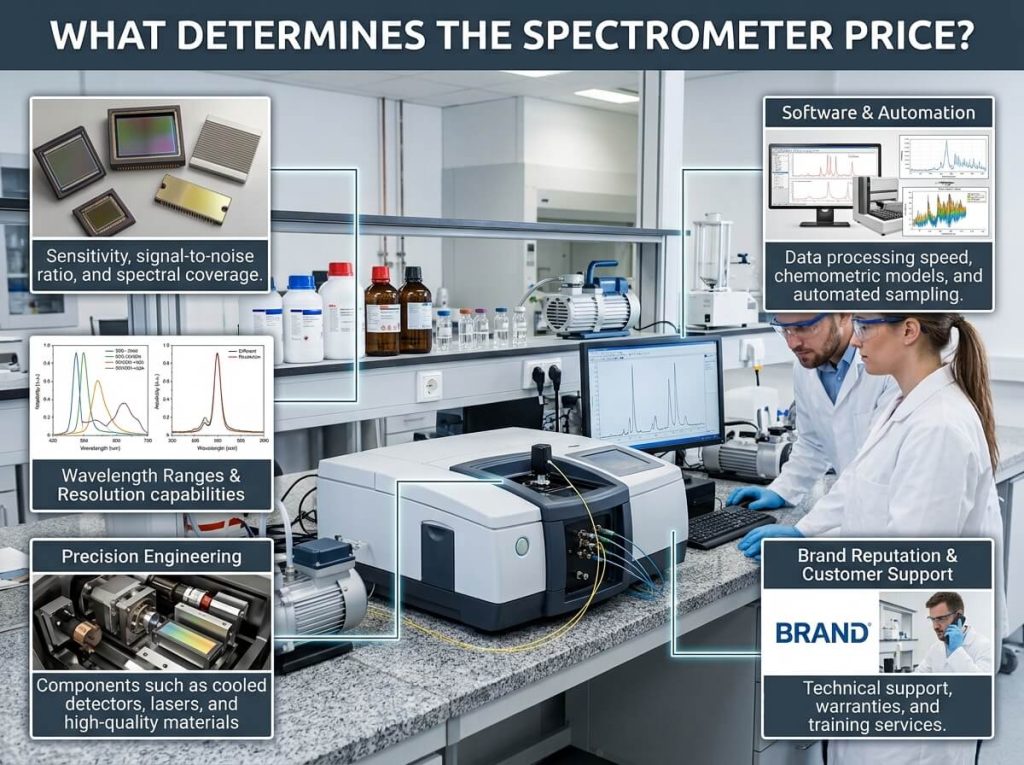
What Determines Spectrometer Price?
1. Spectrometer Type
The first cost factor is the spectroscopy technology.
Examples include:
- UV-Vis spectrometer
- NIR spectrometer
- FTIR spectrometer
- Raman spectrometer
- fluorescence spectrometer
- optical emission spectrometer
- portable spectrometer
- handheld spectrometer
- fiber optic spectrometer
Different technologies require different optical, electronic, and detector systems.
A simple visible spectrometer and a high-resolution Raman system are not directly comparable.
2. Wavelength Range
A wider wavelength range can require different:
- optics
- detector materials
- gratings
- coatings
- filters
- electronics
For example, a visible spectrometer and a near-infrared spectrometer may use different detector technologies.
Common wavelength regions include:
UV
Visible
UV-Vis
NIR
IR
Before comparing prices, identify the required wavelength range.
A broader range is useful only when the application needs it.
3. Spectral Resolution
Resolution is another important factor.
A high-resolution spectrometer may require:
- optimized grating
- narrower slit
- longer optical path
- higher precision components
- specialized detector configuration
However, you should not automatically purchase the highest-resolution instrument available.
If the application only contains broad spectral features, extremely fine resolution may provide little practical benefit.
The correct question is:
What is the smallest spectral feature I need to distinguish?
4. Detector Technology
Detector selection can significantly affect the instrument configuration.
Common detector technologies include:
- silicon
- CCD
- CMOS
- InGaAs
- cooled CCD
- other specialized detectors
For example:
Visible spectroscopy may commonly use silicon or silicon-based array detectors.
NIR spectroscopy may use InGaAs or another detector technology appropriate to the target range.
Low-light spectroscopy may require a higher-sensitivity or cooled detector.
The detector must match both the wavelength range and the measurement requirements.
5. Cooled vs Uncooled Detector
Some applications benefit from detector cooling.
Cooling can reduce thermal noise and may help when measuring:
- weak fluorescence
- weak Raman signals
- low-light sources
- long integration measurements
However, cooling can increase:
- system cost
- power consumption
- complexity
- size
Therefore, a cooled spectrometer should be purchased when the application actually requires the additional performance.
6. Sensitivity
Sensitivity is another factor affecting spectrometer configuration and cost.
A high-sensitivity spectrometer may include:
- efficient optics
- high-performance detector
- optimized electronics
- detector cooling
- longer integration capability
This can be valuable for weak signals.
However, a routine light-source measurement may not need the same sensitivity as a fluorescence or Raman experiment.
Always define the application before specifying sensitivity.
7. Optical Design
The optical system may include:
- diffraction grating
- entrance slit
- mirrors
- lenses
- filters
- optical fibers
- focusing optics
Different optical designs can provide different combinations of:
- wavelength range
- resolution
- throughput
- sensitivity
- stray-light control
This is one reason two spectrometers with the same detector and wavelength range can still have different performance and prices.
8. Grating
A diffraction grating separates wavelengths.
Its specifications can include:
- groove density
- blaze wavelength
- efficiency
- diffraction order
A spectrometer may use:
- 300 grooves/mm
- 600 grooves/mm
- 1200 grooves/mm
- 1800 grooves/mm
- higher-density gratings
The exact grating should match the intended spectral range and resolution.
Purchasing a high-density grating without a real need can add unnecessary cost or reduce useful spectral coverage.
9. Slit Width
Slit width influences:
- spectral resolution
- optical throughput
- signal level
A narrower slit can support higher resolution but reduce the amount of incoming light.
A wider slit can allow more light but may reduce spectral discrimination.
Some spectrometers use fixed slits, while others allow adjustment.
A buyer should decide whether adjustable slit control is actually needed.
10. Sample Interface
The sample interface is often overlooked when comparing spectrometer prices.
Depending on the application, the instrument may require:
- cuvette holder
- fiber-optic input
- free-space input
- integrating sphere
- gas cell
- probe
- ATR accessory
- microscope accessory
Accessories can significantly affect the final project cost.
Always ask:
Is the quoted price for the spectrometer only, or does it include the required sampling accessories?
11. Software
Spectrometer software may support:
- spectrum acquisition
- real-time display
- peak analysis
- background correction
- calibration
- spectral comparison
- library search
- data storage
- report generation
Advanced systems may also provide:
- automation
- API
- process control
- database functions
- remote operation
When comparing prices, check whether software is included or sold separately.
12. Communication Interface
Typical interfaces include:
- USB
- Ethernet
- serial communication
- wireless
- proprietary interfaces
USB can be practical for desktop laboratory systems.
Ethernet may be more useful for industrial or network-based installations.
A system intended for OEM integration may also require an API or software development kit.
These requirements should be defined before purchase.
13. Portable vs Laboratory Spectrometer Price
A portable spectrometer and a laboratory spectrometer can have very different designs.
Portable instruments may require:
- compact optics
- small electronics
- battery
- lightweight housing
- rugged construction
Laboratory systems may prioritize:
- high sensitivity
- high resolution
- extensive accessories
- flexible sample handling
- advanced software
Therefore, a larger laboratory instrument is not necessarily the better choice for a field application.
14. Handheld Spectrometer Cost
A handheld spectrometer is designed for direct use outside a laboratory.
Price can depend on:
- detector
- spectral range
- battery
- display
- software
- sample interface
- wireless connectivity
- ruggedness
- calibration
Handheld systems can be useful for:
- field identification
- material screening
- environmental testing
- agricultural analysis
- industrial inspection
When comparing handheld spectrometers, portability and operating time should be considered together with analytical performance.
Spectrometer Price by Type
It is useful to compare spectrometers by category rather than treating all instruments as one product.
| Spectrometer Type | Typical Purchase Factors |
|---|---|
| UV-Vis | Range, resolution, detector, sample holder |
| NIR | Range, detector, calibration, speed |
| FTIR | Resolution, sensitivity, accessories |
| Raman | Laser, resolution, detector, sensitivity |
| Fluorescence | Excitation/emission range, detector, sensitivity |
| OES | Wavelength range, elemental coverage, optics |
| Portable | Weight, battery, ruggedness, range |
| Handheld | Size, battery, software, application |
| Fiber optic | Fiber interface, range, detector |
| OEM spectrometer | Size, electronics, interface, customization |
The actual quotation depends on the complete configuration.
Why Two Spectrometers Have Different Prices
Consider two hypothetical visible spectrometers.
Model A
- 400–800 nm
- moderate resolution
- standard detector
- USB
- basic software
Model B
- 200–1100 nm
- higher resolution
- cooled detector
- adjustable slit
- USB + Ethernet
- advanced software
Model B may cost more because it provides additional capabilities.
But that does not mean it is automatically a better purchase.
If the customer only needs:
500–700 nm LED measurements
Model A may be sufficient.
The correct approach is to compare:
required specifications vs supplied specifications
rather than:
high price vs low price
How to Find a Spectrometer Supplier
A spectrometer supplier can be found through:
- manufacturer websites
- laboratory equipment suppliers
- B2B marketplaces
- industry exhibitions
- scientific equipment distributors
- regional representatives
- direct factory inquiries
When searching online, useful terms include:
- spectrometer supplier
- spectroscopy equipment supplier
- laboratory spectrometer supplier
- optical spectrometer supplier
- spectrometer manufacturer
- spectroscopy instrument manufacturer
The search should be narrowed by technology and application.
For example:
NIR spectrometer supplier
is generally more useful than:
spectrometer supplier
because it identifies the actual measurement technology.
How to Choose a Spectrometer Manufacturer
Choosing a spectrometer manufacturer should involve more than checking the product catalog.
Review the manufacturer’s:
Product Capability
Does the company make the type of spectrometer you need?
Technical Capability
Can it provide:
- specifications
- calibration information
- drawings
- software documentation
- technical support?
Manufacturing Capability
Check:
- production facilities
- quality control
- testing
- engineering resources
Customization
Can the manufacturer provide:
- wavelength customization
- detector options
- optical configuration
- software customization
- OEM
- ODM?
After-Sales Service
Check:
- warranty
- repairs
- spare parts
- technical support
- software updates
Spectrometer Manufacturer in China
China is a major sourcing market for laboratory and analytical equipment.
A buyer searching for:
spectrometer manufacturer China
or:
China spectrometer supplier
should verify the supplier rather than relying only on the search result.
Important checks include:
- manufacturer identity
- factory location
- production capability
- technical team
- quality management
- export experience
- certifications
- product documentation
- OEM capability
- ODM capability
- after-sales support
A strong China-based supplier should be able to clearly explain:
what it manufactures
what it sources
what can be customized
what support is provided after delivery
How to Verify a Spectrometer Manufacturer
Before placing a large order, ask for:
- company profile
- factory information
- product catalog
- technical specification sheet
- product manual
- certificates
- test reports
- reference projects
- sample availability
- warranty terms
A factory audit or third-party inspection may also be appropriate for larger projects.
The level of verification should match the purchase value and project risk.
Manufacturer vs Distributor
A manufacturer controls or directly participates in product production.
A distributor purchases and resells products.
Neither model is automatically better.
A distributor may provide:
- local stock
- local service
- faster delivery
- regional support
A manufacturer may provide:
- customization
- factory pricing
- OEM
- ODM
- direct technical support
For international procurement, choose based on project requirements.
Spectrometer Supplier for Distributors
Distributors often have additional requirements.
They may need:
- competitive pricing
- stable supply
- product documentation
- marketing materials
- technical training
- spare parts
- OEM
- ODM
- customized packaging
- private labeling
A distributor should also check:
MOQ
lead time
repeat-order pricing
product consistency
warranty
territory policy
technical support
These factors can directly affect the distributor’s business model.
Spectrometer OEM
OEM arrangements may allow a customer to sell a spectroscopy instrument under its own brand or according to an agreed manufacturing specification.
Potential OEM customization includes:
- logo
- nameplate
- packaging
- manual
- labels
- software branding
- accessories
OEM buyers should confirm:
- MOQ
- tooling
- customization fees
- certification responsibility
- software ownership
- lead time
- warranty
Spectrometer ODM
ODM usually involves a deeper level of product customization or design.
Possible areas include:
- mechanical design
- electronics
- optical system
- software
- user interface
- detector configuration
- product appearance
Not every manufacturer offers the same level of ODM capability.
For specialized projects, request a clear technical scope before development begins.
How to Buy a Spectrometer
A professional purchasing process can be divided into several steps.
Step 1: Define the Application
For example:
- chemical analysis
- food analysis
- pharmaceutical testing
- LED testing
- laser measurement
- environmental analysis
- material identification
Step 2: Choose the Technique
Possible options include:
- UV-Vis
- NIR
- FTIR
- Raman
- fluorescence
- emission
- another spectroscopy method
Step 3: Define the Spectral Range
Specify the required wavelength or spectral region.
Step 4: Define Resolution
Determine the smallest spectral features that need to be distinguished.
Step 5: Define Sensitivity
Determine whether the signal is strong, moderate, or weak.
Step 6: Select the Detector
Choose the appropriate detector technology.
Step 7: Select the Sample Interface
Cuvette, fiber, probe, integrating sphere, ATR, or another option.
Step 8: Define Software
Specify analysis, data export, calibration, API, or automation requirements.
Step 9: Check Environment
Laboratory, production line, field, or mobile use.
Step 10: Request Quotations
Send the same requirements to several suppliers.
Step 11: Compare Complete Offers
Review technical and commercial details.
Step 12: Confirm Warranty and Support
Make the after-sales terms clear before ordering.
What Is Total Cost of Ownership?
Total cost of ownership, or TCO, includes more than the purchase price.
It can include:
- instrument
- software
- accessories
- installation
- training
- shipping
- maintenance
- calibration
- spare parts
- batteries
- repairs
- software support
For a five- or ten-year equipment plan, these costs can matter considerably.
A slightly more expensive instrument may have lower long-term costs if it has better reliability, serviceability, and support.
Spectrometer Warranty
Before ordering, ask:
What is the warranty period?
Which parts are covered?
Is the detector covered?
Is the light source covered?
Are accessories covered separately?
Who handles warranty service?
Who pays shipping?
What happens if the instrument cannot be repaired?
These questions can prevent misunderstandings later.
Spectrometer After-Sales Service
Service support may include:
- installation
- commissioning
- calibration
- remote support
- software troubleshooting
- hardware repair
- spare parts
- detector replacement
- training
For international customers, remote technical support may be especially important.
Distributors should also ask whether local service arrangements are available.
Spectrometer Calibration Support
Calibration requirements depend on the instrument and application.
Possible services include:
- wavelength calibration
- intensity calibration
- detector calibration
- dark correction
- reference standards
Some analytical applications may also require calibration models.
When purchasing, ask whether calibration equipment or reference standards are included.
Spectrometer Spare Parts
Long-term procurement should also consider parts availability.
Potential replacement items include:
- detector
- light source
- battery
- cables
- optical accessories
- power supply
- sample holders
Ask:
How long will spare parts remain available?
This can be important when the spectrometer is installed as part of a long-term production or laboratory project.
Spectrometer Price vs Performance
A useful way to compare products is to create a simple ratio:
Required Capability / Total Cost
Instead of:
Highest Specification / Price
For example, if your application requires:
- 400–800 nm
- 1 nm resolution
- standard visible detection
- USB
- routine LED testing
there may be little benefit in paying significantly more for:
- 200–1100 nm
- ultra-high resolution
- cooled detector
- multiple advanced interfaces
unless future applications justify those features.
The best purchase is usually a good match between capability and actual need.
How to Save Money When Buying a Spectrometer
Define the Required Specifications
Do not pay for unnecessary capabilities.
Standardize the Configuration
A standard model can often simplify purchasing.
Compare Multiple Suppliers
Use the same specification sheet for every supplier.
Consider Quantity
Ask about volume pricing for multiple units.
Review Accessories
Check whether you are buying accessories that are not actually needed.
Compare Software
Make sure required functions are included in the quoted price.
Check Warranty
A longer or more complete warranty can reduce risk.
Consider Spare Parts
Low-cost parts availability can affect long-term cost.
When Should You Buy a Portable Spectrometer?
Choose a portable spectrometer when:
- measurements occur outside the laboratory
- samples are difficult to transport
- multiple locations need testing
- rapid on-site screening is required
Common applications include:
- environmental testing
- agriculture
- material identification
- field research
- industrial inspection
Before purchasing, compare:
- weight
- battery
- ruggedness
- measurement speed
- wavelength range
- sensitivity
- software
When Should You Buy a Laboratory Spectrometer?
A laboratory spectrometer may be more appropriate when:
- high sensitivity is required
- advanced sample accessories are needed
- precise temperature control is available
- high analytical flexibility is important
- the instrument will remain in one location
Laboratory instruments can support:
- research
- pharmaceutical analysis
- chemical testing
- material analysis
- quality control
The choice depends on the actual workflow.
Spectrometer for OEM Integration
Equipment manufacturers may want a miniature spectrometer that can be integrated into their own product.
Common requirements include:
- compact dimensions
- low power consumption
- detector integration
- USB or serial communication
- SDK/API
- customized firmware
- optical input
- mounting options
OEM integration can be relevant to:
- analytical instruments
- industrial sensors
- lighting equipment
- environmental monitors
- portable analyzers
For OEM projects, technical support and long-term component availability are particularly important.
Questions to Ask Before Buying a Spectrometer
Before placing the order, ask:
Technical
What is the usable wavelength range?
What is the spectral resolution?
What detector is used?
What is the wavelength accuracy?
What is the SNR?
What is the integration-time range?
Optical
What grating is used?
What slit configuration is available?
What optical input is supported?
Software
What functions are included?
Is data export available?
Is an API available?
Commercial
What is included in the quotation?
What is the MOQ?
What is the lead time?
What is the warranty?
Service
Are spare parts available?
Is remote technical support available?
Can calibration service be provided?
These questions make supplier comparison much more reliable.
Spectrometer Supplier Evaluation Checklist
Before choosing a supplier, review:
Company
□ Manufacturer or distributor
□ Company history
□ Production capability
□ Engineering team
□ Export experience
Product
□ Spectral range
□ Resolution
□ Detector
□ Grating
□ Sensitivity
□ SNR
□ Software
Project
□ Application support
□ Sample interface
□ Compatibility
□ Customization
□ OEM/ODM
Commercial
□ Price
□ MOQ
□ Lead time
□ Shipping
□ Payment terms
Service
□ Warranty
□ Calibration
□ Repair
□ Spare parts
□ Technical support
A supplier that performs well across these categories is usually easier to work with over the long term.
Spectrometer Procurement for International Buyers
International buyers should also consider:
- export packaging
- shipping conditions
- customs documents
- certifications
- local registration
- power supply
- software language
- technical support
- spare parts
- warranty service
For large projects, clarify responsibility for:
installation
commissioning
training
customs
local service
before signing the purchase contract.
Spectrometer Procurement for Africa and the Middle East
For buyers in Africa and the Middle East, environmental and logistical conditions can affect equipment selection.
Depending on the location, consider:
- ambient temperature
- dust
- humidity
- power stability
- transportation
- technical support
- spare parts
- shipping
- local regulations
For laboratory installations, stable environmental conditions and appropriate power protection may be important.
For portable instruments, battery management and ruggedness may be more important.
Spectrometer Procurement for Laboratories
Laboratories should consider both current and future applications.
Ask:
Will this instrument only be used for one test?
or:
Will it need to support several spectroscopy applications?
A flexible spectrometer may be more valuable when the laboratory performs different types of measurements.
Potential considerations include:
- additional gratings
- interchangeable fibers
- sample accessories
- software modules
- calibration
- future detector options
However, paying for unused flexibility may not be economical for every laboratory.
Spectrometer Procurement for Distributors
Distributors should evaluate the product as well as the business relationship.
Important factors include:
factory price
MOQ
product consistency
lead time
OEM
ODM
documentation
certification
spare parts
warranty
technical support
marketing support
A supplier that can provide stable technical and commercial support is often more valuable than a supplier with only a low initial price.
Common Spectrometer Buying Mistakes
Mistake 1: Buying by Price Only
The cheapest product may lack required performance or support.
Mistake 2: Choosing the Widest Spectral Range
Extra range may not provide practical value.
Mistake 3: Choosing Maximum Resolution
Very high resolution may not be required.
Mistake 4: Ignoring the Sample Interface
An unsuitable sample interface can limit the usefulness of the instrument.
Mistake 5: Ignoring Software
Hardware performance alone does not create an efficient workflow.
Mistake 6: Ignoring Calibration
Calibration can be essential for repeatable analytical measurements.
Mistake 7: Ignoring After-Sales Service
A sophisticated instrument still needs support and maintenance.
Mistake 8: Not Checking Compatibility
This is especially important for OEM integration and existing laboratory systems.