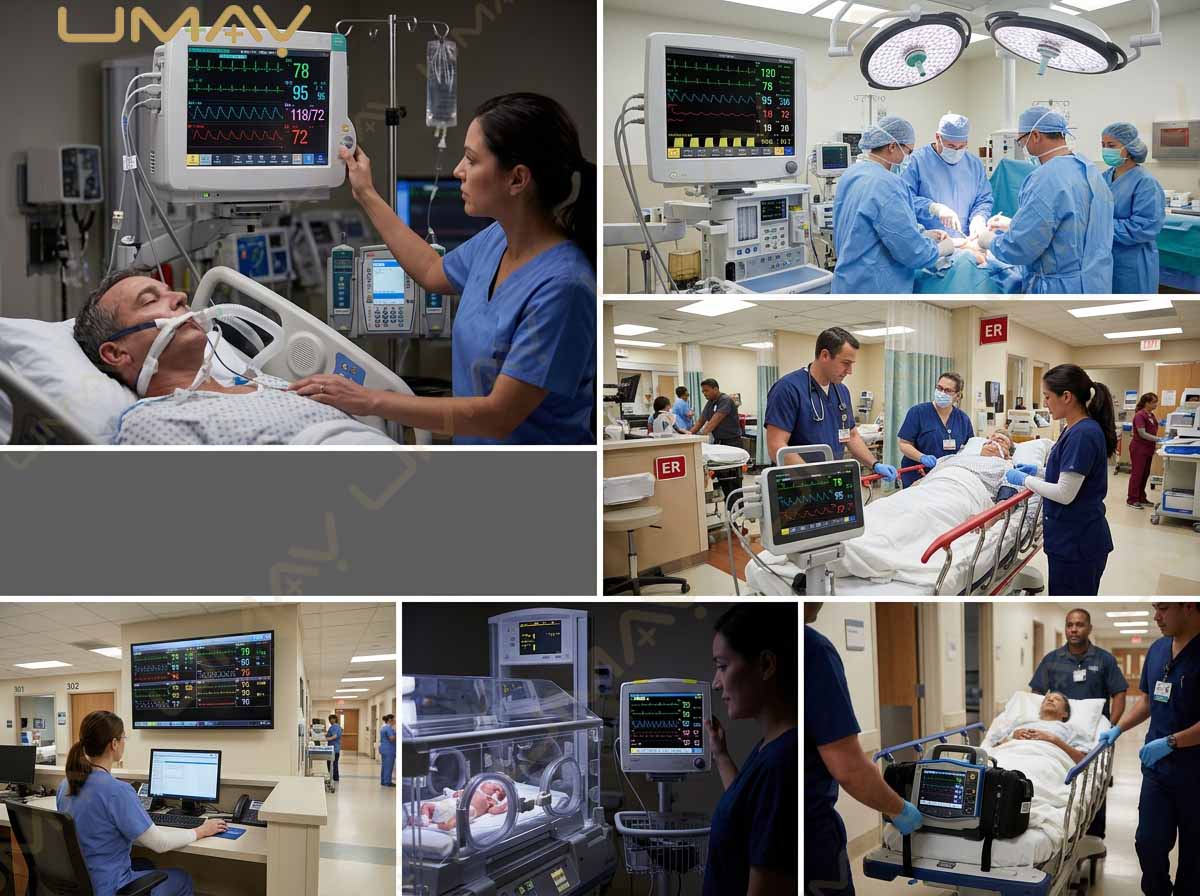
A patient monitor is used across many areas of a hospital, but the monitoring requirements are not the same in every department.
An ICU may need continuous monitoring with ECG, SpO2, NIBP, invasive blood pressure, temperature, respiration, and EtCO2. A general ward may focus on basic vital signs such as blood pressure, oxygen saturation, pulse rate, temperature, and respiratory rate. An operating room may require advanced monitoring during anesthesia and surgery, while a transport monitor needs to remain practical and portable when a patient moves between departments.
Modern patient monitoring solutions can therefore include bedside monitors, multiparameter monitors, vital signs monitors, transport monitors, central monitoring systems, and specialized monitoring equipment. Major patient-monitoring manufacturers currently organize their systems around care areas such as ICU, emergency, operating room, PACU, NICU, general care, and intra-hospital transport.
This guide explains how patient monitors are used in different hospital departments, what parameters are commonly required, and what medical equipment buyers should consider when choosing a patient monitoring solution.
What Are Patient Monitor Applications?
Patient monitor applications refer to the different clinical environments and situations where patient monitoring equipment is used.
Common applications include:
- Intensive Care Unit (ICU)
- Emergency Department (ED)
- Operating Room (OR)
- Post-Anesthesia Care Unit (PACU)
- General Ward
- Cardiac Care Unit (CCU)
- Neonatal Intensive Care Unit (NICU)
- Pediatric Intensive Care Unit (PICU)
- Recovery Room
- Outpatient Department
- Ambulance
- Intra-hospital patient transport
- Diagnostic and procedure rooms
The same monitor may sometimes be used in several departments, particularly when it has a flexible or modular design.
The key difference is usually which parameters are required, how continuously the patient needs to be monitored, how portable the device must be, and whether the monitor needs to connect to a central monitoring system.
1. Patient Monitor in the ICU
The Intensive Care Unit (ICU) is one of the most important applications for multiparameter patient monitors.
ICU patients may require continuous observation because their condition can change quickly. WHO’s ICU guidance emphasizes ongoing measurement and observation of parameters such as blood pressure, pulse rate, and oxygenation, together with other patient observations.
An ICU patient monitor may provide:
- ECG
- Heart rate
- SpO2
- Pulse rate
- NIBP
- IBP
- Respiratory rate
- Temperature
- EtCO2
- ECG waveform
- SpO2 waveform
- Pressure waveforms
- Trend monitoring
- Alarm functions
The exact configuration depends on the patient’s condition and the ICU’s clinical workflow.
ICU Bedside Monitoring
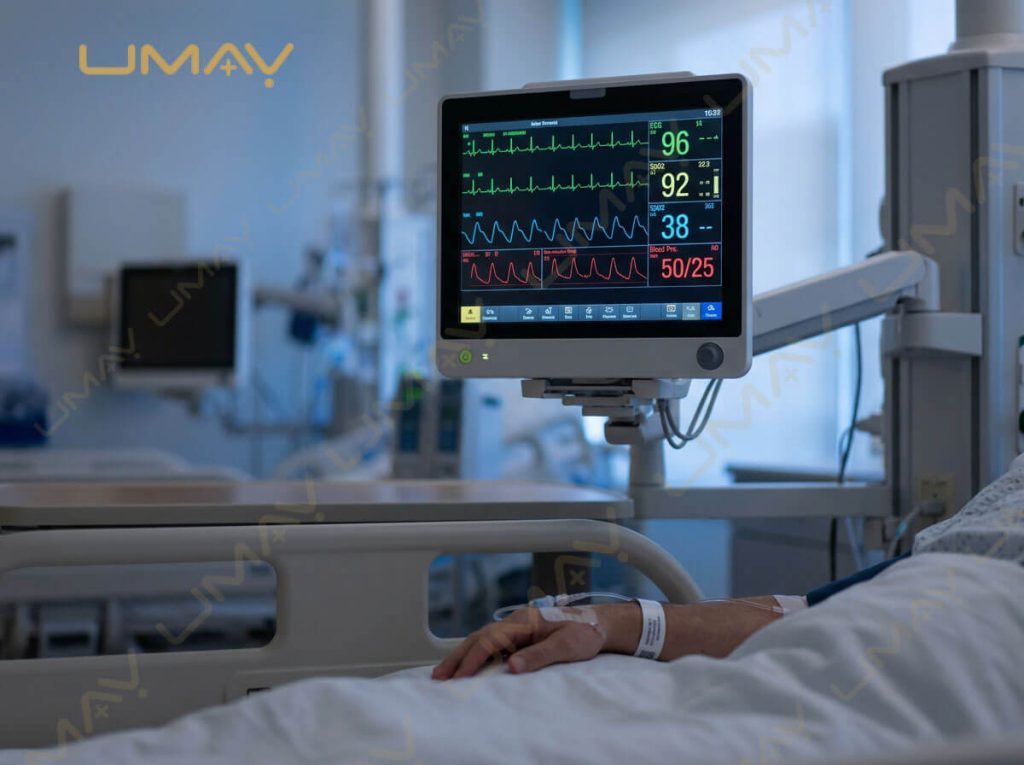
A typical ICU bedside monitor is positioned beside the patient’s bed.
The monitor can display several waveforms and numerical values simultaneously, allowing clinicians to review multiple parameters from one screen.
Advanced ICU monitors may also connect to:
- Central monitoring stations
- Hospital networks
- Electronic medical records
- Clinical information systems
Modern patient monitoring platforms increasingly support monitoring across several hospital departments while maintaining connectivity between bedside and transport workflows.
2. Patient Monitor in the Emergency Department
The Emergency Department, often called the ED or ER, requires flexible and fast patient monitoring.
Patients arriving in an emergency department can have very different monitoring requirements.
A patient monitor may be used for:
- Initial assessment
- Continuous observation
- Emergency procedures
- Short-term observation
- Patient stabilization
- Transfer to another department
Common parameters include:
- ECG
- SpO2
- NIBP
- Heart rate
- Pulse rate
- Respiratory rate
- Temperature
Depending on the clinical situation, EtCO2 and invasive pressure monitoring may also be required.
Why Is a Portable Monitor Useful in Emergency Care?
Emergency departments often move patients between treatment areas.
A portable patient monitor or transport patient monitor can allow monitoring to continue while the patient is moved.
This can be particularly useful when transferring a patient:
Emergency Department → CT → Operating Room → ICU
Transport monitoring solutions are specifically designed for situations where physiological monitoring needs to continue while the patient moves between hospital locations.
3. Patient Monitor in the Operating Room
The Operating Room (OR) is another major application for patient monitoring equipment.
During surgery, the patient’s physiological condition needs to be monitored according to the procedure and anesthesia requirements.
An operating room patient monitor may include:
- ECG
- SpO2
- NIBP
- IBP
- EtCO2
- Temperature
- Respiratory rate
- Advanced respiratory parameters
- Additional anesthesia-related measurements on supported systems
The exact configuration depends on the surgical procedure, patient condition, anesthesia workflow, and equipment setup.
Modern OR monitoring systems can also integrate with anesthesia machines and hospital information systems. For example, some advanced monitoring platforms provide access to anesthesia data, gases, ventilation information, trends, and alarm history.
4. Anesthesia Patient Monitoring
An anesthesia monitor is generally a patient monitor configured for use during anesthesia and surgery.
It may provide information related to:
- ECG
- SpO2
- Blood pressure
- Temperature
- Respiration
- EtCO2
- Airway gases
- Anesthetic gases
- Neuromuscular monitoring
- Other advanced parameters
Not every patient monitor has all of these functions.
For procurement, buyers should compare the exact specifications and optional modules.
In the operating room, the monitor is often part of a larger system that can include:
- Anesthesia machine
- Ventilator
- Patient monitor
- Surgical equipment
- Central monitoring
- Hospital information system
This makes OR patient monitoring an important SEO topic for suppliers targeting hospitals and surgical centers.
5. Patient Monitor in the PACU
PACU stands for Post-Anesthesia Care Unit.
It is also commonly called the recovery room.
After surgery or anesthesia, patients may remain in the PACU for observation before moving to another hospital area.
A PACU patient monitor may measure:
- ECG
- Heart rate
- SpO2
- NIBP
- Respiratory rate
- Temperature
EtCO2 may also be relevant in selected applications.
The monitor allows healthcare staff to observe the patient’s vital signs during recovery.
PACU Monitor Requirements
A PACU monitor should generally be easy to operate and clearly display the required information.
Procurement teams may consider:
- Screen size
- Parameter visibility
- Alarm functions
- NIBP measurement modes
- SpO2 performance
- ECG configuration
- Trend storage
- Battery operation
- Network connectivity
6. Patient Monitor in the General Ward
The general ward is different from the ICU.
Many ward patients may require routine vital signs monitoring rather than the extensive parameter set used in critical care.
A ward patient monitor may include:
- NIBP
- SpO2
- Pulse rate
- Temperature
- Respiratory rate
Some patients may require ECG monitoring depending on their clinical condition.
Vital Signs Monitor for General Wards
A vital signs monitor can be a practical option for general ward applications.
It may be designed for:
- Spot-check monitoring
- Routine measurements
- Periodic vital signs assessment
- Basic patient observation
For hospitals with a large number of beds, ease of use, mobility, battery operation, accessories, and workflow efficiency can be important purchasing factors.
7. Patient Monitor in the CCU
CCU can refer to a Coronary Care Unit or Cardiac Care Unit, depending on the hospital.
Patient monitoring in a cardiac care environment generally places greater emphasis on ECG and cardiovascular parameters.
A CCU patient monitor may include:
- ECG
- Heart rate
- SpO2
- NIBP
- RESP
- Temperature
- IBP when required
- Arrhythmia monitoring
- ST segment monitoring
Advanced cardiac monitoring systems may provide additional ECG analysis and central monitoring.
The specific configuration should be selected according to the clinical requirements of the facility.
8. Patient Monitor in the NICU
NICU stands for Neonatal Intensive Care Unit.
Monitoring neonatal patients requires appropriately designed sensors, accessories, alarms, and parameter configurations.
A neonatal patient monitor may support:
- ECG
- SpO2
- NIBP
- Respiratory rate
- Temperature
- Pulse rate
Depending on the clinical application, additional parameters may be required.
Neonatal Patient Monitor Considerations
When purchasing a NICU patient monitor, hospitals should pay attention to:
- Neonatal patient support
- Appropriate SpO2 sensors
- Neonatal NIBP cuffs
- Temperature probes
- Alarm configuration
- Low measurement ranges
- Screen visibility
- Trend functions
- Network connectivity
The monitor should be selected according to the manufacturer’s stated intended patient population and specifications.
9. Patient Monitor in the PICU
PICU means Pediatric Intensive Care Unit.
Pediatric patients can have different monitoring requirements from adults.
A pediatric patient monitor may support:
- ECG
- SpO2
- NIBP
- RESP
- TEMP
- EtCO2
- IBP
depending on the model and clinical application.
Pediatric Patient Monitor Accessories
Accessories are particularly important for pediatric monitoring.
Examples include:
- Pediatric ECG electrodes
- Pediatric SpO2 sensors
- Pediatric NIBP cuffs
- Temperature probes
- Appropriate monitoring cables
When buying a pediatric patient monitor, hospitals should confirm that the monitor and accessories are intended for the required patient population.
10. Patient Monitor in the Recovery Room
A recovery room monitor is used to observe patients following surgery, anesthesia, sedation, or certain procedures.
Common parameters include:
- ECG
- SpO2
- NIBP
- Pulse rate
- Respiratory rate
- Temperature
The monitor should provide clear numerical information and easily visible alarm notifications.
For recovery environments, hospitals may prefer monitors that are:
- Easy to operate
- Compact
- Mobile
- Easy to clean
- Easy to connect
- Compatible with standard hospital accessories
11. Patient Monitor in Clinics
Not every patient monitoring application requires an advanced ICU monitor.
Clinics and outpatient facilities may need a simpler vital signs monitor.
Common measurements include:
- Blood pressure
- SpO2
- Pulse rate
- Temperature
- Respiratory rate
A clinic patient monitor may be used during:
- Routine examinations
- Pre-procedure assessment
- Post-procedure observation
- Health screening
- Basic patient assessment
For clinics, simplicity and workflow efficiency can be more important than having a large number of advanced parameters.
12. Patient Monitor for Patient Transport
A transport patient monitor is designed to monitor patients while they are being moved.
Patient transport can occur:
- Within a hospital
- Between ICU and imaging
- Between emergency and operating room
- Between operating room and ICU
- From ward to diagnostic department
- During ambulance transport
The exact application depends on whether the device is intended for intra-hospital or pre-hospital use.
Intra-Hospital Transport Monitoring
Intra-hospital transport is particularly important for critically ill patients.
For example:
ICU → CT
or
Emergency Department → OR
During this process, a transport monitor can allow clinicians to continue monitoring selected physiological parameters.
Current transport monitoring systems are designed specifically for movement between hospital departments, including ICU, emergency, operating room, and radiology environments.
13. Transport Monitor vs Bedside Monitor
These two types of patient monitors have different primary purposes.
| Feature | Bedside Monitor | Transport Monitor |
|---|---|---|
| Main application | Fixed patient location | Patient movement |
| Portability | Moderate to low | High |
| Battery | Usually available | Very important |
| Screen | Often larger | Usually compact |
| ICU use | Very common | Common during transfers |
| General ward | Common | Depends on workflow |
| Emergency | Common | Very useful |
| Intra-hospital transport | Limited | Designed for this purpose |
| Central monitoring | Often supported | May be supported |
| Mounting | Bedside/trolley/wall | Bed/rail/trolley |
Some modern platforms are designed so that one monitor can support both bedside and transport workflows. GE HealthCare, for example, describes a transport monitor that can be undocked from a bedside monitor and reconnected at the destination while maintaining data continuity.
14. Patient Monitor for Ambulance Use
A patient monitor for ambulance is intended for mobile environments.
Compared with a standard bedside monitor, ambulance monitoring places greater emphasis on:
- Portability
- Battery operation
- Compact size
- Robust construction
- Easy operation
- Clear display
- Secure mounting
- Required monitoring parameters
A transport or emergency monitor may provide:
- ECG
- SpO2
- NIBP
- RESP
- Temperature
- EtCO2
depending on the model.
However, buyers should verify whether a particular monitor is specifically approved or intended for the relevant pre-hospital environment.
15. Patient Monitor in Diagnostic and Procedure Rooms
Patient monitors are not limited to ICU and emergency care.
They can also be used in procedure areas such as:
- Endoscopy
- Diagnostic imaging
- Interventional procedures
- Minor procedures
- Sedation areas
- Cardiac diagnostic environments
A portable monitor can be useful when a fixed bedside monitoring system is not available.
Transport monitors can also support monitoring during procedures in selected environments. Mindray, for example, describes transport monitoring for procedure rooms such as endoscopy suites and diagnostic areas.
16. Patient Monitor During Intra-Hospital Transfer
One of the important applications of modern patient monitoring is continuous monitoring during patient transfer.
Imagine a patient moving from the ICU to a CT room.
Without a suitable transport solution, staff may need to:
- Disconnect the patient from the bedside monitor.
- Connect a transport monitor.
- Move the patient.
- Transfer the patient to the destination.
- Reconnect the patient to another bedside monitor.
Modern monitoring platforms can simplify this process.
Some systems are designed to maintain monitoring continuity between bedside and transport environments.
This is particularly relevant for hospitals looking to improve:
- Workflow
- Patient data continuity
- Equipment utilization
- Transport efficiency
- Monitoring consistency
17. Central Patient Monitoring System
A central patient monitoring system allows healthcare staff to observe information from multiple connected bedside monitors.
A central station may display:
- Multiple patients
- ECG waveforms
- SpO2
- Blood pressure
- Respiratory rate
- Temperature
- Alarm information
- Trends
Central monitoring is particularly useful in environments where several patients need continuous observation.
Examples include:
- ICU
- CCU
- Telemetry units
- Step-down units
- High-dependency areas
Nihon Kohden describes central monitors that can observe vital-sign data from multiple patients and review patient data over time.
18. Wireless Patient Monitoring
Wireless patient monitoring can provide more flexibility for connected hospital workflows.
Depending on the system, patient monitors can transmit data through:
- Wi-Fi
- Wired networks
- Central monitoring networks
- Hospital information systems
Modern patient monitoring systems may integrate with central stations and hospital information systems using appropriate communication protocols.
For example, some current transport monitors support wired and Wi-Fi connectivity and HL7-based hospital information system integration.
For hospital procurement teams, connectivity should therefore be considered alongside basic monitoring parameters.
19. Patient Monitor Applications by Department
The following table provides a simplified overview.
| Hospital Department | Common Monitor Type | Common Parameters |
| ICU | Advanced bedside monitor | ECG, SpO2, NIBP, IBP, RESP, TEMP, EtCO2 |
| Emergency | Multiparameter monitor | ECG, SpO2, NIBP, RESP, TEMP |
| Operating Room | Anesthesia / multiparameter monitor | ECG, SpO2, NIBP, TEMP, EtCO2, IBP |
| PACU | Bedside monitor | ECG, SpO2, NIBP, RESP, TEMP |
| General Ward | Vital signs / bedside monitor | NIBP, SpO2, PR, TEMP, RESP |
| CCU | Cardiac / multiparameter monitor | ECG, SpO2, NIBP, RESP, TEMP |
| NICU | Neonatal monitor | ECG, SpO2, NIBP, RESP, TEMP |
| PICU | Pediatric monitor | ECG, SpO2, NIBP, RESP, TEMP |
| Clinic | Vital signs monitor | NIBP, SpO2, PR, TEMP |
| Ambulance | Transport monitor | ECG, SpO2, NIBP, RESP, TEMP |
| Patient Transport | Transport monitor | ECG, SpO2, NIBP, RESP |
| Procedure Room | Portable / transport monitor | ECG, SpO2, NIBP, RESP, depending on procedure |
This is a general purchasing reference. The actual parameter requirements should always be determined by the clinical application, patient population, local regulations, and manufacturer’s intended-use information.
20. How to Choose a Patient Monitor for Different Departments
A common mistake in medical equipment purchasing is choosing one monitor configuration for every department.
A better approach is to match the monitor to the application.
For ICU
Look for:
- Advanced multiparameter monitoring
- ECG
- SpO2
- NIBP
- IBP
- RESP
- TEMP
- EtCO2 where required
- Advanced alarms
- Trend storage
- Central monitoring
- Network connectivity
For Emergency Department
Consider:
- Fast operation
- ECG
- SpO2
- NIBP
- RESP
- TEMP
- Portable design
- Battery operation
- Transport capability
For Operating Room
Consider:
- ECG
- SpO2
- NIBP
- EtCO2
- Temperature
- IBP where required
- Anesthesia-related modules
- Gas monitoring where required
- Integration with anesthesia equipment
For General Ward
Consider:
- NIBP
- SpO2
- PR
- TEMP
- RESP
- Simple interface
- Battery operation
- Easy mobility
- Easy cleaning
For Patient Transport
Consider:
- Compact size
- Low weight
- Battery life
- Required parameters
- Secure mounting
- Alarm visibility
- Data continuity
- Compatibility with hospital monitoring systems
21. Why One Patient Monitor May Not Fit Every Department
Hospitals have different patient populations and workflows.
An ICU may require advanced hemodynamic monitoring.
A general ward may only need routine vital signs.
An operating room may require anesthesia and respiratory monitoring.
An emergency department may prioritize rapid deployment.
A transport monitor must prioritize mobility and battery operation.
Therefore, patient monitor selection should be application-based rather than price-based alone.
A hospital may choose several monitor configurations across different departments while maintaining common accessories, software, network infrastructure, or user interfaces where possible.
Modern scalable monitoring platforms increasingly use this approach to support multiple care areas from one monitoring ecosystem.
22. Patient Monitor Accessories by Application
Accessories also change according to the application.
Common patient monitor accessories include:
- ECG cable
- ECG electrodes
- SpO2 sensor
- NIBP cuff
- Temperature probe
- IBP cable
- IBP transducer
- EtCO2 sampling line
- Battery
- Power adapter
- Bed rail mount
- Wall mount
- Mobile trolley
For neonatal and pediatric monitoring, appropriate patient-size accessories are especially important.
For transport applications, hospitals may also need:
- Bed mounts
- Rail mounts
- Carrying handles
- Batteries
- Compact accessories
A complete procurement plan should therefore include both the patient monitor and its compatible accessories.
23. Patient Monitor and Hospital Workflow
Patient monitoring is not only about measuring physiological parameters.
The monitor is also part of the hospital workflow.
A modern monitoring system may need to support:
Patient → Monitor → Central Station → Hospital Network → Medical Record
This can help reduce manual data transfer and provide healthcare staff with more consistent access to patient information.
Connectivity is becoming increasingly important as hospitals move toward integrated monitoring environments. Philips, for example, describes patient monitoring solutions that include bedside monitors, transport monitors, central monitoring, mobile applications, and interoperable monitoring systems.
24. Patient Monitoring for Low-Acuity and High-Acuity Patients
Another useful way to classify patient monitor applications is by patient acuity.
Low-Acuity Monitoring
Often used in:
- General wards
- Clinics
- Routine observation
Typical parameters:
- NIBP
- SpO2
- PR
- TEMP
Medium-Acuity Monitoring
May be used in:
- Emergency observation
- Step-down units
- Recovery areas
Typical parameters:
- ECG
- SpO2
- NIBP
- RESP
- TEMP
High-Acuity Monitoring
Commonly associated with:
- ICU
- Critical care
- Advanced operating room applications
May include:
- ECG
- SpO2
- NIBP
- IBP
- RESP
- TEMP
- EtCO2
- Advanced cardiac or respiratory parameters
The exact configuration should always match the intended clinical use.
25. Patient Monitor for Different Patient Types
Patient monitors can also be selected according to patient population.
Adult Patient Monitor
Commonly used for adult patients in:
- ICU
- OR
- Emergency
- Ward
- PACU
Pediatric Patient Monitor
Designed for pediatric applications with suitable:
- NIBP cuffs
- SpO2 sensors
- ECG accessories
- Alarm settings
Neonatal Patient Monitor
Used in neonatal environments with appropriate:
- Neonatal SpO2 sensors
- Neonatal NIBP cuffs
- Temperature probes
- ECG accessories
- Monitoring configurations
The same monitor platform may support multiple patient categories, but buyers should verify the manufacturer’s specifications.
Patient Monitor Application FAQ
Where are patient monitors used?
Patient monitors are used in ICUs, emergency departments, operating rooms, recovery rooms, general wards, NICUs, PICUs, clinics, ambulances, and during patient transport.
What is an ICU patient monitor?
An ICU patient monitor is generally a multiparameter monitor configured for continuous monitoring of patients in intensive care.
What is an emergency patient monitor?
An emergency patient monitor is designed for rapid and flexible monitoring in emergency care environments.
What is an operating room patient monitor?
An operating room patient monitor is used during surgery and may include ECG, SpO2, NIBP, temperature, EtCO2, IBP, and other anesthesia-related parameters.
What is a ward patient monitor?
A ward patient monitor is generally used for routine monitoring of patients in general hospital wards.
What is a transport patient monitor?
A transport patient monitor is designed to monitor patients while they are moved between hospital departments or, for appropriate models, during ambulance transport.
What is a bedside patient monitor?
A bedside patient monitor is positioned near the patient’s bed and provides continuous or intermittent monitoring according to its configuration.
What is a neonatal patient monitor?
A neonatal patient monitor is configured for monitoring newborn or neonatal patients with appropriate sensors, cuffs, accessories, and monitoring ranges.
Can one patient monitor be used in different departments?
Yes, some flexible or modular monitoring platforms can support different care environments. However, the available parameters and intended use should match each clinical application.
Is a transport monitor necessary in an ICU?
It depends on the hospital’s workflow and transport requirements. If critically ill patients frequently move between departments, a suitable transport monitoring solution may help maintain monitoring during transfers.
What parameters are common in ICU monitoring?
Common ICU parameters include ECG, SpO2, NIBP, respiratory rate, temperature, and, when required, IBP and EtCO2.
What parameters are common in general wards?
General wards commonly use NIBP, SpO2, pulse rate, temperature, and respiratory rate, although requirements vary.
What is central patient monitoring?
Central monitoring allows healthcare staff to observe information from multiple connected patient monitors at a central station.
Conclusion
Patient monitor applications cover almost every major area of a modern hospital.
In the ICU, advanced multiparameter monitoring can support continuous observation of critically ill patients. In the emergency department, flexible and portable monitoring can support rapid assessment and patient movement. In the operating room, patient monitors can work alongside anesthesia and surgical equipment. In the general ward, simpler vital signs monitoring may be sufficient for many patients. In the NICU and PICU, monitor configuration and accessories need to match the patient population.
Transport is another important application. A transport patient monitor can help maintain monitoring while patients move between the emergency department, ICU, operating room, imaging department, and other areas. Modern systems can also connect bedside monitoring, transport monitoring, central stations, and hospital networks.
For hospitals and medical equipment buyers, the key is to match the patient monitor type, parameters, accessories, portability, connectivity, and workflow to the intended application.