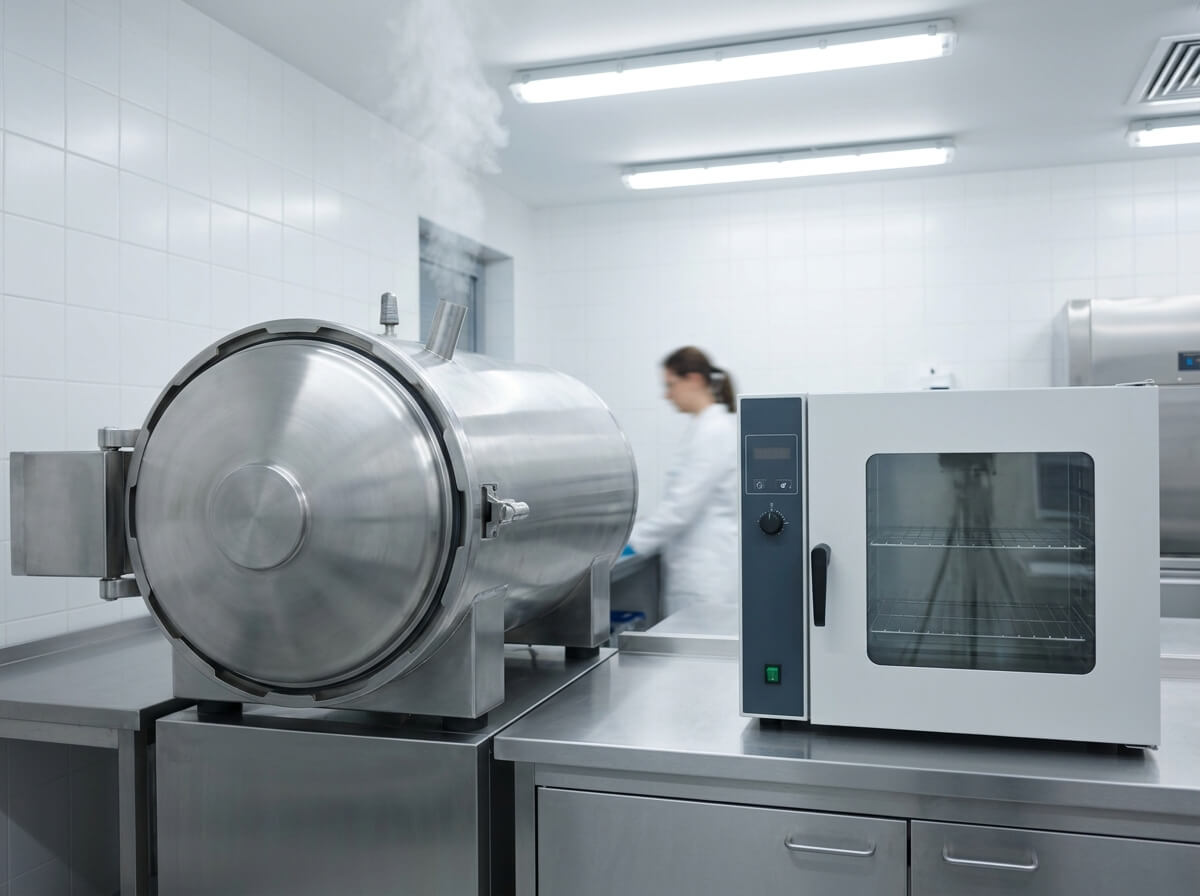
Choosing the right autoclave sterilizer is an important decision for hospitals, dental clinics, laboratories, veterinary facilities, pharmaceutical companies, research centers, and medical equipment distributors.
There are many types of steam sterilizers on the market, including tabletop autoclaves, vertical autoclaves, horizontal autoclaves, pre-vacuum sterilizers, gravity autoclaves, laboratory autoclaves, dental autoclaves, and hospital steam sterilizers.
The most expensive machine is not necessarily the right choice. A small dental clinic may need a compact tabletop sterilizer, while a large hospital CSSD may require a high-capacity horizontal steam sterilizer with pre-vacuum cycles, drying, data recording, and advanced loading systems.
FDA currently classifies steam sterilizers as Class II medical devices under 21 CFR 880.6880 in the United States and recognizes standards covering hospital steam sterilizers, tabletop steam sterilizers, water for medical-device processing, material compatibility, and moist-heat sterilization.
This autoclave buying guide explains what buyers should check before purchasing a steam sterilizer, including application, chamber capacity, sterilization cycle, vacuum, drying, utilities, safety, accessories, regulatory documentation, maintenance, price, and supplier support.
1. Start With the Application
The first step in choosing an autoclave is understanding what you need to sterilize and where the equipment will be used.
Common applications include:
- Hospitals
- CSSD departments
- Operating rooms
- Dental clinics
- General clinics
- Laboratories
- Microbiology laboratories
- Pharmaceutical facilities
- Veterinary clinics
- Research centers
- Universities
- Medical waste facilities
Different applications require different sterilizer configurations.
Hospital
A hospital may require:
- Large chamber capacity
- Pre-vacuum
- Drying
- Multiple cycles
- Data recording
- Loading systems
- High daily throughput
Dental Clinic
A dental clinic may prioritize:
- Compact design
- Tabletop installation
- Simple operation
- Instrument cycles
- Drying
- Easy maintenance
Laboratory
A laboratory may need:
- Liquid cycles
- Media cycles
- Glassware cycles
- Waste cycles
- Programmable operation
- Flexible chamber configurations
Pharmaceutical Facility
A pharmaceutical facility may require:
- Process control
- Validation support
- Documentation
- Data recording
- Controlled utilities
- Specialized chamber and piping configurations
The first purchasing question should therefore be:
“What will this autoclave sterilize?”
2. Identify the Load Type
The load determines many of the autoclave’s technical requirements.
Potential loads include:
- Surgical instruments
- Dental instruments
- Wrapped instruments
- Unwrapped instruments
- Porous materials
- Laboratory glassware
- Culture media
- Liquids
- Textiles
- Veterinary instruments
- Medical waste
- Pharmaceutical components
A steam sterilizer designed mainly for packaged surgical instruments may not be the best choice for liquid laboratory loads.
This is why the supplier should know the actual load profile before recommending a model.
3. Choose the Right Autoclave Type
The main types include:
Tabletop Autoclave
Best suited to smaller facilities such as:
- Dental clinics
- Small clinics
- Outpatient facilities
- Small laboratories
Vertical Autoclave
Common in:
- Laboratories
- Veterinary facilities
- Universities
- Research centers
Horizontal Autoclave
Often used in:
- Hospitals
- CSSD
- Large laboratories
- High-volume facilities
Pre-Vacuum Autoclave
Common for applications requiring more effective air removal and steam penetration for appropriate loads.
Gravity Autoclave
Uses incoming steam to displace air and can be suitable for a range of compatible loads.
The correct choice depends on the load and workflow rather than the equipment name alone.
4. Tabletop vs Vertical vs Horizontal Autoclave
| Feature | Tabletop | Vertical | Horizontal |
|---|---|---|---|
| Typical size | Small | Small to medium | Medium to large |
| Loading | Usually front | Usually top | Usually front |
| Footprint | Compact | Moderate | Larger |
| Dental use | Common | Less common | Uncommon |
| Laboratory use | Possible | Common | Common |
| Hospital CSSD | Limited | Depends on model | Very common |
| Large loads | Limited | Moderate | Excellent |
| Mobility | Relatively easy | Limited | Fixed installation |
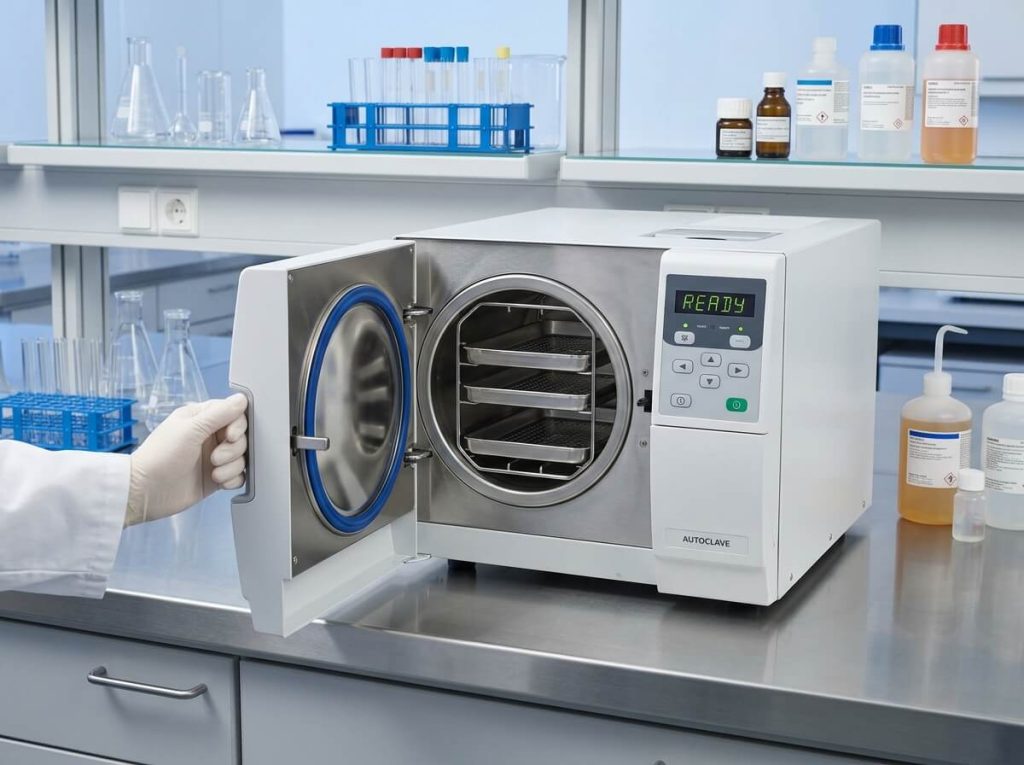
A tabletop autoclave is usually appropriate when space and workload are limited.
A horizontal sterilizer is generally more suitable when the facility needs high-volume processing and a dedicated sterilization area.
5. Determine the Required Chamber Capacity
Autoclave capacity is one of the most important specifications.
Common search terms include:
- autoclave capacity
- autoclave chamber size
- autoclave volume
- 18L autoclave
- 23L autoclave
- 24L autoclave
- 50L autoclave
- 100L autoclave
- 150L autoclave
- 200L autoclave
- large capacity autoclave
However, choosing the biggest chamber is not always the best solution.
Consider:
- Number of loads per day
- Load size
- Instrument tray dimensions
- Packaging
- Maximum load weight
- Available floor space
- Cycle time
- Future capacity requirements
For example, a dental practice may not benefit from a large industrial sterilizer if it only processes a small number of instruments each day.
6. How to Calculate Autoclave Capacity
A simple purchasing approach is to estimate:
Required daily workload ÷ practical loads per day = required load capacity
For example, consider:
- Number of trays per day
- Number of instrument packs
- Average load weight
- Number of available cycles
- Working hours
The goal is to avoid two common problems:
Undersized Equipment
The sterilizer is too small, causing:
- Too many cycles
- Longer processing time
- Workflow delays
Oversized Equipment
The sterilizer is significantly larger than necessary, resulting in:
- Higher purchase cost
- More installation space
- Potentially higher utility requirements
Capacity should therefore be matched to the actual workflow.
7. Check the Chamber Dimensions
Do not look only at the chamber volume in liters.
Two autoclaves may both have a 50-liter chamber, but their internal dimensions can be different.
Important measurements include:
- Chamber diameter
- Chamber width
- Chamber depth
- Chamber height
- Door opening
- Tray dimensions
- Rack dimensions
For hospitals and laboratories, instrument trays may be the most important consideration.
A chamber should be able to accommodate the actual trays, baskets, containers, and instruments being processed.
8. Consider Sterilization Cycle Types
The available cycle programs are important.
Common programs may include:
- Instrument cycle
- Wrapped instrument cycle
- Unwrapped cycle
- Porous load cycle
- Liquid cycle
- Waste cycle
- Drying cycle
- Vacuum cycle
- Custom programmable cycle
The exact programs depend on the equipment.
Before purchasing, ask:
Which cycles are standard?
Which cycles are optional?
Can cycles be customized?
Are cycle parameters validated for the intended application?
9. Gravity vs Pre-Vacuum
One of the most important technical decisions is whether the facility requires gravity displacement or dynamic air removal / pre-vacuum.
Gravity Autoclave
Advantages may include:
- Simpler design
- Lower equipment complexity
- Suitable for certain basic loads
- Common laboratory applications
Pre-Vacuum Autoclave
Advantages can include:
- More effective air removal
- Better steam penetration for appropriate porous and wrapped loads
- Common hospital CSSD applications
- More advanced cycle control
The choice should be based on the load and validated process requirements.
10. Do You Need a Vacuum Function?
A vacuum autoclave can actively remove air from the chamber.
This can be especially important for:
- Wrapped instruments
- Porous loads
- Complex loads
- Hollow devices
Before choosing a vacuum sterilizer, ask:
- Is a vacuum pump included?
- How many vacuum stages are available?
- What is the vacuum level?
- Is vacuum drying included?
- Is the vacuum system automatically monitored?
- What maintenance does the vacuum pump require?
If the facility only needs basic sterilization of simple nonporous loads, a vacuum system may not be necessary.
11. Check Autoclave Temperature
Common search terms include:
- autoclave temperature
- sterilization temperature
- 121°C autoclave
- 132°C autoclave
- 134°C autoclave
- steam sterilizer temperature
A buyer should not select a machine simply because it advertises a high temperature.
The important question is:
Can the sterilizer provide the validated cycle required for the intended load?
Temperature must be considered together with:
- Pressure
- Exposure time
- Steam
- Air removal
- Load configuration
- Packaging
Different cycles can use different temperature and exposure-time combinations.
12. Check Autoclave Pressure
A steam sterilizer uses pressure to achieve the required steam temperature.
When comparing specifications, check:
- Working pressure
- Maximum pressure
- Pressure control
- Pressure display
- Pressure sensors
- Overpressure protection
However, pressure should never be evaluated independently from temperature and cycle conditions.
A higher maximum pressure does not automatically make one sterilizer better.
The relevant question is whether the machine can maintain the correct validated process.
13. Check Autoclave Cycle Time
Autoclave cycle time is a common purchasing consideration.
But distinguish between:
Exposure time
and
Total cycle time
Total cycle time can include:
- Conditioning
- Heating
- Air removal
- Exposure
- Exhaust
- Drying
Therefore, compare the complete cycle.
Ask the supplier:
- What is the typical cycle time?
- What load was used to calculate it?
- Does the quoted time include drying?
- Does it include heating?
- Does it include vacuum?
- What happens with a full load?
This prevents misleading comparisons between different machines.
14. Evaluate the Drying Function
A drying cycle can be important for packaged instruments.
Check:
- Is drying standard?
- Is vacuum drying available?
- Can drying time be adjusted?
- What types of loads can be dried?
- How much moisture remains after the cycle?
Wet packs can create handling and storage problems, so drying capability can be an important consideration for hospitals and dental clinics.
15. Choose Automatic or Manual Operation
Manual Autoclave
The operator may control more parts of the process.
Possible benefits:
- Simple operation
- Lower initial cost for some models
- Useful for specific basic applications
Potential limitations:
- More operator involvement
- Greater dependence on user procedures
- Less automated documentation
Automatic Autoclave
The controller manages selected cycle stages automatically.
Potential functions include:
- Automatic heating
- Automatic pressure control
- Automatic exposure timing
- Automatic exhaust
- Automatic drying
- Alarm management
- Data recording
For hospitals and high-volume facilities, automation can improve workflow consistency.
16. Check the Control System
Modern autoclaves can use:
- Microprocessor control
- Digital displays
- LCD screens
- Touchscreens
- Programmable logic controllers
- Industrial control interfaces
A good control system should make it easy to:
- Select a cycle
- View temperature
- View pressure
- Check remaining time
- Review alarms
- Access cycle history
For international hospital projects, ask whether the interface supports the required language.
17. Check Data Recording
For many healthcare applications, autoclave cycle records are important.
Depending on the system, the machine may record:
- Date
- Time
- Cycle number
- Temperature
- Pressure
- Vacuum
- Exposure time
- Drying time
- Alarm events
- Operator information
Data can potentially be:
- Printed
- Stored locally
- Exported
- Transferred through USB
- Transferred through a network
The exact functions depend on the machine.
For large hospitals, data recording can be an important part of quality management and documentation.
18. Consider Connectivity
Modern hospital sterilization equipment may need to connect with:
- Central management systems
- Hospital networks
- Equipment management systems
- Data servers
For a connected autoclave, ask:
- Is LAN available?
- Is Wi-Fi available?
- Is USB data export available?
- Is a printer included?
- What data format is supported?
- Can cycle records be archived?
For a small dental clinic, these functions may not be necessary.
For a hospital CSSD, they may become important.
19. Check Water Requirements
Water is an important part of steam sterilizer installation.
Before purchase, determine:
- Water quality requirement
- Water source
- Water consumption
- Built-in reservoir
- External water supply
- Drain requirement
- Water treatment requirements
FDA’s current steam-sterilizer classification page recognizes AAMI ST108:2023, covering water for the processing of medical devices, as a consensus standard associated with steam sterilizers.
The manufacturer’s technical documentation should specify the actual water requirements of the machine.
20. Check Power Requirements
An autoclave may require a substantial electrical supply depending on its size and heating system.
Check:
- Voltage
- Frequency
- Phase
- Rated power
- Current
- Plug type
- Electrical protection
International buyers should provide:
Country + voltage + frequency + installation environment
before requesting a quotation.
A supplier can then confirm the appropriate electrical configuration.
21. Check Installation Requirements
Before purchasing an autoclave, check the installation environment.
Potential requirements include:
- Floor space
- Door clearance
- Ventilation
- Drainage
- Water supply
- Electrical supply
- Steam supply
- Room temperature
- Equipment access
- Loading/unloading space
For large hospital systems, installation planning should happen before shipment.
A large sterilizer should not arrive at a facility before confirming that the room, doorway, utilities, and floor conditions can support it.
22. Check Door Configuration
Autoclaves can have:
- Single-door configuration
- Double-door configuration
A single-door autoclave is common in many clinics, laboratories, and standard sterilization rooms.
A double-door or pass-through sterilizer can be useful in larger controlled workflows where loading and unloading occur from separate areas.
FDA recognizes automated sterilizer loading systems as equipment designed to improve hospital workflow efficiency in conjunction with steam sterilizers.
For a CSSD project, the door configuration should therefore be evaluated together with:
- Clean/dirty workflow
- Room layout
- Loading system
- Unloading system
- Infection-control design
23. Check Safety Features
Autoclaves operate with high temperature and pressure, so safety is an essential purchasing criterion.
Potential safety features include:
- Door interlock
- Overpressure protection
- Temperature protection
- Low-water protection
- Safety valve
- Automatic fault detection
- Emergency stop
- Alarm system
- Pressure release protection
Ask the supplier for a complete safety specification.
Do not evaluate safety using a single feature such as “automatic door lock.”
24. Choose the Right Chamber Material
The chamber is exposed to:
- Heat
- Steam
- Pressure
- Water
- Repeated cycles
Common chamber materials and finishes may include stainless steel.
Buyers should ask about:
- Chamber material
- Thickness
- Corrosion resistance
- Surface finish
- Door material
- Chamber warranty
Material compatibility is also recognized in FDA’s current consensus-standard list for steam sterilizers through AAMI TIR17.
25. Consider Load Capacity
Chamber volume and maximum load capacity are not necessarily the same thing.
Ask the manufacturer:
- What is the maximum recommended load?
- Is the specification based on mass or chamber volume?
- What is the maximum tray load?
- What is the maximum liquid load?
- Are there separate limits for different cycles?
For a hospital, the daily load and number of trays may matter more than the chamber volume alone.
26. Check Autoclave Accessories
Accessories can affect both workflow and long-term cost.
Common accessories include:
- Stainless steel trays
- Baskets
- Racks
- Tray holders
- Loading carts
- Transfer carts
- Instrument baskets
- Water treatment equipment
- Printers
- Spare batteries for certain control systems
- Data interfaces
Before buying, request a detailed autoclave accessory list.
Ask:
What is included?
and
What is optional?
This avoids unexpected additional costs after purchase.
27. Consider Consumables
Although the autoclave is the main equipment, facilities may also regularly purchase:
- Sterilization pouches
- Chemical indicators
- Biological indicators
- Printer paper
- Water treatment consumables
- Seals
- Gaskets
- Filters
Hospitals should calculate recurring costs as part of the total equipment budget.
28. Autoclave Maintenance Requirements
Ask the supplier about:
- Preventive maintenance
- Cleaning
- Door seal replacement
- Filter replacement
- Vacuum pump maintenance
- Water system maintenance
- Sensor inspection
- Safety-valve inspection
- Software updates
- Calibration or verification
The exact maintenance requirements depend on the model.
A good supplier should provide a maintenance schedule and user instructions.
29. Autoclave Calibration and Verification
Buyers may search for:
- autoclave calibration
- steam sterilizer calibration
- autoclave validation
- autoclave temperature calibration
- autoclave pressure calibration
These terms should be distinguished.
Calibration involves checking measurement accuracy against a reference.
Validation is broader and concerns demonstrating that a defined sterilization process consistently achieves its intended requirements.
FDA’s current recognized standards list includes ISO 17665:2024 for developing, validating, and routinely controlling moist-heat sterilization processes for medical devices.
Hospitals and regulated facilities should follow the applicable manufacturer’s procedures and local requirements.
30. Check Sterilization Monitoring
A complete steam sterilization program may involve:
- Mechanical monitoring
- Chemical indicators
- Biological indicators
A buyer should determine:
- Which monitoring methods are required?
- Is the sterilizer compatible with the required indicators?
- Is cycle information recorded?
- Are alarm events stored?
- Is testing support available?
The autoclave should be considered as part of the overall sterilization quality system.
31. Check Regulatory Documentation
This is particularly important for international B2B purchasing.
Potential documents may include:
- Product registration
- Declaration of conformity
- Quality management certification
- Test reports
- Electrical safety documentation
- EMC documentation
- User manual
- Technical specification
- Certificate of origin
- Other target-market documentation
Requirements vary between countries.
A certificate that is suitable for one market does not automatically satisfy another market’s regulatory requirements.
FDA currently identifies steam sterilizers under product code FLE, regulation 880.6880, as Class II devices in its U.S. classification system.
For international procurement, buyers should specify the destination market before asking what regulatory documents are available.
32. Check Certifications for the Target Market
Instead of asking only:
“Does this autoclave have certificates?”
Ask:
“Which certificates and regulatory documents are applicable to my destination market?”
For example, depending on the market, buyers may need documentation related to:
- Medical device registration
- Quality management
- Electrical safety
- EMC
- Pressure equipment
- Local import requirements
The supplier should be able to explain what documents apply to the specific model.
33. Evaluate Autoclave Price
Autoclave price is one of the most common commercial search terms.
However, there is no universal price.
Cost can vary according to:
- Type
- Chamber size
- Vacuum system
- Drying
- Automation
- Control system
- Optional modules
- Data recording
- Door configuration
- Accessories
- Certification
- Quantity
- Customization
- Installation
- Service
A basic tabletop autoclave and a large hospital steam sterilizer are fundamentally different investments.
Therefore, buyers should compare complete configurations, not just headline prices.
34. Autoclave Cost of Ownership
Initial price is only one part of the total cost.
A useful way to think about it is:
Total Cost of Ownership = Purchase + Installation + Utilities + Consumables + Maintenance + Spare Parts + Service
Potential long-term costs include:
- Electricity
- Water
- Printer supplies
- Gaskets
- Filters
- Vacuum pump maintenance
- Sensors
- Door seals
- Indicator systems
- Service visits
For a hospital purchasing dozens of sterilizers, these recurring expenses can have a major impact.
35. Cheap Autoclave vs Higher-Specification Autoclave
A low-priced autoclave may look attractive initially.
But buyers should compare:
- Chamber materials
- Cycle performance
- Safety systems
- Monitoring
- Automation
- Accessories
- Warranty
- Spare parts
- Technical support
The lowest purchase price does not necessarily provide the lowest long-term cost.
For B2B procurement, value should be assessed over the expected working life of the equipment.
36. Compare Autoclave Suppliers
When comparing suppliers, look at more than their product catalog.
Product
- Parameters
- Chamber size
- Cycle options
- Materials
- Safety
- Accessories
Manufacturing
- Factory capability
- Production capacity
- Quality management
- OEM/ODM capability
Regulatory
- Certifications
- Registration support
- Technical documents
Service
- Warranty
- Spare parts
- Technical training
- Installation
- After-sales support
Commercial
- MOQ
- Lead time
- Payment terms
- Packaging
- Shipping
The right supplier should be capable of supporting the product throughout its lifecycle.
37. Manufacturer vs Distributor
A buyer may purchase from:
Autoclave Manufacturer
or
Local Distributor
Manufacturer
Potential advantages include:
- Direct technical communication
- OEM/ODM
- Factory pricing
- Product customization
- Direct documentation
- Large-project support
Distributor
Potential advantages may include:
- Local stock
- Local service
- Local language support
- Faster spare parts
- Local regulatory assistance
International buyers should compare the total service package rather than automatically choosing one model.
38. Questions to Ask an Autoclave Manufacturer
Before purchasing, ask:
Technical
- What is the chamber volume?
- What are the internal dimensions?
- Is the system gravity or pre-vacuum?
- What cycles are available?
- What temperature ranges are supported?
- What is the pressure range?
- Is drying included?
- Is vacuum drying available?
- What is the total cycle time?
- What is the maximum recommended load?
Utilities
- What voltage is required?
- What is the rated power?
- What water quality is required?
- How much water is consumed?
- What drainage is required?
Control
- Is the system automatic?
- Is touchscreen control available?
- Are cycle records stored?
- Can data be exported?
- Is a printer available?
Safety
- What door safety system is used?
- Is overpressure protection included?
- Is low-water protection included?
- What alarm functions are available?
Service
- What is the warranty period?
- Are spare parts available?
- What is the recommended maintenance interval?
- Is technical training included?
- Is remote support available?
- Is onsite support available?
39. How to Request an Autoclave Quotation
A detailed RFQ will usually produce a more useful quotation.
Instead of writing:
“Please send your autoclave price.”
Provide:
Application: Hospital CSSD
Load: Wrapped surgical instruments
Capacity: Required chamber volume
Cycle: Pre-vacuum + sterilization + drying
Power: Local electrical specification
Water: Available water system
Quantity: Number of units
Destination: Target country
Certification: Required market documentation
Accessories: Trays, racks, loading carts
Service: Warranty and training requirements
The supplier can then prepare a much more accurate commercial and technical proposal.
40. OEM and ODM Autoclave
International distributors may also search for:
- OEM autoclave
- ODM autoclave
- private label autoclave
- customized steam sterilizer
- custom autoclave manufacturer
Possible customization may include:
- Logo
- Packaging
- User interface
- Language
- Product configuration
- Accessories
- Software functions
Before starting an OEM/ODM project, discuss:
- MOQ
- Development time
- Certification
- Registration
- Documentation
- Warranty
- Spare parts
- Product changes
Not every manufacturer offers the same level of customization.
41. Autoclave Installation Support
For larger sterilizers, installation support can be important.
Ask whether the supplier provides:
- Installation guidance
- Site preparation requirements
- Utility drawings
- Commissioning
- Operator training
- Validation support
- Troubleshooting
For hospitals, installation may also involve:
- Engineering department
- Infection-control team
- CSSD management
- Biomedical engineering
- Facilities management
Large projects should be planned before shipment.
42. Autoclave Training
Operators should be trained on:
- Loading
- Cycle selection
- Parameter review
- Unloading
- Safety
- Cleaning
- Routine checks
- Alarm handling
- Basic troubleshooting
Technical personnel may require additional training in:
- Preventive maintenance
- Performance verification
- Sensor checks
- Vacuum system maintenance
- Service procedures
Training should be included in the project plan.
43. How to Choose an Autoclave for a Dental Clinic
For a dental practice, prioritize:
- Appropriate chamber size
- Tabletop installation
- Instrument compatibility
- Wrapped-load capability where required
- Drying
- Automatic programs
- Easy controls
- Water quality requirements
- Maintenance
- Regulatory documentation
A larger chamber is only useful when it matches the clinic’s workflow.
44. How to Choose an Autoclave for a Laboratory
For a laboratory, ask:
- Do you process liquids?
- Do you process culture media?
- Do you sterilize glassware?
- Do you process laboratory waste?
- How large are your loads?
- How often is the autoclave used?
If the laboratory has multiple load types, a programmable system with different cycles may be useful.
45. How to Choose an Autoclave for a Hospital
For hospital procurement, consider:
- Daily load
- Number of instrument trays
- Wrapped instruments
- Porous loads
- Vacuum requirements
- Drying
- Chamber capacity
- Cycle documentation
- Central workflow
- Loading trolleys
- Pass-through configuration
- Installation
- Validation
- Technical service
FDA recognizes hospital and tabletop steam sterilizers as distinct standards categories, reinforcing the importance of choosing equipment appropriate to its intended setting.
46. How to Choose an Autoclave for a Pharmaceutical Facility
Pharmaceutical buyers should focus on:
- Intended load
- Cycle development
- Process validation
- Documentation
- Data integrity
- Sensor accuracy
- Steam quality
- Utilities
- Qualification
- Maintenance
- Regulatory expectations
A pharmaceutical sterilizer should be evaluated with the quality and validation teams involved.
Autoclave Buying Guide FAQ
How do I choose an autoclave?
Start with the application and load type, then compare capacity, cycle type, vacuum, drying, utilities, safety, monitoring, regulatory documentation, accessories, maintenance, and supplier support.
What size autoclave should I buy?
Choose the chamber capacity according to daily workload, load size, tray dimensions, cycle frequency, and available space.
Is a bigger autoclave better?
Not necessarily. A larger chamber is useful only when the facility has enough workload to justify the additional capacity.
What is the difference between a tabletop and horizontal autoclave?
Tabletop autoclaves are compact and commonly used in dental clinics, small clinics, and laboratories. Horizontal sterilizers are generally larger and are often used in hospitals and high-volume facilities.
Should I choose a gravity or pre-vacuum autoclave?
The choice depends on the load. Pre-vacuum systems are commonly used for suitable wrapped and porous loads because of their dynamic air-removal capability.
Do I need a vacuum autoclave?
Not every facility needs one. Determine whether your load requires dynamic air removal and follow the applicable validated cycle requirements.
What temperature should an autoclave use?
Common steam sterilization temperatures include approximately 121°C, 132°C, and 134°C, but the correct cycle depends on the sterilizer, load, packaging, and manufacturer instructions.
How important is the drying function?
Drying can be important for packaged instruments and other loads where residual moisture needs to be controlled.
What accessories should I buy with an autoclave?
Typical accessories include trays, baskets, racks, loading systems, water-treatment equipment, printers, and other model-specific components.
Does an autoclave need special water?
Many steam sterilizers have specific water-quality requirements. Check the manufacturer’s technical specification before installation.
Does an autoclave need special electrical power?
The electrical requirement depends on the model. Check voltage, frequency, phase, current, and rated power before ordering.
How much does an autoclave cost?
The price depends on chamber size, autoclave type, vacuum system, drying, control system, accessories, certifications, quantity, and service requirements.
How can I compare two autoclave suppliers?
Compare technical specifications, manufacturing capability, certifications, warranty, spare parts, technical service, lead time, accessories, and total cost of ownership.
Should I buy directly from a manufacturer?
Direct purchasing can be useful for large projects, OEM/ODM, customization, and technical communication. Local distributors may provide advantages in local service and inventory.
What documents should an international buyer request?
Typical requests include technical specifications, user manuals, applicable certificates, regulatory documents, warranty information, packing details, and spare-parts information.
What is the most important specification when buying an autoclave?
There is no single most important specification. The correct combination of application, load, cycle, chamber capacity, utilities, safety, monitoring, and service support matters more.