A hematology analyzer is an important part of modern laboratory testing. Once the equipment is installed, however, buying the machine is only the beginning.
Regular maintenance, correct reagent handling, quality control, calibration or calibration verification, and timely troubleshooting all contribute to reliable analyzer operation.
For laboratory technicians, the main concerns are usually practical:
- How often should a hematology analyzer be cleaned?
- What should be checked every day?
- What causes high background?
- What should be done when the sample probe is clogged?
- How should hematology analyzer reagents be stored?
- What is the difference between calibration and QC?
- What should be checked when results become inconsistent?
For laboratory managers and medical equipment buyers, there are additional questions:
- What maintenance does the analyzer require?
- How much technical support is needed?
- What consumables are required?
- How easy is troubleshooting?
- What happens when the analyzer generates an error?
- What support can the supplier provide?
CLSI H26 specifically addresses validation, verification, calibration, quality assurance, and quality control for automated hematology analyzers, while CLSI QMS23 covers broader laboratory equipment performance qualification, monitoring, calibration verification, and preventive maintenance.
This guide explains the main applications, maintenance tasks, reagent considerations, QC concepts, common problems, and supplier-support questions in straightforward language.
Important: Maintenance procedures are model-specific. Operators should always follow the analyzer manufacturer’s instructions, service manual, and applicable laboratory procedures.
What Is a Hematology Analyzer Used For?
A hematology analyzer is primarily used to automate blood cell counting and analysis.
Common laboratory applications include:
- Complete blood count (CBC)
- Red blood cell analysis
- White blood cell analysis
- Platelet counting
- White blood cell differential
- Routine hematology testing
- Laboratory screening workflows
- Hospital laboratory testing
- Clinic laboratory testing
- Diagnostic laboratory testing
The exact capabilities depend on the instrument.
A compact 3-part hematology analyzer may focus on routine CBC testing and a three-group WBC differential. A 5-part hematology analyzer may provide more detailed differentiation of neutrophils, lymphocytes, monocytes, eosinophils, and basophils.
Some advanced systems can also support additional platelet, reticulocyte, flagging, and specialized functions.
Hematology Analyzer Applications in Different Laboratories
Hospital Laboratory
Hospitals often have larger and more diverse laboratory workflows.
A hematology analyzer may be used for:
- Routine CBC testing
- Inpatient testing
- Outpatient testing
- Emergency laboratory work
- Preoperative laboratory workflows
- Monitoring programs
- Specialized hematology testing, depending on the analyzer
Hospital buyers usually place greater importance on:
- Throughput
- Automation
- 5-part differential capability
- LIS integration
- QC functions
- Service support
- Reagent availability
Clinic Laboratory
Clinics may perform a smaller number of CBC tests each day.
A compact analyzer may be attractive because of:
- Small footprint
- Simple operation
- Lower sample requirements
- Easier workflow
- Lower equipment complexity
The right system depends on the clinic’s testing menu and applicable local requirements.
Diagnostic Laboratory
Diagnostic centers may process substantially more samples.
Important considerations can include:
- High throughput
- Sample handling
- Barcode identification
- Continuous loading
- Reagent capacity
- Data management
- LIS connectivity
- Automatic cleaning
- Result flagging
- Technical support
For high-volume laboratories, even small differences in workflow efficiency can become significant over time.
Medical and Regional Laboratories
Regional laboratories may need equipment that balances:
Capacity + reliability + operating cost + service support.
In markets where technical support is limited, reagent availability and supplier response can be particularly important.
Why Is Hematology Analyzer Maintenance Important?
Automated blood cell analyzers are measurement systems. Their performance depends on the analyzer itself, reagents, sample handling, environmental conditions, QC practices, and maintenance.
Poor maintenance can contribute to:
- Unexpected error messages
- High background
- Clogged probes
- Poor sample aspiration
- Increased carryover
- Unstable results
- Reagent problems
- Unplanned downtime
CLSI guidance emphasizes that reliable hematology results depend on appropriate system validation and verification, quality control, calibration, and attention to specimen handling.
Routine maintenance is therefore not simply about keeping the machine clean. It is part of the overall laboratory quality process.
Daily Hematology Analyzer Maintenance
The exact daily procedure depends on the model, but common tasks may include:
1. Check Reagent Levels
Before starting routine testing:
- Confirm reagent availability
- Check reagent expiration dates
- Inspect reagent containers
- Confirm tubing connections
- Check waste capacity
A low reagent level can interrupt testing during a busy laboratory shift.
2. Check the Sample Probe
Inspect the sample probe and aspiration area.
Look for:
- Visible contamination
- Residue
- Dried blood
- Bending or physical damage
- Poor aspiration behavior
A damaged or contaminated probe can interfere with sample handling.
3. Run Background Checks
Some analyzers use background testing or startup procedures to verify that the system is ready.
The exact acceptance criteria are model-specific.
If the analyzer reports abnormal background values, follow the manufacturer’s troubleshooting instructions rather than repeatedly running patient samples.
4. Perform Recommended Cleaning
Daily cleaning can include specific cleaning cycles for:
- Sample probe
- Fluid system
- Measurement chamber
- Tubing
- Internal pathways
Do not substitute unapproved cleaning chemicals.
Use only the manufacturer’s recommended cleaning solution and concentration.
5. Check Quality Control
Where required by the laboratory’s QC program, control materials should be run according to the established schedule.
The purpose is to monitor system performance before reporting patient results.
Weekly Hematology Analyzer Maintenance
Weekly maintenance depends on the model, but may include more thorough cleaning of:
- Probe assemblies
- Mixing components
- Fluid pathways
- Waste systems
- External surfaces
- Reagent connections
The operator should follow the service manual rather than creating an independent cleaning schedule.
A laboratory can also use a maintenance checklist to record:
- Date
- Operator
- Cleaning completed
- QC status
- Reagent status
- Error observations
- Service actions
Documentation is useful when troubleshooting recurring problems.
Preventive Maintenance
Preventive maintenance is planned maintenance designed to reduce avoidable equipment problems.
Depending on the analyzer, preventive maintenance may include:
- Inspection of fluid pathways
- Tubing replacement
- Pump inspection
- Valve inspection
- Probe inspection
- Cleaning
- Sensor checks
- Software review
- Reagent-system checks
- Replacement of scheduled consumables
The exact frequency should come from the manufacturer.
CLSI QMS23 addresses preventive maintenance and ongoing performance monitoring as part of laboratory equipment management.
For procurement teams, preventive maintenance requirements should be requested before purchase.
Hematology Analyzer Reagents
Reagents are a critical part of automated CBC testing.
Depending on the system, a hematology analyzer may require:
- Diluent
- Lyse reagent
- Cleaner
- Rinse solution
- Probe cleaning solution
- Specialized reagents
The reagent configuration depends on the measurement technology and analyzer design.
How Should Hematology Analyzer Reagents Be Managed?
Reagent management should cover:
Storage
Follow the manufacturer’s specified temperature and storage conditions.
Expiration
Do not use expired reagents outside the manufacturer’s approved procedures.
Lot Information
Record reagent lot numbers where required by laboratory procedures.
Connections
Check reagent tubing and connections for leaks, damage, or incorrect installation.
Consumption
Monitor usage to avoid unexpected shortages.
Availability
Maintain enough stock to support normal laboratory demand.
This is particularly important in locations where replacement reagents require longer international shipping times.
What Is Hematology Analyzer Quality Control?
Quality control (QC) is used to monitor analytical performance.
Control materials with assigned or expected characteristics can be analyzed to assess whether the analyzer is operating within established limits.
CLSI H26 specifically includes internal QC and external quality assessment within the quality framework for automated hematology analyzers.
A QC program may monitor:
- Precision
- Stability
- Trends
- Shifts
- Reagent performance
- Analyzer performance
The laboratory should define its own QC procedures based on applicable standards, regulations, manufacturer instructions, and laboratory policy.
What Is Calibration?
Calibration is different from routine quality control.
In simple terms, calibration establishes or adjusts the relationship between the analyzer’s measurement response and assigned reference values according to the manufacturer’s procedure.
CLSI terminology distinguishes calibration materials from control materials: calibrators are used to establish or adjust measurement, while control materials are used to assess performance and are not intended to be used as calibrators in the same process.
The calibration process is instrument-specific.
Some hematology analyzers use manufacturer-defined calibration procedures, while others may require specific verification or adjustment under defined conditions.
Operators should never change calibration settings simply because a patient result looks unusual.
Calibration vs Quality Control
This is a common source of confusion.
| Calibration | Quality Control |
|---|---|
| Establishes or adjusts measurement | Monitors analytical performance |
| Uses calibrator or approved calibration process | Uses control material |
| Performed according to defined procedures | Performed according to QC schedule |
| Typically associated with setup or defined calibration events | Used routinely to monitor performance |
| Manufacturer procedures are critical | Laboratory QC rules are critical |
A simple way to remember it is:
Calibration establishes the measurement relationship.
QC checks whether the system continues to perform as expected.
What Is Hematology Analyzer Verification?
Verification is the laboratory’s process of confirming that an analyzer performs according to specified requirements under its actual conditions of use.
CLSI H26 distinguishes manufacturer validation from end-user laboratory verification and emphasizes that laboratories should consider their own patient populations and operating conditions.
For a new analyzer, verification may involve reviewing characteristics such as:
- Precision
- Comparability
- Reportable range
- Carryover
- Reference intervals
- Other relevant performance characteristics
The exact protocol depends on the laboratory, analyzer, intended use, and applicable requirements.
Common Hematology Analyzer Problems
Even well-maintained instruments can occasionally generate errors or unexpected results.
Some common issues include:
- Reagent alarm
- Probe blockage
- Sample aspiration error
- High background
- Abnormal histogram
- WBC or PLT flag
- QC failure
- Calibration issue
- Excessive carryover
- Communication error
- Waste alarm
- Temperature alarm
The correct troubleshooting process depends on the exact error message and analyzer model.
Hematology Analyzer Troubleshooting: Basic Approach
When an analyzer reports an error, avoid immediately changing multiple settings.
A simple troubleshooting sequence is:
Step 1: Read the Error Message
Record the exact error code or warning.
Step 2: Stop Patient Testing if Necessary
Do not continue routine testing if the manufacturer’s instructions indicate that the analyzer is not ready.
Step 3: Check Simple Causes
Look for:
- Empty reagent
- Waste container full
- Loose tubing
- Air bubbles
- Incorrect reagent installation
- Probe contamination
- Sample clot
- Blockage
Step 4: Run the Manufacturer’s Recommended Cleaning or Recovery Procedure
Do not improvise chemical or mechanical procedures.
Step 5: Recheck QC or Background
After corrective action, perform the appropriate checks before returning to routine testing.
Step 6: Contact Technical Support
If the problem persists, provide the service team with:
- Analyzer model
- Serial number
- Error code
- Time of error
- Recent maintenance
- Reagent lot
- QC results
- Relevant sample information
This usually helps technical support diagnose the problem faster.
Hematology Analyzer Probe Clogging
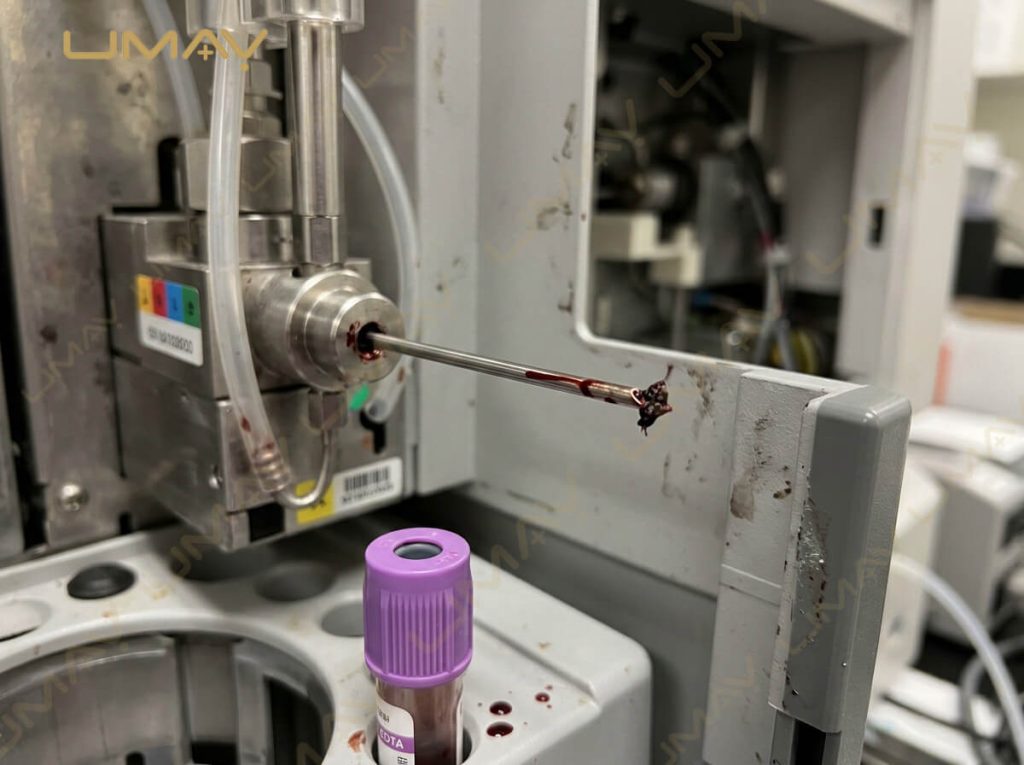
A clogged sample probe is one of the common issues users may encounter.
Possible contributing factors can include:
- Poor sample mixing
- Clotted specimen
- Dried sample residue
- Inadequate cleaning
- Sample aspiration problems
- Fluid pathway contamination
Possible signs include:
- Aspiration error
- Sample volume warning
- Repeated failed aspiration
- Unusual background
- Inconsistent operation
The operator should follow the manufacturer’s probe-cleaning procedure.
Do not insert sharp objects into the probe unless the manufacturer specifically instructs you to do so.
High Background on a Hematology Analyzer
A high background result can indicate that the system is detecting unwanted material when it should be measuring a clean baseline.
Potential causes can include:
- Contaminated fluid pathways
- Inadequate cleaning
- Reagent problems
- Residual sample
- Dirty measurement chamber
- Instrument malfunction
A basic troubleshooting sequence may be:
- Check reagent condition.
- Check fluid connections.
- Run the recommended cleaning cycle.
- Perform another background check.
- Review the manufacturer’s troubleshooting procedure.
- Contact service support if the problem continues.
Do not report patient results until the analyzer is operating within the laboratory’s established criteria.
Hematology Analyzer Reagent Errors
A reagent-related alarm may be caused by:
- Empty reagent container
- Incorrect reagent
- Expired reagent
- Improper connection
- Blocked tubing
- Air in the fluid line
- Reagent temperature problem
- Reagent lot issue
- Sensor problem
The first step is to identify whether the problem is related to the reagent itself or the reagent delivery system.
Replacing a reagent bottle without checking the rest of the system may not solve the problem.
What Causes Abnormal CBC Results?
An unusual result does not necessarily mean that the analyzer is malfunctioning.
Possible factors include:
- Genuine patient variation
- Sample collection problem
- Sample clot
- Inadequate mixing
- Sample age
- Interference
- Analyzer flag
- Reagent issue
- Instrument issue
This is why abnormal results should be interpreted according to laboratory procedures rather than immediately attributed to the machine.
When a result is flagged, follow the laboratory’s established review and repeat-testing process.
Hematology Analyzer QC Failure
A QC result outside the laboratory’s defined acceptable limits can have several possible causes.
Consider:
- Reagent lot change
- Reagent deterioration
- Control material problem
- Analyzer maintenance issue
- Calibration issue
- Environmental conditions
- Instrument drift
- Incorrect QC handling
A useful troubleshooting order is:
Control material → Reagents → Maintenance → Calibration status → Instrument → Procedure
However, laboratories should follow their validated QC SOP rather than relying on a generic sequence.
What Should You Do When QC Fails?
A QC failure should not be ignored.
Depending on laboratory policy:
- Review the QC result.
- Check recent QC trends.
- Confirm the control material was handled correctly.
- Check reagent status.
- Review maintenance records.
- Check for recent reagent lot changes.
- Perform appropriate corrective action.
- Repeat QC according to procedure.
- Escalate to technical support when necessary.
- Document the investigation.
The goal is not simply to “make QC pass.” The goal is to understand why the system did not meet the laboratory’s established acceptance criteria.
Hematology Analyzer Carryover
Carryover describes the possibility that material from one specimen may influence a following specimen.
Carryover can be important in automated laboratory analyzers, especially in high-throughput environments.
Potential contributors can include:
- Fluid pathway contamination
- Inadequate washing
- Sample characteristics
- Instrument design
- Maintenance status
Manufacturers typically specify carryover performance as part of instrument evaluation.
Laboratories should use documented procedures when investigating carryover rather than relying on informal testing.
What Environmental Conditions Matter?
Laboratory analyzers operate within specified environmental conditions.
Depending on the model, these may include:
- Temperature
- Humidity
- Power quality
- Ventilation
- Dust control
- Installation surface
- Water quality, where applicable
- Waste handling
A laboratory should verify the installation requirements before delivery.
This is particularly important for international procurement, because power supply standards and environmental conditions can vary between countries.
Electrical and Installation Requirements
Before installing a hematology analyzer, check:
- Voltage
- Frequency
- Power consumption
- Grounding
- UPS requirements
- Bench space
- Clearance
- Network connection
- Environmental requirements
For distributors, these specifications should be confirmed before shipment.
A preventable installation mismatch can delay commissioning.
Hematology Analyzer Service and Technical Support
Good after-sales service can be just as important as the analyzer itself.
A supplier should ideally be able to support:
- Installation
- Commissioning
- Operator training
- Preventive maintenance
- Troubleshooting
- Spare parts
- Reagent information
- Software support
- Remote technical support
For international customers, ask whether the manufacturer provides:
- Remote video support
- Online manuals
- Spare-part supply
- Training materials
- Local distributor support
- Technical service documentation
These factors should be evaluated before purchase rather than after an instrument develops a problem.
What Should a Supplier Include in an After-Sales Package?
For a B2B hematology analyzer purchase, request an after-sales package that includes:
Technical Documents
- User manual
- Service manual where applicable
- Maintenance schedule
- Installation instructions
- Reagent information
Training
- Operator training
- Basic troubleshooting
- Maintenance training
- QC operation
Service
- Warranty
- Remote support
- Spare parts
- Preventive maintenance guidance
Quality and Compliance
- Product specifications
- Performance information
- Regulatory documentation applicable to the market
A supplier that can provide a complete documentation and support package can reduce operational risk for the buyer.
Hematology Analyzer Maintenance for Distributors
Medical equipment distributors also need to understand maintenance.
A distributor should know:
- What consumables are needed
- Which parts are serviceable
- Which problems operators can solve
- Which problems require engineers
- What spare parts should be stocked
- How quickly reagents can be delivered
- What training is required
For distributors serving remote regions, spare-part planning can be especially important.
A small stock of commonly needed service components can help reduce downtime.
Hematology Analyzer Maintenance in Remote or Resource-Limited Areas
In some markets, laboratories may have limited access to biomedical engineers.
For these environments, buyers should pay special attention to:
- Analyzer simplicity
- Reagent availability
- Remote technical support
- Spare-part availability
- Preventive maintenance requirements
- Operator training
- Power protection
- Local service partners
A system that is easy for trained operators to maintain may be more practical than a highly complex system that requires frequent specialist intervention.
When Should You Call a Service Engineer?
Operators should generally contact technical support when:
- The analyzer repeatedly fails startup checks
- A major error returns after approved troubleshooting
- Mechanical parts are damaged
- Calibration cannot be completed according to procedure
- QC problems persist after the laboratory’s corrective-action process
- Fluid leakage is suspected
- Electrical or communication faults occur
- The instrument requires internal component replacement
Operators should not disassemble critical instrument components unless they are trained and authorized to do so.
How to Reduce Hematology Analyzer Downtime
A good preventive strategy includes:
1. Follow the manufacturer’s maintenance schedule.
2. Train operators before independent use.
3. Keep commonly used reagents and consumables available.
4. Monitor QC trends instead of waiting for major failures.
5. Record recurring error messages.
6. Maintain clear service contacts.
7. Keep appropriate spare parts where recommended.
8. Review maintenance records regularly.
These simple steps can help a laboratory identify small problems before they become major interruptions.
Common Hematology Analyzer Troubleshooting Questions
Why is my hematology analyzer showing a high background?
Possible causes include contamination, inadequate cleaning, reagent problems, residual sample, or a fluid-pathway issue. Follow the manufacturer’s background troubleshooting procedure before returning to patient testing.
Why is the hematology analyzer not aspirating the sample?
Possible causes include probe blockage, a clot in the sample, insufficient sample volume, tubing problems, or a mechanical issue.
Why is the CBC analyzer giving a reagent alarm?
Check the reagent level, expiration, connections, tubing, reagent identification, and the manufacturer’s recommended troubleshooting steps.
Why did QC suddenly fail?
Review control handling, reagent status, recent lot changes, maintenance, calibration status, QC trends, and environmental conditions according to the laboratory’s SOP.
Why are hematology analyzer results inconsistent?
Possible causes include sample issues, reagent problems, maintenance problems, calibration status, instrument performance, or normal specimen variation.
Why is the analyzer producing abnormal flags?
Flags may be generated because of unusual cell distributions, possible interference, instrument conditions, or predefined software criteria. A flag requires review; it is not by itself a diagnosis.
How often should a hematology analyzer be cleaned?
The frequency depends on the analyzer model. Follow the manufacturer’s daily, weekly, and periodic maintenance schedule.
Can I use a different reagent brand?
Only when the analyzer manufacturer and applicable laboratory procedures explicitly support it. Reagent compatibility should never be assumed from similar packaging or chemical names.
How often should a hematology analyzer be calibrated?
There is no single universal interval for all analyzers. Follow the manufacturer’s calibration procedure and applicable laboratory requirements.
Does QC replace calibration?
No. QC and calibration serve different purposes. QC monitors ongoing performance, while calibration establishes or adjusts the measurement relationship according to the defined procedure.