The Digital Transformation of Ophthalmic Care
The ophthalmology landscape is shifting rapidly from static, centralized clinic settings to flexible, cloud-connected, and mobile care delivery models. Driven by advancements in artificial intelligence (AI), high-resolution mobile optics, and tele-ophthalmology software, eye care providers can now detect sight-threatening conditions earlier and outside traditional hospital rooms.
For clinic directors, healthcare procurement managers, and medical device distributors, investing in modern, portable, and AI-compatible hardware is key to increasing patient screening volume, expanding geographic reach, and future-proofing capital investments.
+-----------------------------------------------------------------------------------+
|                     NEXT-GENERATION OPHTHALMIC WORKFLOW                           |
+-----------------------------------------------------------------------------------+
|  1. Portable Screening   | Handheld Fundus Camera / Rebound Tonometer             |
|  2. Automated AI Analysis| Cloud-based AI detection (Diabetic Retinopathy/Glaucoma)|
|  3. Tele-Consultation    | DICOM / PACS cloud export to remote specialist         |
|  4. Targeted Treatment   | Referral to central hospital for specialized surgery   |
+-----------------------------------------------------------------------------------+
1. AI-Powered Ophthalmic Screening & Automated Diagnostics
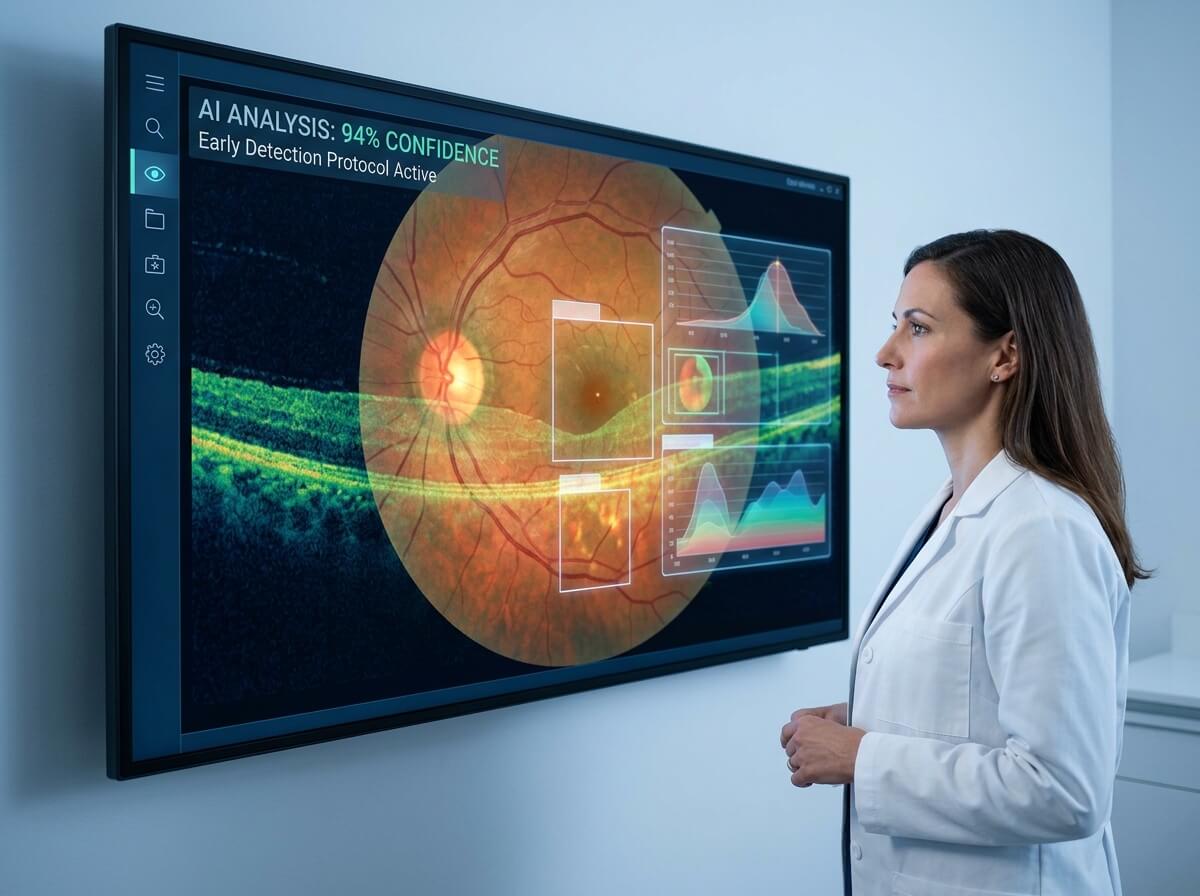
Artificial intelligence integration in eye diagnostic equipment transitions clinical workflows from manual photo interpretation to automated triage and decision support.
Autonomous Retinal Image Analysis
-
Diabetic Retinopathy (DR) Screening: AI algorithms analyze non-mydriatic fundus photos to automatically flag referable diabetic retinopathy within seconds, operating effectively without an on-site retinal specialist.
-
Glaucoma & Macular Pathology Detection: Deep-learning models evaluate optic disc cupping, retinal nerve fiber layer (RNFL) thickness on OCTs, and age-related macular degeneration (AMD) biomarkers.
-
Workflow Acceleration: Automated scoring reduces specialist review backlogs, letting clinicians focus resources on high-risk patients requiring immediate intervention.
Cloud AI vs. Edge AI Integration
-
Edge AI (On-Device Processing): Algorithms run directly on the diagnostic instrument’s embedded hardware, allowing offline automated screening in remote regions with limited internet connectivity.
-
Cloud-Based AI Ecosystems: Diagnostic raw data is uploaded to secure cloud servers, continuously updated with evolving normative databases and multi-disease detection capabilities.
2. Tele-Ophthalmology Infrastructure & Connectivity Standards
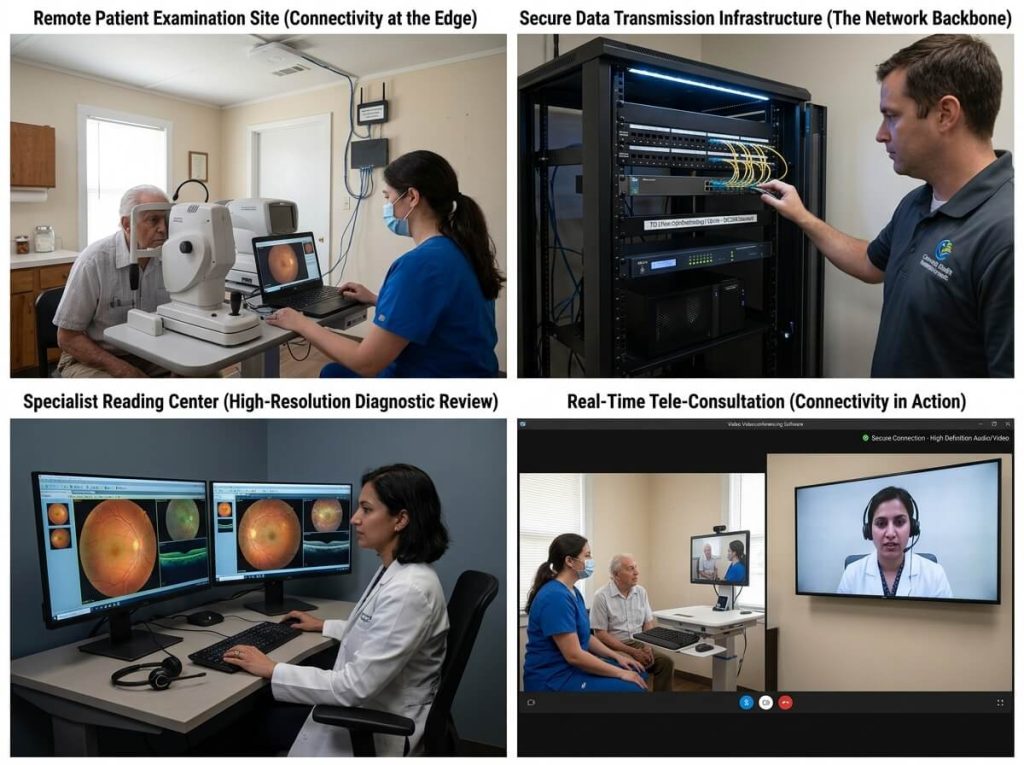
Deploying remote screening networks requires seamless data interoperability between diagnostic hardware and digital healthcare platforms.
                      TELE-OPHTHALMOLOGY DATA ARCHITECTURE
                                       |
       +-------------------------------+-------------------------------+
       |                                                               |
Diagnostic Hardware Layer                         Data & Telehealth Ecosystem
- Handheld & Tabletop Modalities                 - DICOM 3.0 Standard Protocol
- High-Resolution Sensor Capture                 - HL7 / EMR Integration Interface
- Embedded Wi-Fi / Bluetooth Module              - Cloud PACS & Remote Specialist Portal
Essential Connectivity Standards
-
DICOM 3.0 Compliance: Standardized Digital Imaging and Communications in Medicine protocol ensures fundus images, OCT scans, and perimetry maps transfer cleanly to central picture archiving and communication systems (PACS).
-
HL7 & EMR Interoperability: Enables automated patient data synchronization between handheld optical devices and Electronic Medical Record (EMR) software.
-
Data Privacy Compliance: Encryption standards (AES-256) ensure cloud tele-consultation platforms conform to international patient privacy regulations (HIPAA, GDPR).
3. The Portable & Handheld Ophthalmic Equipment Revolution
Handheld diagnostic instruments bring clinic-grade diagnostic capabilities to field screenings, emergency rooms, nursing homes, and pediatric care.
Handheld Slit Lamps
-
Portability & Illumination: Compact lightweight designs (≤ 800 g) with high-luminance LED illumination, variable magnification (10x, 16x), and long-lasting lithium-ion battery packs.
-
Clinical Utility: Essential for examining bedridden, pediatric, or wheelchair-bound patients where positioning on a standard tabletop biomicroscope is impossible.
Handheld & Rebound Tonometers
-
Rebound Tonometry (Micro-Probe): Measures intraocular pressure (IOP) using a lightweight disposable probe that briefly touches the cornea. Requires no topical anesthesia or air puffs.
-
High-Volume Screening: Ideal for rapid glaucoma screening in community health drives, pediatric clinics, and home IOP monitoring setups.
Portable Non-Mydriatic Fundus Cameras
-
Mobile Retinal Imaging: Compact, battery-operated units with auto-focus, auto-capture, and small pupil compatibility (≥ 2.8 mm).
-
Smart Device Integration: Many modern portable fundus cameras pair directly with tablets or smartphones via Wi-Fi for immediate image viewing and automated AI cloud uploads.
4. Operational Comparison: Traditional Tabletop vs. Portable AI-Enabled Systems
| Parameter / Feature | Traditional Tabletop Diagnostic Units | Portable & AI-Enabled Systems |
| Primary Deployment | Centralized Eye Clinics, Hospitals | Remote Outreach, ERs, Primary Care |
| Measurement Velocity | High precision, manual alignment | Ultra-fast automated / auto-tracking |
| Operator Skill Required | Certified Optometrist / Ophthalmic Tech | General Practitioner / Community Nurse |
| Data Workflow | Local workstation storage | Direct Wi-Fi / Cloud PACS export |
| Initial Equipment Footprint | Large dedicated room setup | Fits in a compact protective carry case |
5. Strategic Buyer Checklist: Future-Proofing Device Investments
When acquiring next-generation diagnostic hardware, procurement committees should assess long-term software support and upgrade flexibility:
-
Open API Architecture: Verify that device software offers open Application Programming Interfaces (APIs) or standard DICOM export formats to prevent vendor lock-in.
-
Modular AI Compatibility: Choose hardware platforms capable of integrating third-party AI algorithm subscriptions via software updates without requiring full hardware replacements.
-
Battery & Power Reliability: Ensure portable devices use standardized rechargeable lithium batteries capable of operating through a full shift (≥ 6 hours continuous use).
-
Ruggedized Design & Field Durability: Verify that mobile fundus cameras and handheld slit lamps include drop-tested protective carrying cases and lens caps for field transit.
6. Frequently Asked Questions (FAQ)
Q1: Can AI fundus screening replace an ophthalmologist’s clinical diagnosis?
No. Autonomous AI screening tools serve as triage devices designed to detect referable disease (e.g., moderate-to-severe diabetic retinopathy) and flag patients who require full clinical evaluation by an ophthalmologist.
Q2: What is the main operational advantage of rebound tonometers over air-puff tonometers?
Rebound tonometers do not require topical anesthesia, cause minimal patient discomfort, and are compact enough to fit in a pocket. This makes them significantly easier to use in pediatric care, field screenings, and domiciliary visits.
Q3: What internet bandwidth is needed for a cloud-based tele-ophthalmology setup?
Standard color fundus images require minimal bandwidth (2 – 10 MB per image file). However, high-density 3D OCT datasets require steady broadband connections (≥ 10 – 20 Mbps) for fast cloud PACS transmission.