Buying a flat panel detector is an important investment for hospitals, clinics, diagnostic centers, veterinary facilities, mobile X-ray providers, and medical equipment distributors.
A buyer may begin with a simple search such as:
flat panel detector price
But a professional purchasing process involves much more than price.
You may also need to compare:
- flat panel detector manufacturers
- DR detector suppliers
- wireless DR detector price
- X-ray detector compatibility
- detector size
- CsI or GOS
- pixel pitch
- software
- DICOM
- PACS
- battery
- warranty
- spare parts
- technical support
- delivery time
- replacement options
- OEM
- ODM
- wholesale supply
The cheapest detector is not always the lowest-cost solution in the long term.
A suitable detector should fit the X-ray system, application, workload, budget, and service requirements.
This procurement guide explains what affects flat panel detector prices, how to compare manufacturers and suppliers, how to choose replacement detectors, how to check compatibility, and how to request a quotation.
What Is the Price of a Flat Panel Detector?
There is no single price for every flat panel detector.
The cost can vary significantly depending on the specification and configuration.
Important price factors include:
- detector size
- wired or wireless design
- CsI or GOS scintillator
- pixel pitch
- active area
- image performance
- detector weight
- battery system
- durability
- IP rating
- software
- accessories
- certifications
- warranty
- service
- order quantity
- customization
For example, a basic wired detector and a wireless portable detector may have very different configurations.
A detector designed for heavy hospital use may also have a different price from a detector intended for a smaller clinic.
Therefore, searching for:
flat panel detector price
is only the first step.
A more useful approach is to request a quotation based on your exact requirements.
What Factors Affect Flat Panel Detector Cost?
1. Detector Size
Detector size has a direct influence on product design and cost.
Common formats include:
- 14 × 17 inch
- 17 × 17 inch
- 24 × 30 cm
- 35 × 43 cm
- specialized small-format detectors
Larger detectors may require a larger imaging area, housing, sensor array, and electronics.
However, price should never be estimated from size alone.
2. Wired vs Wireless
A wireless flat panel detector can have a different price from a wired model because it may include:
- wireless communication hardware
- rechargeable battery
- charging system
- wireless software
- additional electronics
- communication management
For hospitals using mobile X-ray, the additional flexibility of wireless operation may justify the additional cost.
For a fixed X-ray room, a wired detector may be sufficient.
Therefore, first identify the application.
3. CsI vs GOS
Scintillator type is another factor that may influence detector pricing.
Two commonly discussed scintillator technologies are:
CsI — Cesium Iodide
GOS — Gadolinium Oxysulfide
The final price depends on the complete detector configuration rather than scintillator material alone.
Compare:
- detector architecture
- pixel pitch
- DQE
- MTF
- image performance
- active area
- housing
- software
- wireless configuration
When requesting a quotation, state whether you require a specific scintillator or whether you are open to technically suitable alternatives.
4. Pixel Pitch
Pixel pitch can also affect detector design and cost.
Typical values may include:
- 100 μm
- 120 μm
- 140 μm
- 143 μm
- 150 μm
- 160 μm
- 180 μm
A smaller pixel pitch means a different detector pixel structure and may affect sensor design and image data requirements.
However, do not choose a detector only because it has a smaller pixel pitch.
The total detector performance should be evaluated.
5. Detector Size and Application
Price should always be considered together with application.
For example:
Fixed Hospital Room
May prioritize:
- image performance
- large detector area
- integration
- workload
- reliability
Mobile X-Ray
May prioritize:
- wireless
- portability
- weight
- battery
- durability
Veterinary X-Ray
May prioritize:
- flexibility
- durability
- cleaning
- portability
Therefore, two detectors with different specifications can both be appropriate even when their prices are different.
6. Software and Accessories
The quoted detector price may or may not include:
- acquisition software
- image workstation
- charger
- battery
- cables
- detector holder
- calibration tools
- DICOM module
- PACS integration
- installation
- training
Always ask:
What is included in the quoted price?
A low detector price may look attractive until software, accessories, installation, or integration are added separately.
7. Quantity
Quantity can influence the commercial terms.
A hospital may purchase several detectors.
A distributor may order:
- 5 units
- 10 units
- 20 units
- larger quantities
OEM or wholesale buyers may receive different quotations from the same supplier depending on order volume and configuration.
When requesting a quotation, always state the expected quantity.
How to Find a Flat Panel Detector Supplier
A buyer can find suppliers through:
- manufacturer websites
- medical equipment marketplaces
- distributor networks
- industry exhibitions
- medical technology directories
- regional representatives
- B2B platforms
- direct manufacturer inquiries
For international procurement, it is important to distinguish between:
manufacturer
supplier
distributor
trading company
These companies may provide different levels of technical support and customization.
Flat Panel Detector Manufacturer vs Supplier
A manufacturer generally has direct involvement in production.
A supplier can be a manufacturer, distributor, exporter, integrator, or another type of provider.
For large projects, the buyer should verify:
- company background
- manufacturing capability
- technical team
- product range
- quality management
- certifications
- export experience
- warranty policy
- service capability
- spare parts
- production capacity
This is particularly important when buying equipment for hospitals or when establishing a distribution relationship.
How to Choose a Flat Panel Detector Manufacturer
When selecting a flat panel detector manufacturer, do not focus only on the product catalog.
Look at five major areas.
Manufacturing Capability
Check whether the company has:
- production facilities
- quality control
- engineering capabilities
- testing procedures
- production capacity
Product Capability
Check whether the manufacturer offers different:
- detector sizes
- wired/wireless configurations
- scintillators
- pixel pitches
- applications
Technical Support
Ask whether the company can support:
- installation
- system integration
- software
- troubleshooting
- remote support
Documentation
Request:
- product specification
- user manual
- technical drawing
- certificates
- software information
- compatibility documents
After-Sales Support
Check:
- warranty
- repair
- spare parts
- battery replacement
- technical training
- service response
A manufacturer that can support the product after delivery can be more valuable than a supplier offering only a low initial price.
How to Find a Flat Panel Detector Manufacturer in China
China is an important sourcing market for medical imaging equipment.
When searching for:
China flat panel detector manufacturer
or:
China DR detector supplier
international buyers should evaluate more than the country of origin.
Check:
- manufacturing location
- factory capability
- quality control
- export experience
- technical documentation
- product certifications
- OEM capability
- ODM capability
- after-sales service
- spare parts
- international shipping experience
You can also ask for:
- factory information
- product videos
- test reports
- technical drawings
- sample units
- references
- project experience
The goal is to determine whether the supplier can support your actual application and market.
Flat Panel Detector Supplier for Hospitals
Hospitals usually require a more complete solution than an individual detector.
Hospital procurement may involve:
- detector hardware
- workstation
- software
- integration
- installation
- training
- PACS
- DICOM
- warranty
- technical service
A supplier should be able to clearly explain the installation and support process.
Ask:
Who will handle installation?
Who will provide training?
What happens if the detector fails?
How quickly can spare parts be supplied?
Can replacement batteries be purchased?
These questions are important for long-term operation.
Flat Panel Detector Supplier for Distributors
Distributors have different requirements.
A distributor may be looking for:
- competitive pricing
- stable supply
- multiple detector sizes
- private label
- OEM
- ODM
- product documentation
- certification support
- marketing materials
- technical training
- spare parts
A distributor should also consider whether the supplier can maintain stable product specifications over time.
For repeat business, consistency can be just as important as the initial quotation.
What Is Flat Panel Detector OEM?
OEM stands for Original Equipment Manufacturer.
In medical equipment sourcing, OEM arrangements can allow a distributor or brand owner to sell equipment under its own branding or according to an agreed manufacturing arrangement.
Potential OEM requirements may include:
- logo
- packaging
- labels
- manuals
- accessories
- software appearance
- product naming
- documentation
Not every manufacturer offers the same level of OEM customization.
Therefore, confirm the exact scope before signing an agreement.
What Is Flat Panel Detector ODM?
ODM means Original Design Manufacturer.
Under an ODM model, the manufacturer may provide more substantial product design or customization.
Potential areas can include:
- product configuration
- hardware
- software
- mechanical design
- branding
- packaging
- user interface
OEM and ODM requirements should be discussed in detail before production.
Flat Panel Detector Wholesale
Wholesale buyers usually focus on:
- unit price
- MOQ
- quantity discounts
- shipping
- lead time
- payment terms
- warranty
- packaging
- spare parts
A distributor should calculate the full landed cost rather than looking only at the factory price.
The landed cost may include:
product price + accessories + freight + insurance + taxes + customs + local handling + integration
This produces a more realistic procurement budget.
How to Buy a Flat Panel Detector
A professional purchase can follow a simple process.
Step 1: Identify the Application
Decide whether the detector will be used for:
- hospital radiography
- mobile X-ray
- veterinary imaging
- orthopedic imaging
- clinic X-ray
- DR retrofit
Step 2: Determine Detector Size
Decide whether you need:
- 14 × 17
- 17 × 17
- 24 × 30 cm
- another format
Step 3: Choose Wired or Wireless
Determine whether mobility is required.
Step 4: Define Technical Specifications
Specify:
- pixel pitch
- scintillator
- active area
- detector weight
- battery
- image performance
Step 5: Confirm Compatibility
Provide the existing X-ray equipment information.
Step 6: Compare Suppliers
Request quotations from multiple suppliers.
Step 7: Compare Total Cost
Review product price, software, shipping, warranty, and service.
Step 8: Confirm Documentation
Check technical and regulatory documentation.
Step 9: Place the Order
Finalize:
- specification
- quantity
- delivery
- payment
- warranty
- packaging
Step 10: Installation and Testing
Verify:
- detector communication
- image quality
- software
- DICOM/PACS
- X-ray exposure synchronization
How to Request a Flat Panel Detector Quote
A good RFQ for a DR detector should contain technical information.
Instead of writing:
Please quote your wireless detector.
A better inquiry would be:
We are looking for a wireless 14 × 17 inch flat panel detector for an existing mobile X-ray system. Please provide the detector technology, pixel pitch, active area, weight, battery specifications, wireless communication, IP rating, image acquisition software, DICOM support, compatibility requirements, warranty, MOQ, lead time and unit price.
This gives the supplier enough information to prepare a more accurate quotation.
Flat Panel Detector RFQ Checklist
Include:
Product: Flat Panel Detector
Application: General / Mobile / Veterinary / Retrofit
Size: 14 × 17 / 17 × 17 / Other
Type: Wired / Wireless
Scintillator: CsI / GOS / Required specification
Pixel Pitch: Required value
Active Area: Required area
Battery: Required operating time
Weight: Maximum preferred weight
Software: Acquisition / Processing
DICOM: Yes / No
PACS: Yes / No
Compatibility: X-ray machine model
Quantity: Number of units
Target Market: Country or region
Certification: Required certification
Warranty: Required period
Delivery: Required lead time
This format can significantly improve the quality of supplier responses.
How to Check Flat Panel Detector Compatibility
Compatibility should be checked before purchase.
There are at least five levels of compatibility.
Mechanical Compatibility
Does the detector fit the:
- Bucky
- wall stand
- radiography table
- mobile X-ray tray
- detector holder?
Electrical Compatibility
Can the detector operate with the existing system?
Communication Compatibility
Can the detector communicate with the workstation?
Software Compatibility
Can the acquisition software recognize and control the detector?
Workflow Compatibility
Can patient information, exposure data, and images move through the intended workflow?
A detector can be mechanically compatible but still require additional software or interface work.
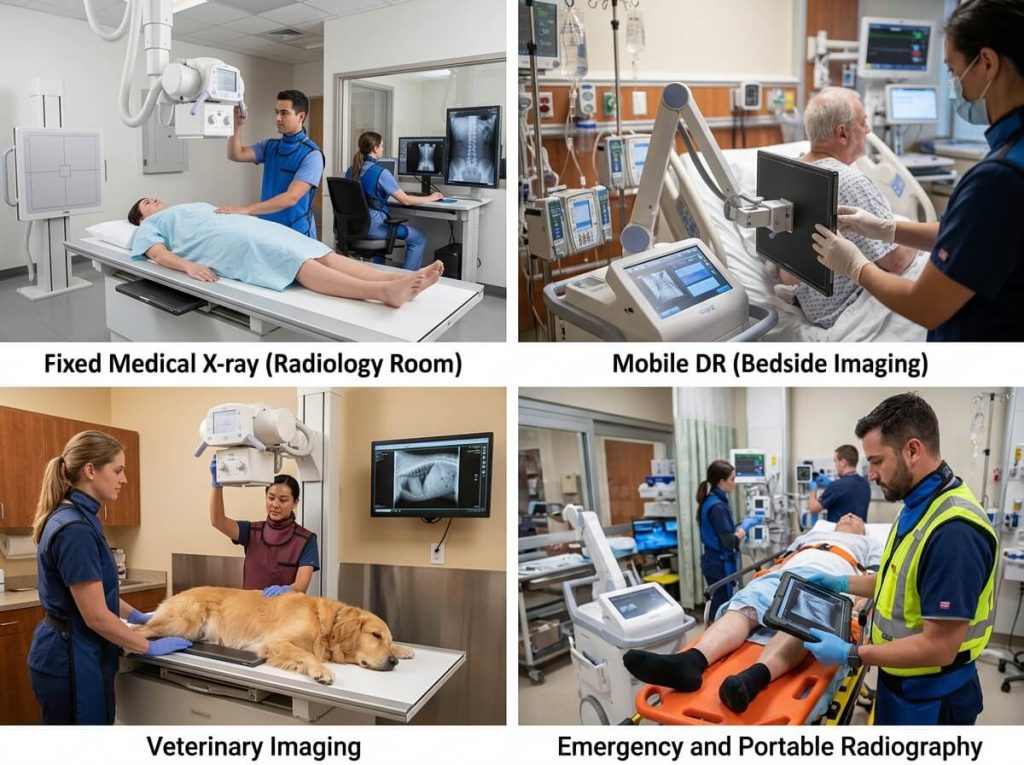
Flat Panel Detector Replacement
A damaged or aging DR detector does not always mean that the complete X-ray system needs replacement.
A flat panel detector replacement may be possible when:
- the X-ray generator remains functional
- the table or wall stand remains usable
- software can support the new detector
- the physical dimensions are suitable
- the communication system is compatible
Replacement can apply to:
- broken detector
- damaged housing
- aging detector
- weak battery
- outdated detector
- unavailable spare parts
Before purchasing a replacement detector, identify why the original detector failed.
What Information Is Needed for Detector Replacement?
For a replacement project, provide:
- X-ray machine brand
- X-ray machine model
- detector model
- detector size
- detector dimensions
- current software
- Bucky model
- wall stand model
- generator model
- existing communication system
Photos can also help a supplier understand:
- detector label
- connector
- detector tray
- Bucky
- cable
- workstation
- existing interface
The more information provided, the easier it is to confirm compatibility.
Can a Different Brand Replace the Original Detector?
Potentially, but compatibility must be checked.
A replacement from another manufacturer may require:
- software adaptation
- interface equipment
- mechanical adjustment
- new workstation
- generator integration
- different detector tray
Therefore, do not assume:
Same size = compatible.
The physical dimensions are only one part of the compatibility assessment.
Flat Panel Detector Replacement Cost
The cost of replacing a detector depends on:
- detector size
- technology
- wireless or wired configuration
- software
- battery
- integration
- accessories
- installation
- warranty
A replacement project may also involve additional costs for:
- interface hardware
- software
- mounting
- shipping
- customs
- installation
For this reason, compare the total replacement cost rather than the detector unit price alone.
New X-Ray System vs DR Retrofit
When an existing X-ray system is still functional, buyers may compare:
complete X-ray replacement
versus:
DR retrofit
A retrofit can involve:
- FPD
- acquisition workstation
- software
- detector interface
- DICOM/PACS
- mounting components
The best option depends on:
- age of the existing system
- generator condition
- mechanical condition
- image workflow
- upgrade cost
- future requirements
- service availability
A technical assessment should be completed before deciding.
Flat Panel Detector for Existing X-Ray Machines
Many buyers want to upgrade an existing X-ray machine rather than purchase a completely new system.
Important questions include:
Can a flat panel detector fit my existing Bucky?
Can the detector work with my existing generator?
Can the current workstation be used?
Do I need new acquisition software?
Can the system connect to PACS?
Is a wireless detector possible?
Does the machine require an exposure synchronization interface?
The answers depend on the specific X-ray system.
How to Compare Flat Panel Detector Quotations
Suppose three suppliers provide quotations.
Do not compare only:
Supplier A — $X
Supplier B — $Y
Supplier C — $Z
Create a complete comparison.
| Item | Supplier A | Supplier B | Supplier C |
|---|---|---|---|
| Detector size | Compare | Compare | Compare |
| Wired/Wireless | Compare | Compare | Compare |
| Scintillator | Compare | Compare | Compare |
| Pixel pitch | Compare | Compare | Compare |
| Active area | Compare | Compare | Compare |
| Weight | Compare | Compare | Compare |
| Battery | Compare | Compare | Compare |
| IP rating | Compare | Compare | Compare |
| Software | Compare | Compare | Compare |
| DICOM | Compare | Compare | Compare |
| Compatibility | Verify | Verify | Verify |
| Warranty | Compare | Compare | Compare |
| Spare parts | Compare | Compare | Compare |
| Lead time | Compare | Compare | Compare |
| Shipping | Compare | Compare | Compare |
| Unit price | Compare | Compare | Compare |
| Total cost | Compare | Compare | Compare |
This makes supplier evaluation much more objective.
What Does a Flat Panel Detector Warranty Usually Cover?
Warranty terms vary by manufacturer.
Possible warranty coverage may include:
- detector hardware
- electronics
- manufacturing defects
- battery
- charger
- software
Some components may have separate warranty terms.
Before ordering, ask:
What is the warranty period?
What parts are excluded?
Who pays shipping for warranty service?
Where is the repair center?
How long does repair normally take?
Is a loaner detector available?
The answers can be particularly important for hospitals and distributors.
After-Sales Service for DR Detectors
Good after-sales service can reduce operational risk.
Useful services may include:
- remote technical support
- installation support
- software support
- troubleshooting
- detector calibration
- battery replacement
- spare parts
- repair
- operator training
For international customers, also ask whether support is available remotely and whether local technical partners are available.
Spare Parts for Flat Panel Detectors
Common replacement items may include:
- battery
- charger
- cable
- power adapter
- communication accessories
- detector holder
Before purchasing, ask:
Are spare batteries available?
How long will spare parts be supported?
Can accessories be purchased separately?
This is particularly important for long-term hospital and distributor projects.
How to Reduce Flat Panel Detector Procurement Costs
There are several practical ways to control procurement costs without simply selecting the cheapest detector.
Define Requirements Clearly
Avoid paying for specifications that you do not need.
Compare Several Suppliers
Compare similar configurations.
Consider Total Cost
Include:
- freight
- software
- accessories
- warranty
- service
- replacement parts
Purchase Appropriate Quantities
Larger orders may have different commercial terms.
Ask About Standard Configurations
Standard products may reduce customization costs.
Clarify Compatibility Before Ordering
Compatibility problems can create expensive modifications later.
Consider Long-Term Support
A slightly higher initial price may be reasonable if it includes stronger service and spare-part support.
How to Choose a Flat Panel Detector Supplier for Long-Term Cooperation
For distributors and large healthcare projects, supplier selection should be viewed as a long-term relationship.
Consider:
Product Stability
Can the same model remain available?
Supply Capacity
Can the manufacturer support repeat orders?
Quality Consistency
Are specifications stable between batches?
Technical Support
Can the supplier solve integration problems?
Documentation
Can updated technical documents be supplied when needed?
Spare Parts
Can batteries and accessories remain available?
OEM/ODM
Can the supplier support future customization?
Communication
Can the supplier respond quickly and clearly?
A long-term supplier should be evaluated as a business partner, not just as a source of low-cost products.
Flat Panel Detector Procurement for Africa and the Middle East
International procurement can involve additional considerations.
For buyers in Africa and the Middle East, evaluate:
- local voltage requirements
- climate
- temperature
- dust
- transportation
- customs
- certifications
- spare parts
- remote support
- installation
- training
- shipping
For mobile X-ray deployments, battery management and environmental protection can be especially important.
Distributors should also consider whether the manufacturer can supply documentation required for local registration or tender processes.
Flat Panel Detector for Government and Hospital Projects
Large tenders may require more than a product quotation.
A project may require:
- technical specifications
- compliance documents
- company qualification
- manufacturer information
- certificates
- warranty
- installation
- training
- service plan
- delivery plan
For a tender project, prepare the complete technical and commercial package before submitting the offer.
What Makes a Good Flat Panel Detector Supplier?
A useful supplier should be able to provide more than a product price.
Look for a supplier that can provide:
clear specifications
compatibility support
technical documentation
reasonable lead time
warranty
spare parts
software support
installation guidance
after-sales service
OEM/ODM capability where required
This is especially important when the detector is part of a larger X-ray system project.
Frequently Asked Questions
How much does a flat panel detector cost?
There is no fixed price. Cost depends on detector size, technology, wired or wireless configuration, pixel pitch, software, battery, durability, quantity, warranty, and other factors.
How much is a wireless DR detector?
Wireless DR detector prices vary according to size, scintillator, image specifications, battery, software, durability, and supplier configuration.
What affects flat panel detector price?
Key factors include size, technology, pixel pitch, active area, wireless communication, battery, software, durability, accessories, certifications, warranty, and order quantity.
Where can I buy a flat panel detector?
You can purchase through medical imaging manufacturers, specialized suppliers, distributors, B2B platforms, or regional medical equipment companies.
How do I find a flat panel detector manufacturer?
Search for manufacturers based on detector type, application, country, certifications, manufacturing capabilities, and technical support. Verify the manufacturer’s actual production and service capabilities before ordering.
How do I find a flat panel detector manufacturer in China?
Compare Chinese medical imaging manufacturers based on production capability, product specifications, quality systems, certifications, export experience, OEM/ODM capability, and after-sales service.
Can I buy a flat panel detector wholesale?
Yes. Medical equipment distributors and project buyers can request wholesale quotations based on quantity and required configuration.
Is there a minimum order quantity for DR detectors?
MOQ depends on the supplier, product, customization, and OEM requirements. Always confirm MOQ when requesting a quotation.
Can I order a sample flat panel detector?
Some suppliers may provide sample units for testing. Confirm sample price, delivery, configuration, and return or credit conditions with the supplier.
Can I get an OEM flat panel detector?
OEM arrangements may be available from manufacturers that support private-label products. Confirm branding, packaging, software, documentation, MOQ, and certification requirements.
Can a manufacturer provide ODM flat panel detectors?
Some manufacturers offer ODM services involving hardware, software, mechanical, or branding customization. The exact scope depends on the manufacturer’s capabilities.
Can I replace my old DR detector?
In many cases, a replacement may be possible, but compatibility must be checked carefully.
Can a different brand replace my existing flat panel detector?
Potentially, but the replacement may require compatible hardware, software, communication, and mechanical integration.
Does the replacement detector have to be the same size?
Not always, but the new detector must fit the available mounting or tray system and meet the required imaging coverage.
How do I know whether a flat panel detector is compatible?
Check mechanical dimensions, detector interface, generator communication, software, exposure synchronization, workstation, and DICOM/PACS requirements.
Can I use a flat panel detector with an old X-ray machine?
A suitable FPD may be used as part of a DR retrofit, depending on the condition and configuration of the existing X-ray machine.
What is a DR retrofit?
A DR retrofit upgrades an existing X-ray system with digital radiography components, commonly including a flat panel detector and image acquisition system.
Is a wireless detector suitable for an old mobile X-ray machine?
It may be, depending on generator communication, exposure synchronization, software, and detector compatibility.
What should I include in an RFQ?
Include application, detector size, wired or wireless requirement, pixel pitch, scintillator, X-ray machine model, quantity, software requirements, DICOM/PACS, certification, warranty, and delivery requirements.
How many suppliers should I compare?
Comparing several suppliers can help buyers understand differences in specification, price, warranty, service, and delivery.
Is the cheapest flat panel detector the best choice?
Not necessarily. Total cost, compatibility, image performance, durability, software, warranty, and service should also be considered.
What is total cost of ownership?
Total cost of ownership includes the purchase price plus relevant costs such as software, installation, shipping, maintenance, batteries, spare parts, repairs, and replacement.
Is a manufacturer better than a trading company?
Not automatically. A supplier should be evaluated according to product quality, technical capability, service, documentation, pricing, and long-term support.
What should I ask a flat panel detector supplier?
Ask about specifications, compatibility, software, battery, warranty, spare parts, lead time, certifications, installation, technical support, and total cost.
Flat Panel Detector Procurement Checklist
Before placing an order, confirm all of the following.
Product
□ Detector size
□ Wired or wireless
□ CsI or GOS
□ Direct or indirect conversion
□ Pixel pitch
□ Active area
□ Pixel matrix
□ Image performance
Physical
□ Weight
□ Thickness
□ Durability
□ IP rating
□ Load capacity
Wireless
□ Battery
□ Charger
□ Wireless communication
□ Spare battery
Software
□ Acquisition software
□ Image processing
□ DICOM
□ PACS
□ Workstation
Compatibility
□ X-ray machine
□ Generator
□ Bucky
□ Wall stand
□ Table
□ Mobile X-ray system
Commercial
□ Unit price
□ Quantity
□ MOQ
□ Accessories
□ Shipping
□ Warranty
□ Spare parts
□ Lead time
□ Technical support
□ Installation
Supplier
□ Manufacturer or supplier
□ Factory capability
□ Certifications
□ Export experience
□ OEM/ODM capability
□ After-sales support
A Practical Flat Panel Detector Buying Process
For most buyers, the following process is enough:
1. Define the application
Hospital, clinic, mobile X-ray, veterinary, orthopedic, emergency, or retrofit.
2. Define the detector format
14 × 17, 17 × 17, 24 × 30 cm, or another size.
3. Define technical needs
Pixel pitch, scintillator, active area, image performance.
4. Decide wired or wireless
Based on the workflow.
5. Check compatibility
Provide the existing X-ray machine information.
6. Shortlist suppliers
Compare manufacturers and suppliers.
7. Request quotations
Ask for complete technical and commercial offers.
8. Compare total cost
Include shipping, accessories, software, warranty, and support.
9. Confirm documentation
Technical specifications, certificates, drawings, manuals.
10. Confirm after-sales support
Warranty, spare parts, batteries, repair, and training.
11. Place the order
Finalize all commercial and technical details.
12. Test after installation
Verify detector operation, image acquisition, software, and integration.
Conclusion
Purchasing a flat panel detector is more than finding the lowest unit price.
A proper procurement decision should consider:
price
detector technology
size
pixel pitch
image performance
wired or wireless design
battery
weight
durability
software
compatibility
DICOM/PACS
warranty
spare parts
technical support
delivery
The right detector depends on the application.
A hospital may prioritize reliability, workflow, integration, and daily workload.
A mobile X-ray provider may prioritize portability, wireless communication, battery life, and durability.
A veterinary clinic may need flexible positioning and easy handling.
A distributor may prioritize wholesale pricing, stable supply, OEM/ODM services, documentation, and long-term support.
For replacement and DR retrofit projects, compatibility becomes one of the most important issues.
The recommended process is simple:
Define the application → select the detector size → choose the technology → determine wired/wireless needs → verify compatibility → compare suppliers → calculate total cost → review warranty and service → place the order.
When requesting a quotation, provide as much technical information as possible. A clear RFQ can help suppliers recommend the right DR detector, digital X-ray detector, wireless flat panel detector, portable DR detector, or replacement FPD for your system.
For hospitals, clinics, distributors, and medical equipment integrators, comparing the complete solution rather than only the product price can help reduce procurement risk and support a more practical long-term investment.