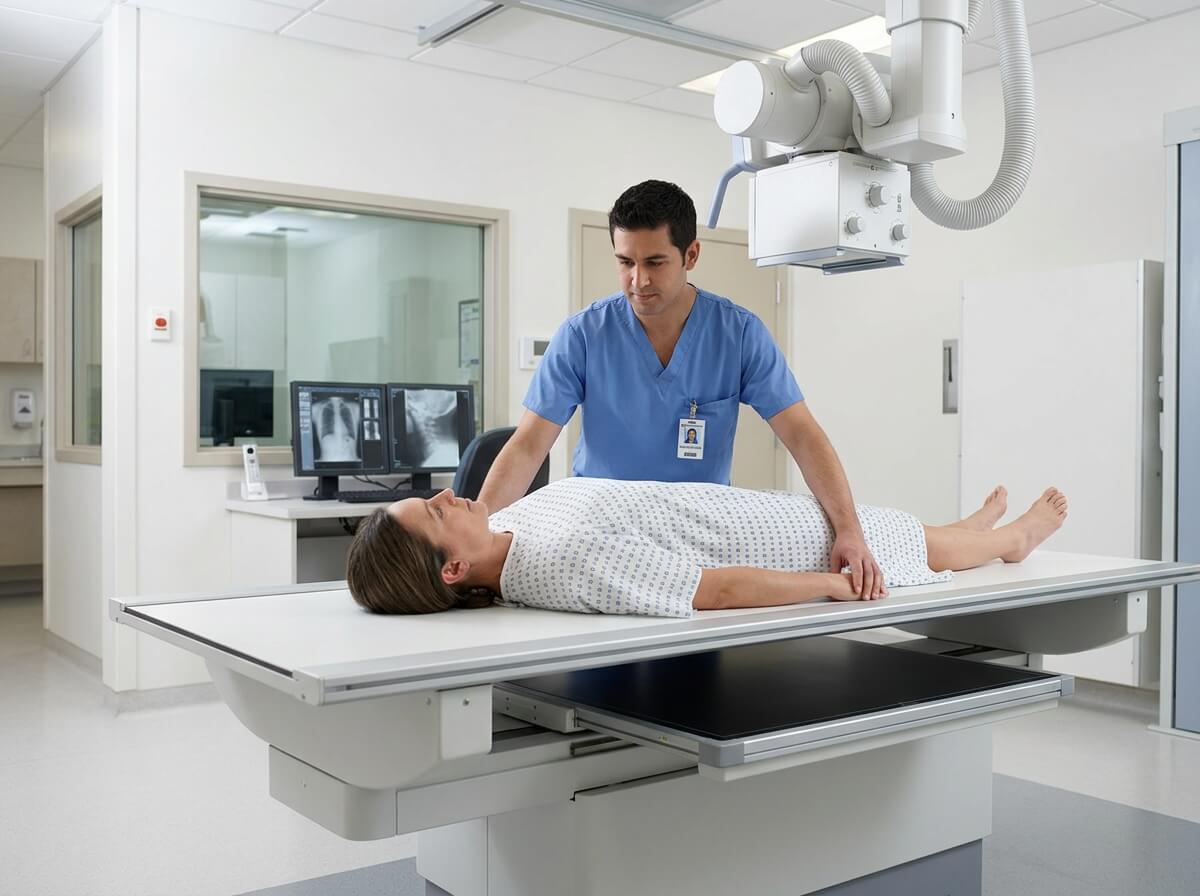
A flat panel detector (FPD) is widely used in modern digital X-ray imaging, but the way a detector is used can vary significantly depending on the healthcare environment.
A detector installed in a fixed hospital X-ray room may have different requirements from a detector used for bedside imaging, mobile radiography, veterinary X-ray, or orthopedic examinations.
This is why people searching for a flat panel detector may use very different search terms.
For example:
- flat panel detector for hospital
- DR detector for clinic
- mobile X-ray detector
- portable DR detector
- veterinary flat panel detector
- orthopedic X-ray detector
- emergency X-ray detector
- bedside radiography detector
- wireless DR detector
- digital X-ray detector
- DR retrofit detector
Understanding the application is important because the right detector depends not only on image specifications, but also on portability, detector size, wireless communication, battery life, durability, cleaning, workflow, and compatibility.
This guide explains the major applications of flat panel detectors and what hospitals, clinics, veterinary facilities, distributors, and medical equipment buyers should consider for each environment.
What Is a Flat Panel Detector Used For?
A flat panel detector is primarily used to capture X-ray information and convert it into a digital radiographic image.
It can be used in many types of digital radiography systems, including:
- fixed X-ray systems
- mobile X-ray machines
- portable X-ray systems
- hospital radiography rooms
- clinic X-ray rooms
- emergency radiography
- bedside X-ray
- orthopedic imaging
- veterinary radiography
- DR retrofit systems
- specialty radiography
The physical detector may look similar across these applications, but the required specifications can be very different.
For example, a fixed-room detector may remain inside a wall stand or Bucky table most of the day.
A mobile DR detector may need to be carried between multiple hospital wards.
A veterinary detector may need to be positioned under animals of different sizes.
The application therefore determines how a buyer should prioritize the detector specifications.
Flat Panel Detectors for Hospital X-Ray
Hospitals are one of the largest application environments for digital X-ray detectors.
A hospital may use FPDs in:
- radiology departments
- emergency departments
- intensive care units
- operating rooms
- inpatient wards
- outpatient departments
- orthopedic departments
- trauma centers
A hospital may also use several detector types within the same facility.
For example, a fixed radiography room may use a detector integrated into a wall stand, while mobile X-ray units use wireless portable detectors.
What Does a Hospital Look for in an FPD?
Hospital procurement teams often evaluate:
- detector size
- pixel pitch
- image quality
- DQE
- MTF
- detector weight
- durability
- wireless communication
- battery life
- software
- DICOM
- PACS compatibility
- cleaning requirements
- warranty
- technical support
The hospital environment can also involve high daily workloads.
A detector may be exposed to repeated handling, frequent cleaning, and intensive use.
For this reason, product durability and long-term service support can be important alongside image performance.
Flat Panel Detector for Radiology Departments
A radiology department commonly performs a wide range of general X-ray examinations.
These may include:
- chest X-ray
- abdominal X-ray
- spine X-ray
- pelvic X-ray
- skull X-ray
- extremity X-ray
- orthopedic X-ray
- general radiography
For a fixed digital radiography room, buyers may prioritize:
image quality
detector size
active area
pixel pitch
workflow
system integration
reliability
A common approach is to use a larger detector format for general radiography.
The exact detector size should be selected based on the X-ray table, wall stand, Bucky system, patient anatomy, and imaging workflow.
Flat Panel Detector for Mobile X-Ray
One of the most important applications for wireless FPD technology is mobile X-ray.
A mobile X-ray machine allows the operator to bring the imaging system to the patient instead of moving the patient into a fixed radiography room.
Mobile radiography can be useful for:
- hospitalized patients
- ICU patients
- emergency patients
- patients with limited mobility
- post-operative patients
- trauma patients
- bedside examinations
A wireless DR detector can make mobile imaging easier because the detector can be positioned independently from the workstation.
Important Specifications for Mobile DR
When purchasing a mobile DR detector, consider:
- detector size
- weight
- wireless communication
- battery life
- charging
- durability
- IP protection
- image preview time
- software
- system compatibility
Portability is especially important.
The operator may need to carry the detector between rooms several times a day.
A detector that is too heavy or difficult to handle can negatively affect the workflow even if its technical specifications look attractive.
Bedside X-Ray and Portable Radiography
Bedside radiography is a major application of portable digital X-ray detectors.
The patient may remain in:
- a hospital bed
- ICU bed
- emergency room
- recovery room
- isolation room
- ward
The detector is placed behind or beneath the anatomy being examined.
Wireless communication is often useful because the detector does not need to remain permanently connected to a workstation.
Why Is an FPD Useful for Bedside Imaging?
A portable DR detector can support:
- flexible positioning
- rapid image acquisition
- electronic image transfer
- mobile workflow
- reduced need for patient movement
For bedside imaging, the detector should also be easy to clean and handle.
Cleaning and infection-control procedures should always follow the manufacturer’s instructions.
Flat Panel Detector for Emergency Imaging
Emergency departments often need rapid access to diagnostic imaging.
Applications can include:
- chest X-ray
- trauma imaging
- fracture imaging
- portable X-ray
- bedside radiography
- emergency orthopedic imaging
In an emergency environment, workflow can be more important than having the smallest possible pixel pitch.
A useful emergency DR detector may need:
- fast image acquisition
- quick image preview
- wireless operation
- easy positioning
- good battery management
- strong physical housing
- reliable software
The entire system should allow the operator to move from patient positioning to image review efficiently.
Flat Panel Detector for Trauma Imaging
Trauma patients may have limited mobility or may need to remain in a specific position.
A mobile X-ray system combined with a portable flat panel detector can support imaging without transferring the patient to a fixed X-ray room.
Potential trauma applications include:
- chest imaging
- pelvic imaging
- limb imaging
- spine imaging
- fracture assessment
- post-trauma follow-up
For trauma imaging, detector size and positioning flexibility can be important.
The selected detector should be compatible with the mobile X-ray system and suitable for the intended patient positions.
Flat Panel Detector for Orthopedic Imaging
Orthopedic imaging is another important FPD application.
Digital radiography can be used for:
- bone imaging
- joints
- extremities
- fractures
- arthritis assessment
- orthopedic follow-up
- pre-operative imaging
- post-operative imaging
Typical examinations include:
- hand X-ray
- wrist X-ray
- elbow X-ray
- shoulder X-ray
- foot X-ray
- ankle X-ray
- knee X-ray
- hip X-ray
- spine X-ray
Which Detector Is Suitable for Orthopedic Imaging?
The answer depends on the anatomy and system configuration.
For extremities, a smaller detector may provide convenient positioning.
For larger anatomy, a larger detector may be more appropriate.
Important specifications can include:
- pixel pitch
- image quality
- active area
- detector dimensions
- weight
- durability
For orthopedic departments, the detector should be selected according to the complete imaging workflow rather than a single specification.
Flat Panel Detector for Extremity X-Ray
Extremity imaging focuses on relatively small anatomical areas.
Examples include:
- fingers
- hands
- wrists
- elbows
- feet
- ankles
- knees
A smaller or cassette-style detector can sometimes make positioning more convenient.
For mobile extremity imaging, a lightweight wireless detector may also be useful.
The best detector size depends on:
- anatomy
- patient positioning
- X-ray system
- available space
- image field requirement
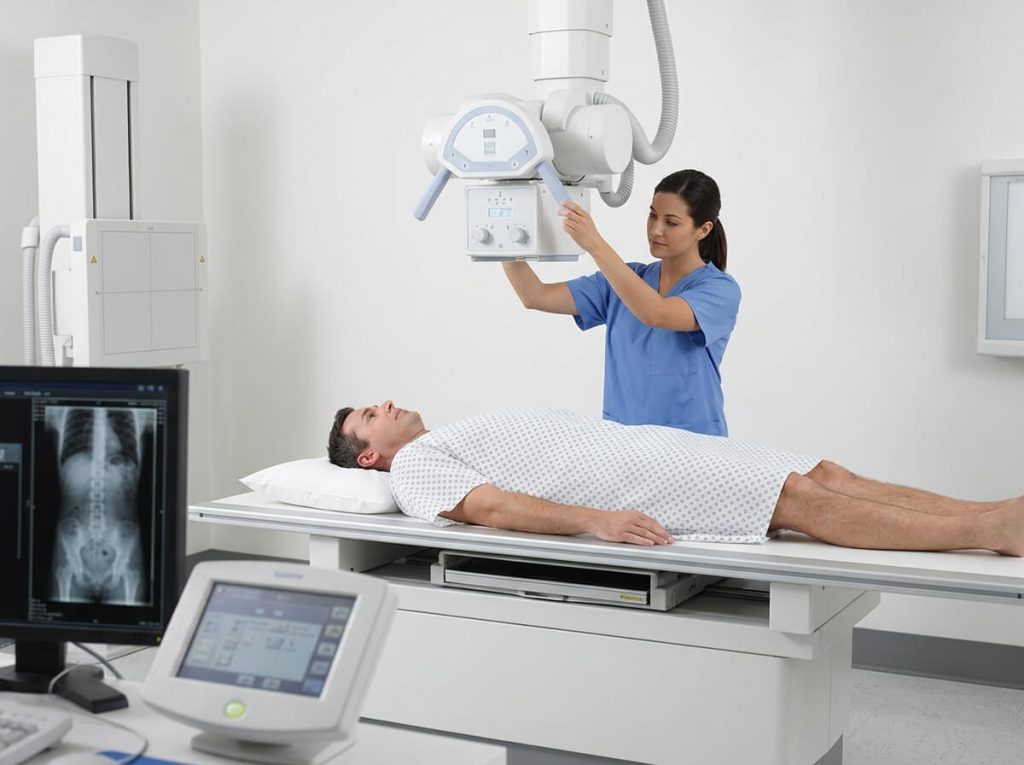
Healthcare professional adjusting overhead X-ray tube positioning for a patient undergoing abdominal radiograph examination.
Flat Panel Detector for Chest X-Ray
Chest radiography is one of the most common digital X-ray applications.
It may be performed in:
- fixed radiography rooms
- mobile X-ray systems
- emergency departments
- ICU
- inpatient wards
- clinics
For chest imaging, the detector needs to provide sufficient coverage for the required anatomy.
Common full-size detector formats can be suitable for chest radiography when they match the X-ray system and patient positioning workflow.
For mobile chest X-ray, a wireless detector can also help simplify bedside positioning.
Flat Panel Detector for Clinics
Small and medium-sized clinics may have different requirements from large hospitals.
A clinic may perform:
- chest X-ray
- orthopedic X-ray
- abdominal imaging
- routine radiography
- pre-employment imaging
- general health examinations
The clinic may prioritize:
- simple operation
- reasonable investment
- easy installation
- compatibility
- reliable software
- low maintenance
- technical support
A fixed wired detector may be suitable for a single-room clinic.
A wireless detector may be more useful for a clinic operating a mobile or flexible X-ray workflow.
Flat Panel Detector for Diagnostic Imaging Centers
Diagnostic imaging centers may have high patient throughput and a strong focus on workflow efficiency.
Important factors may include:
- image acquisition speed
- detector reliability
- patient throughput
- image quality
- system integration
- PACS
- DICOM
- service support
A detector should be considered as part of the complete digital radiography system.
The X-ray generator, detector, workstation, software, network, and PACS all contribute to the final workflow.
Flat Panel Detector for Veterinary X-Ray
Veterinary radiography is a growing application for digital X-ray detectors.
A veterinary flat panel detector may be used for:
- dogs
- cats
- horses
- livestock
- exotic animals
- small-animal imaging
- large-animal imaging
Unlike human patients, animals may need additional positioning support or different imaging techniques.
The detector may therefore need to be flexible and easy to handle.
Common Veterinary Applications
Veterinary digital radiography can include:
thoracic imaging
abdominal imaging
orthopedic imaging
fracture imaging
spine imaging
dental or skull-related radiography
The exact detector size depends on the animal and examination.
Flat Panel Detector for Small Animal X-Ray
Small-animal clinics often perform imaging on:
- cats
- dogs
- rabbits
- small pets
A lightweight wireless detector can offer flexibility when the operator needs to position the detector around a treatment table.
For small-animal imaging, consider:
- detector dimensions
- weight
- battery
- wireless transmission
- durability
- cleaning
- image processing
- workstation compatibility
The detector should be easy to position and clean according to the veterinary facility’s workflow.
Flat Panel Detector for Equine Imaging
Large-animal imaging creates different requirements.
For horse and equine radiography, the operator may need to work in:
- barns
- treatment areas
- outdoor environments
- veterinary hospitals
Portability and durability can therefore become important.
A wireless detector can provide flexibility in situations where connecting a detector by cable is inconvenient.
For equine applications, buyers should pay particular attention to:
- detector size
- weight
- shock resistance
- environmental protection
- battery
- wireless communication
The final choice should be based on the exact imaging environment.
Flat Panel Detector for Veterinary Orthopedics
Veterinary orthopedic imaging may include:
- fracture assessment
- joint imaging
- limb imaging
- spinal imaging
- pre-operative imaging
- post-operative imaging
For these applications, image quality and positioning flexibility can be important.
A portable DR detector can be especially useful when imaging must be performed without moving the animal into a fixed radiography room.
Flat Panel Detector for Operating Rooms
Operating room imaging can involve:
- C-arm systems
- portable X-ray systems
- surgical imaging
- orthopedic surgery
- trauma surgery
Flat panel detectors are also used in many modern fluoroscopy and mobile imaging systems, although detector requirements vary by system architecture.
For surgical environments, equipment may need to support:
- compact workflow
- fast image display
- mobility
- reliable communication
- easy cleaning
- integration with the imaging system
The exact detector design depends on whether the system is used for static radiography or dynamic fluoroscopic imaging.
Flat Panel Detector for ICU Imaging
In intensive care units, patients often cannot easily be transported to the radiology department.
Portable X-ray is therefore an important imaging option.
An ICU X-ray detector may be used for:
- chest imaging
- line placement checks
- tube positioning evaluation
- follow-up imaging
- bedside radiography
A wireless portable DR detector can be useful because it can be placed behind the patient while the mobile X-ray system remains outside or beside the bed area.
For ICU applications, detector portability, infection-control procedures, battery management, and workflow are important considerations.
Flat Panel Detector for Neonatal Imaging
Neonatal imaging can involve particularly small patients and specialized positioning.
Portable X-ray may be used when moving an infant to a fixed imaging room is undesirable.
For neonatal radiography, detector selection should consider:
- detector size
- positioning
- image quality
- workflow
- cleaning
- compatibility with the portable X-ray system
The clinical team should always follow appropriate radiation protection and imaging procedures.
Flat Panel Detector for Field and Remote Imaging
Digital X-ray systems can also be used outside traditional hospital radiology departments.
Possible environments include:
- remote clinics
- field hospitals
- temporary medical facilities
- disaster response
- military medical settings
- rural healthcare
In these environments, portability can become particularly important.
A portable DR detector may need:
- lightweight construction
- wireless operation
- strong battery life
- rugged housing
- flexible software
- easy transportation
- simple charging
For remote deployments, buyers should also consider power availability, environmental conditions, technical support, spare parts, and transportation requirements.
Flat Panel Detector for Rural Clinics
Rural medical facilities may have limited access to large imaging departments.
A compact digital X-ray solution can help bring radiography capability closer to patients.
Potential requirements include:
- mobile X-ray compatibility
- simple operation
- wireless detector
- low maintenance
- reliable software
- battery operation
- remote technical support
A detector should be selected based on the clinic’s actual workload and infrastructure.
Flat Panel Detector for DR Retrofit
Not every facility wants to replace an entire X-ray machine.
A DR retrofit system can be used to upgrade an existing X-ray setup with digital imaging technology.
A retrofit project may involve:
- flat panel detector
- acquisition workstation
- image processing software
- detector interface
- generator communication
- detector holder
- DICOM connection
- PACS integration
This can be an attractive option when the existing X-ray generator and mechanical system remain serviceable.
However, compatibility is critical.
Before purchasing a retrofit detector, confirm:
machine model
generator interface
detector dimensions
Bucky dimensions
wall stand
software
communication
exposure synchronization
Flat Panel Detector for Analog X-Ray Upgrade
Facilities still using film-based or analog X-ray systems may consider upgrading to digital radiography.
A digital detector can be one part of this transition.
The upgrade process may involve:
- Existing X-ray system assessment
- Detector selection
- Mechanical installation
- Generator integration
- Image acquisition software
- Workstation setup
- DICOM/PACS configuration
- Testing
- Staff training
The exact upgrade requirements depend on the original machine.
Flat Panel Detector for CR Replacement
Some facilities use CR systems and may consider moving to direct digital radiography.
A flat panel detector can remove the separate CR reader workflow in suitable system configurations.
Potential workflow differences include:
CR
X-ray exposure → cassette → CR reader → image processing → workstation
DR
X-ray exposure → digital detector → image processing → workstation
The DR workflow can simplify the image acquisition process by eliminating the separate cassette-reading step.
However, converting from CR to DR still requires a compatibility and integration assessment.
Fixed Flat Panel Detector vs Portable Flat Panel Detector
This is another useful application comparison.
| Feature | Fixed Detector | Portable Detector |
|---|---|---|
| Main environment | X-ray room | Mobile/bedside |
| Mobility | Limited | High |
| Wireless | Optional | Often useful |
| Battery | Usually not required | Usually required for wireless models |
| Weight | Less critical | Important |
| Durability | Important | Often especially important |
| Main priority | Workflow and integration | Portability and flexibility |
Neither category is universally better.
They serve different operational needs.
Wireless Flat Panel Detector Applications
Wireless DR detectors are useful when detector movement is important.
Common application terms include:
- wireless X-ray detector
- wireless DR detector
- portable wireless detector
- mobile DR detector
- wireless digital radiography
- wireless flat panel X-ray detector
Potential environments include:
- bedside imaging
- mobile X-ray
- emergency imaging
- ICU
- veterinary clinics
- orthopedic imaging
- field radiography
- retrofit DR
When choosing a wireless detector, remember that wireless communication is only one specification.
Battery, software, network stability, durability, and compatibility also matter.
Portable DR Detector Applications
The word portable can refer to different types of equipment.
A portable DR detector should generally be easy to:
- carry
- position
- store
- charge
- clean
- transport
This is particularly useful when the same detector needs to be used in different locations.
For example, one portable detector could potentially support several compatible mobile X-ray workflows.
However, buyers should confirm whether the detector can actually be shared between the intended X-ray systems.
Flat Panel Detector for Multi-Room Use
Some healthcare facilities may want one detector to support multiple rooms.
This can increase utilization but also introduces additional considerations.
Check:
- physical compatibility
- software compatibility
- detector sharing workflow
- charging
- wireless network coverage
- cleaning
- transportation
- user access
- image routing
A multi-room detector strategy can be useful, but only when the equipment and software are designed to support it.
Flat Panel Detector for Mobile Imaging in Developing Markets
Mobile and portable digital X-ray can be especially relevant where healthcare infrastructure is developing.
For international buyers, additional considerations may include:
- power supply
- environmental conditions
- transportation
- spare parts
- service network
- warranty
- operator training
- language support
- software integration
- local regulations
Medical equipment distributors may also need:
- stable supply
- product documentation
- OEM options
- private-label support
- packaging
- spare batteries
- accessories
- technical training
The right detector should fit both the clinical application and the local operating environment.
Which Flat Panel Detector Is Suitable for Each Application?
A simple comparison can help.
| Application | Important Considerations |
|---|---|
| Hospital radiography | Image quality, integration, reliability, workload |
| Mobile X-ray | Weight, wireless, battery, durability |
| Bedside X-ray | Portability, wireless, cleaning, workflow |
| Emergency imaging | Speed, mobility, durability, battery |
| Orthopedic imaging | Resolution, size, positioning |
| Veterinary X-ray | Portability, durability, cleaning |
| Rural clinic | Simplicity, portability, reliability |
| DR retrofit | Compatibility, dimensions, software |
| ICU imaging | Wireless, battery, cleaning, workflow |
| Field imaging | Portability, battery, durability, power |
| Fixed clinic | Integration, size, software, cost |
This illustrates why there is no single flat panel detector that fits every application.
How Application Affects Detector Size
Detector size should always be connected to the intended examination.
For general radiography, common formats include:
- 14 × 17 inch
- 17 × 17 inch
Smaller formats can be used for specific applications.
A buyer should consider:
field of view
patient anatomy
positioning
tray dimensions
detector weight
transportability
For mobile applications, a smaller or lighter detector can sometimes be more convenient.
For general chest and body radiography, larger formats may provide useful coverage.
How Application Affects Detector Weight
Detector weight is much more important when the detector moves frequently.
Consider two situations.
Fixed Room
The detector remains in a table or wall stand.
Weight may have a relatively low impact on workflow.
Mobile X-Ray
The operator carries the detector between patients.
Weight becomes a daily ergonomic consideration.
This makes detector weight an important keyword and procurement factor for:
- portable DR detector
- mobile X-ray detector
- wireless DR detector
- veterinary DR detector
- bedside X-ray detector
How Application Affects Detector Durability
A fixed detector may experience less physical handling than a mobile detector.
Mobile and veterinary systems may involve:
- repeated carrying
- repositioning
- cleaning
- accidental contact
- challenging environments
Therefore, mobile detector buyers should pay attention to:
- drop resistance
- shock resistance
- waterproofing
- IP rating
- load resistance
- housing design
Durability specifications should always be checked against the manufacturer’s actual test conditions.
Choosing a Flat Panel Detector by Industry
A useful approach for procurement teams is to divide the selection by industry.
Hospital
Focus on:
- workload
- integration
- image quality
- durability
- service
Clinic
Focus on:
- cost
- ease of installation
- compatibility
- workflow
- support
Veterinary
Focus on:
- portability
- durability
- size
- wireless
- cleaning
Mobile Imaging Provider
Focus on:
- weight
- battery
- wireless
- durability
- transport
Distributor
Focus on:
- product range
- price
- certifications
- supply
- OEM/ODM
- technical support
- spare parts
This industry-based approach can simplify procurement decisions.
Flat Panel Detector Applications for Medical Equipment Distributors
Distributors often need to think beyond one end user.
A medical equipment distributor may supply detectors to:
- hospitals
- clinics
- veterinary facilities
- diagnostic centers
- government projects
- mobile imaging providers
- radiology departments
Therefore, a flexible product portfolio can be useful.
A distributor may need several detector configurations, such as:
- 14 × 17 inch
- 17 × 17 inch
- wired
- wireless
- CsI
- GOS
- different pixel pitches
- different accessories
The supplier’s ability to support different markets can therefore be important.
Flat Panel Detector Applications and Compatibility
Regardless of the application, compatibility remains critical.
Before selecting an FPD, confirm compatibility with:
- X-ray generator
- mobile X-ray unit
- Bucky tray
- wall stand
- table
- image acquisition software
- workstation
- DICOM
- PACS
This is especially important for DR retrofit, replacement detector projects, and systems using equipment from different manufacturers.
Common Questions About Flat Panel Detector Applications
What is a flat panel detector used for?
A flat panel detector is used to capture X-ray images digitally in digital radiography and other compatible X-ray imaging systems.
Can an FPD be used in a hospital?
Yes. Flat panel detectors are widely used in fixed and mobile hospital X-ray imaging workflows.
Can a flat panel detector be used for mobile X-ray?
Yes. Portable and wireless DR detectors are commonly used with mobile X-ray systems.
Can an FPD be used at the bedside?
Yes. A suitable portable detector can be used for bedside radiography when the detector and mobile X-ray system are properly configured.
Can a wireless DR detector be used in the ICU?
A compatible wireless detector can support ICU bedside radiography, depending on the complete imaging system and hospital workflow.
Can a flat panel detector be used for veterinary X-ray?
Yes. Digital detectors can be used for veterinary radiography, including small-animal and large-animal applications.
What detector is suitable for veterinary X-ray?
The appropriate detector depends on animal size, imaging application, mobility requirements, durability, detector size, and X-ray system compatibility.
Can an FPD be used for orthopedic imaging?
Yes. Flat panel detectors can support orthopedic and extremity digital radiography.
What size detector is suitable for chest X-ray?
Common full-size formats such as 14 × 17 inch or 17 × 17 inch may be suitable depending on the X-ray system and imaging workflow.
Can one detector be used for several X-ray machines?
Only when the detector, software, communication, mechanical interfaces, and workflow are compatible with those systems.
Can an FPD replace a CR detector?
A flat panel detector can be part of a transition from CR to DR, but system compatibility and integration must be assessed.
What is a DR retrofit?
A DR retrofit upgrades an existing X-ray system with digital radiography components instead of replacing the entire system.
Is a wireless FPD better for mobile X-ray?
Wireless operation can improve positioning flexibility, but the complete detector system should also be evaluated for battery, weight, durability, software, and compatibility.
Is a portable DR detector suitable for rural clinics?
A portable DR solution can be useful in rural or remote environments, provided the system meets local infrastructure, power, technical support, and operating requirements.
What is the difference between mobile and fixed DR?
Fixed DR is typically installed in a dedicated radiography room, while mobile DR is designed to move between patients or locations.
What type of FPD is suitable for emergency imaging?
A portable or wireless detector may be useful for emergency imaging when mobility and rapid workflow are important.
Application-Based Flat Panel Detector Buying Checklist
Before buying an FPD, identify the application first.
Hospital
□ Fixed radiography
□ Mobile X-ray
□ ICU
□ Emergency
□ Operating room
□ Orthopedic
Clinic
□ General radiography
□ Chest X-ray
□ Orthopedic
□ Mobile imaging
Veterinary
□ Small animals
□ Large animals
□ Orthopedic
□ Mobile veterinary X-ray
Retrofit
□ Existing X-ray machine
□ Existing Bucky
□ Generator compatibility
□ Software compatibility
□ DICOM/PACS
Field Use
□ Portable X-ray
□ Battery
□ Wireless
□ Durability
□ Transportation
Once the application is defined, the technical specifications become much easier to evaluate.
Conclusion
Flat panel detectors are used across a wide range of digital X-ray applications, from fixed hospital radiography to mobile bedside imaging and veterinary X-ray.
The application determines what the buyer should prioritize.
For hospital radiography, image quality, workflow, compatibility, reliability, and workload can be important.
For mobile X-ray, weight, wireless communication, battery, portability, and durability often become more important.
For veterinary imaging, flexibility, durability, detector size, cleaning, and portability can influence the selection.
For orthopedic imaging, detector size, positioning, pixel pitch, and image performance may receive greater attention.
For emergency and bedside radiography, rapid workflow, portability, wireless communication, battery management, and ease of handling can be valuable.
For DR retrofit projects, compatibility with the existing X-ray system is essential.
The most useful way to select an FPD is therefore not to ask:
“Which flat panel detector is the best?”
Instead, ask:
“Which flat panel detector is suitable for this application, X-ray system, workflow, and operating environment?”
Start with the application, then compare:
detector size → pixel pitch → technology → wireless/wired → weight → battery → durability → software → compatibility → service → total cost
This approach can help hospitals, clinics, veterinary facilities, diagnostic centers, distributors, and medical equipment buyers select a digital X-ray detector that fits their actual needs.
For organizations planning to upgrade an existing X-ray system, add mobile DR capability, or purchase replacement detectors, an application-based evaluation can also make it easier to compare different flat panel detector manufacturers, DR detector suppliers, portable DR detector solutions, and digital X-ray detector systems.