
Two Analyzers, Two Different Sodium Results. What Should the Laboratory Check?
A clinical laboratory measures sodium in a sample using two different analytical systems. The results do not agree as closely as expected.
Does this mean one electrolyte analyzer is faulty?
Not necessarily.
Before replacing an electrode or recalibrating an instrument, the laboratory should consider the measurement method, sample characteristics, collection procedure, calibration status and quality-control results.
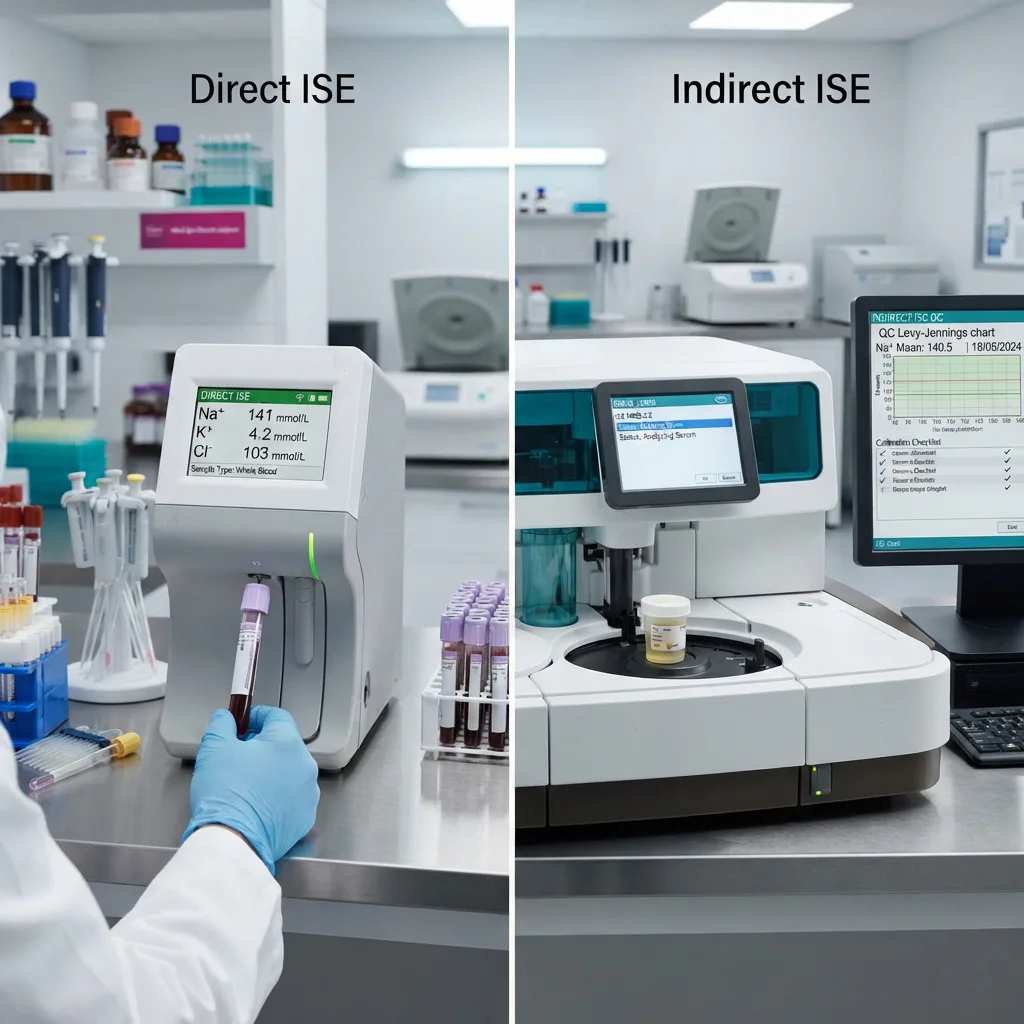
Direct ISE and indirect ISE are two established methods for electrolyte measurement. Both use ion-selective electrode technology, but they handle the sample differently. Under certain conditions, this difference can contribute to discrepancies in reported sodium concentrations.
For example, indirect ISE measurements may be affected by unusually high concentrations of lipids or proteins in a sample, potentially producing a falsely low sodium result known as pseudohyponatremia. This is a recognized analytical issue discussed in clinical laboratory literature.
For laboratory managers, biomedical engineers and medical equipment buyers, understanding these differences helps with instrument selection, quality-control planning and troubleshooting.
This guide explains direct and indirect ISE technology, sample handling, calibration, quality control, common measurement errors and routine electrolyte analyzer maintenance.
1. What Is Direct ISE?
Direct ion-selective electrode measurement, commonly called direct ISE, measures ion activity in an undiluted sample.
Depending on the instrument, the sample may be whole blood, serum or another supported specimen.
Direct ISE is commonly used in blood gas analyzers and point-of-care electrolyte testing systems. It is also available in some dedicated laboratory electrolyte analyzers.
The general measurement process is:
-
An appropriate sample enters the analyzer.
-
The sample contacts the relevant ion-selective electrode system.
-
The electrode generates a potential related to the target ion’s activity.
-
The analyzer processes the signal using its calibration system.
-
The instrument reports the measured parameter.
Common direct ISE parameters include sodium, potassium and chloride, depending on the configured instrument.
Why Do Laboratories Use Direct ISE?
Direct ISE can be useful when laboratories need electrolyte measurements from undiluted samples.
Because it does not require the same predilution step used by indirect ISE, it avoids the particular dilution-related source of sodium measurement bias associated with abnormal serum solids.
This is especially relevant when a sample contains unusually high concentrations of lipids or proteins.
However, direct ISE is not automatically free from every analytical interference. Sample collection, contamination, calibration, electrode condition and other pre-analytical or analytical factors still matter.
Common Direct ISE Search Terms
-
direct ISE analyzer
-
direct ion selective electrode
-
direct ISE electrolyte analyzer
-
direct ISE sodium measurement
-
direct sodium analyzer
-
undiluted sample electrolyte testing
-
direct potentiometry electrolyte analyzer
-
point of care electrolyte analyzer
-
blood gas electrolyte analyzer
-
direct ISE measurement system
2. What Is Indirect ISE?
Indirect ion-selective electrode measurement, also called indirect ISE, uses a dilution step before the sample is measured.
This method is widely used in automated clinical chemistry analyzers and integrated electrolyte testing systems.
After the diluted sample is measured, the analyzer calculates the reported concentration according to its measurement procedure and calibration.
Indirect ISE can support efficient processing of many samples in an automated clinical laboratory.
Why Is Dilution Used?
Dilution is part of the analytical design. It allows the instrument to process a small amount of sample through a controlled measurement procedure.
The analyzer’s reporting calculation is based on the intended sample composition and the assumptions incorporated into the method.
Under normal sample conditions, this approach can provide appropriate electrolyte measurements when the instrument is correctly operated and quality controlled.
However, the assumptions involved in indirect measurement may become problematic when sample composition differs substantially from normal.
Common Indirect ISE Search Terms
-
indirect ISE analyzer
-
indirect ion selective electrode
-
indirect ISE electrolyte measurement
-
indirect sodium measurement
-
diluted sample electrolyte testing
-
indirect potentiometry
-
clinical chemistry ISE module
-
automated electrolyte testing
-
high throughput electrolyte testing
3. Direct vs Indirect ISE: What Is the Difference?
The main difference is how the sample is prepared for measurement.
| Feature | Direct ISE | Indirect ISE |
|---|---|---|
| Sample preparation for measurement | No predilution step | Sample is diluted before measurement |
| Common equipment | Blood gas analyzers, point-of-care systems and some electrolyte analyzers | Many automated clinical chemistry systems |
| Sodium measurement | Less affected by the electrolyte exclusion effect associated with abnormal serum solids | Can be affected by abnormal protein or lipid concentrations |
| Sample handling | Depends on the instrument and supported sample type | Depends on the instrument and specified dilution procedure |
| Calibration | Required according to the instrument’s method | Required according to the instrument’s method |
| Quality control | Required | Required |
| Universal superiority | Not applicable | Not applicable |
The table summarizes common characteristics, not every possible instrument configuration.
Direct and indirect ISE results should not be assumed to be interchangeable under all sample conditions. If a laboratory changes methods or compares results between platforms, the method difference and relevant clinical context should be considered.
Which Method Is Better?
There is no universally correct answer for every laboratory.
Direct ISE may be particularly useful in workflows requiring undiluted whole blood measurement or when pseudohyponatremia associated with abnormal serum solids is a concern.
Indirect ISE is widely incorporated into automated clinical chemistry analyzers, which can support high-volume, multi-parameter laboratory testing.
When choosing an electrolyte analyzer, the method should match the intended application, sample types, laboratory workflow and reporting requirements.
The correct question is not simply which method is better, but which method is appropriate for the laboratory’s needs.
4. Why Can Direct and Indirect ISE Produce Different Sodium Results?
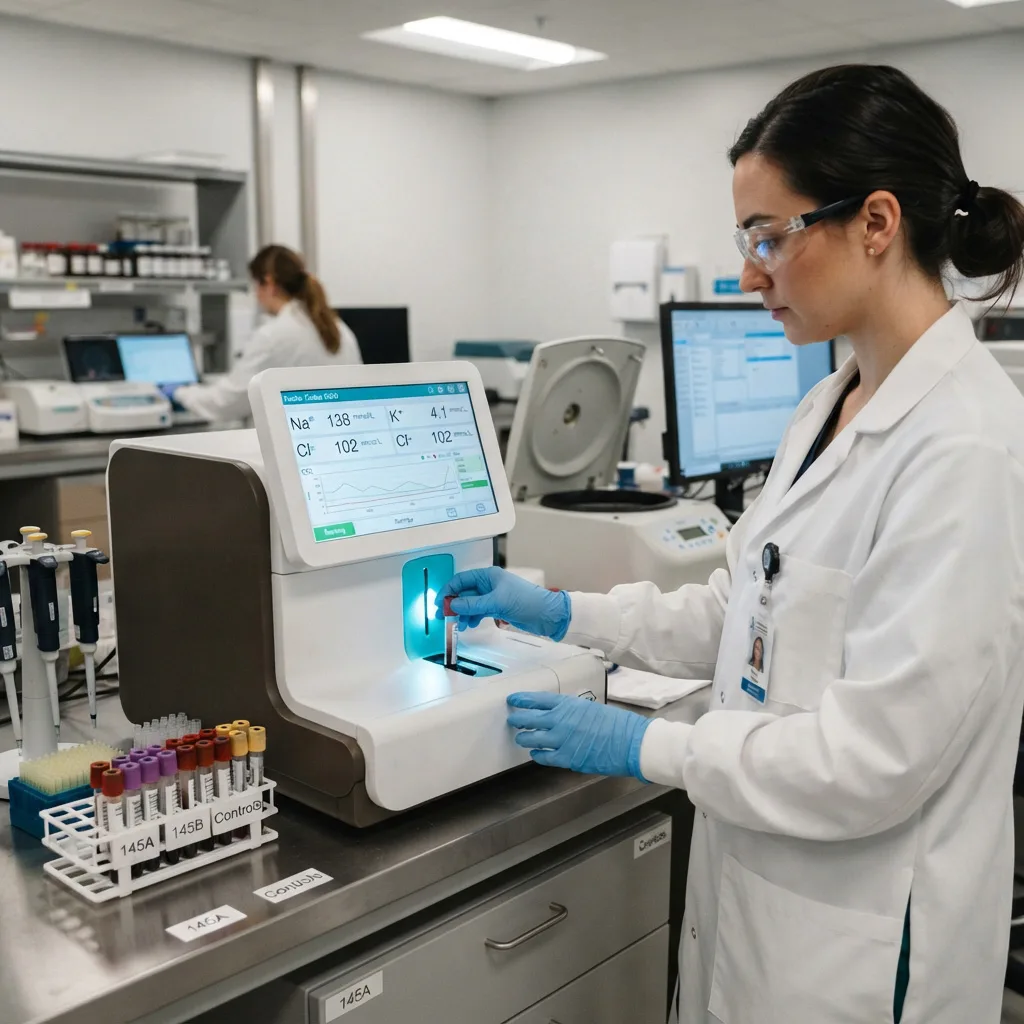
One important reason is the difference between the sample’s water fraction and its total volume.
Sodium is mainly present in the aqueous phase of plasma. Routine indirect ISE methods typically use a dilution procedure and a calculation based on expected sample composition.
If the sample contains abnormally high concentrations of lipids or proteins, the proportion of water in a given volume of plasma may be reduced.
This can cause the indirect method to report a sodium concentration lower than the concentration that would be obtained using direct ISE.
This phenomenon is known as pseudohyponatremia.
It is an analytical issue, not the same condition as a true reduction in sodium concentration associated with decreased plasma tonicity.
The distinction is clinically important because misinterpreting a falsely low laboratory result can lead to inappropriate decisions.
What Causes Pseudohyponatremia?
Pseudohyponatremia can occur when indirect ISE measurement is affected by unusually high serum lipid or protein concentrations.
Examples include:
-
Severe hypertriglyceridemia
-
Markedly elevated serum lipids
-
Hyperproteinemia
-
Certain conditions associated with increased immunoglobulin concentrations
The size of the measurement difference depends on the sample and the analytical system.
Laboratory personnel should not assume that every low sodium result is pseudohyponatremia, or that every discrepancy between two analyzers is caused by this effect.
Other possibilities include true electrolyte abnormalities, pre-analytical problems, method-related differences and instrument issues.
What Should a Laboratory Do When Sodium Results Disagree?
A laboratory should follow its established investigation procedure.
A suitable review may include:
-
Confirming the sample identity and collection details.
-
Checking the measurement methods used by the two systems.
-
Reviewing quality-control and calibration status.
-
Examining whether the sample has unusually high lipid or protein concentrations.
-
Considering an appropriate alternative measurement method when indicated by laboratory procedures.
-
Documenting the investigation and following the laboratory’s result-reporting policy.
Clinical decisions should not be based solely on an unexplained discrepancy between instruments.
5. Sample Collection: The First Step Toward Reliable Results
An electrolyte analyzer can only measure the sample it receives.
If the sample was collected incorrectly, contaminated or poorly handled, the instrument may produce a technically valid measurement of a compromised specimen.
This is why pre-analytical quality is an important part of electrolyte testing.
Common factors to review include:
-
Correct patient and sample identification
-
Appropriate collection tube
-
Correct anticoagulant
-
Adequate sample volume
-
Proper mixing where required
-
Avoidance of contamination
-
Appropriate storage conditions
-
Time between collection and analysis
-
Sample suitability for the selected analyzer
The exact collection procedure depends on whether the laboratory is testing whole blood, serum, plasma or another supported specimen.
Whole Blood Electrolyte Testing
Whole blood is commonly used by certain direct ISE systems.
The collection device must be compatible with the instrument’s instructions.
For example, an unsuitable anticoagulant or contamination from a collection device can affect some measurements. The specimen should not be assumed suitable merely because the analyzer accepts whole blood.
Before purchasing a whole blood electrolyte analyzer, buyers should confirm:
-
Supported collection tubes or syringes
-
Accepted anticoagulants
-
Minimum sample volume
-
Mixing instructions
-
Maximum time before measurement
-
Storage and transport conditions
-
Whether sample aspiration is manual or automated
Serum and Plasma Samples
Serum and plasma are used in many clinical laboratory testing workflows.
The preparation process differs: serum is obtained after clotting, while plasma is separated from anticoagulated blood.
The correct specimen type and anticoagulant depend on the assay and analyzer.
For indirect ISE measurement, serum or plasma composition can also be relevant to interpretation when protein or lipid concentrations are substantially abnormal.
Why Sample Contamination Matters
Contamination can introduce substances that change the measured electrolyte concentration.
For example, contamination from an unsuitable collection tube, additive or infusion-related source can produce results that do not accurately represent the patient’s circulating electrolyte levels.
An unexpectedly abnormal result should therefore be evaluated according to the laboratory’s procedures rather than automatically attributed to analyzer malfunction.
6. Hemolysis and Potassium Measurement
Hemolysis is a particularly important pre-analytical issue in electrolyte testing.
When red blood cells rupture, intracellular components are released into the sample.
Because red blood cells contain substantially more potassium than the surrounding plasma, hemolysis can falsely increase the measured potassium concentration.
This can create uncertainty when the result is used for clinical decision-making.
What Can Cause Hemolysis?
Potential causes include:
-
Difficult blood collection
-
Excessive mechanical stress during collection
-
Improper mixing or handling
-
Unsuitable transport conditions
-
Delayed processing in some circumstances
-
Inappropriate temperature exposure
The cause and degree of interference vary between specimens.
How Can Hemolysis Affect Potassium Results?
Hemolysis may release intracellular potassium into serum, plasma or other affected samples.
As a result, the reported potassium concentration can be higher than the concentration in the patient’s circulating blood.
In some cases, this can mask a low potassium concentration or make a normal value appear elevated.
However, not every elevated potassium result is caused by hemolysis. A genuinely abnormal potassium concentration is also possible.
What Should the Laboratory Check?
The laboratory should review:
-
Sample appearance or available hemolysis indicators
-
Collection and transport conditions
-
Whether the analyzer supports relevant interference detection
-
Quality-control status
-
The laboratory’s rejection and reporting policy
-
Whether recollection or additional assessment is appropriate
Do not apply an improvised mathematical correction to a potassium result from a hemolyzed sample.
7. Other Factors That Can Affect Electrolyte Measurement
Hemolysis is not the only issue that may lead to unexpected results.
Laboratory personnel should understand the following additional factors.
Lipemia
Lipemia describes increased lipid content that can make a sample visibly cloudy or interfere with certain analytical methods.
In indirect ISE sodium measurement, markedly elevated serum lipids may contribute to pseudohyponatremia.
The effect depends on the sample and measurement method. Direct ISE is less susceptible to this particular sample-solids effect, but does not eliminate all potential sources of error.
High Protein Concentrations
Abnormal protein concentrations may affect indirect ISE sodium measurements.
Laboratories should consider the measurement method when investigating unexplained sodium differences in samples with substantially abnormal protein concentrations.
Incorrect Sample Volume
Some analyzers need a defined minimum sample quantity.
Insufficient sample volume can lead to aspiration problems, sample errors or failed tests.
The required volume should be checked in the manufacturer’s instructions and should not be inferred from the nominal sample volume alone.
Air Bubbles
Air bubbles can interfere with sample aspiration or fluid flow in some instruments.
If the analyzer reports aspiration or fluidic errors, follow the specific troubleshooting procedure rather than attempting to bypass the warning.
Contamination and Carryover
Residual sample material or unsuitable cleaning procedures can contribute to unwanted carryover.
The risk depends on the instrument’s design and sample pathway.
Reagent or Calibrator Problems
Incorrect, expired, improperly stored or contaminated solutions may contribute to calibration or measurement problems.
Before opening a new container, check the expiration date, storage conditions and handling instructions.
8. Why Does an Electrolyte Analyzer Need Calibration?
Calibration establishes the relationship between the instrument’s measurement signal and the result it reports.
In ISE systems, electrode response and other characteristics are accounted for through the analyzer’s specified calibration procedure.
Without appropriate calibration, the instrument’s reported concentrations may not meet its expected performance requirements.
Calibration does not, however, prove that every subsequent patient result is correct. Independent quality-control procedures are also needed.
What Is an Electrolyte Analyzer Calibrator?
A calibrator is material with assigned values or properties used by the analytical system to establish or adjust its measurement relationship.
Depending on the analyzer, calibration solutions may be used in automated or operator-initiated procedures.
Different models may use different calibration arrangements. For example, one system may perform automatic calibration at configured intervals, while another may require calibration after particular events or according to a specified schedule.
These arrangements are model-dependent.
What Is Two-Point Calibration?
A two-point calibration uses two calibrators or calibration levels to establish the measurement relationship over a defined interval.
A one-point calibration uses one calibration level to adjust a specified aspect of the system.
Not every electrolyte analyzer uses identical procedures. The terms should be interpreted according to the instrument’s technical documentation.
When Should an Electrolyte Analyzer Be Calibrated?
The calibration schedule should follow the manufacturer’s instructions and the laboratory’s approved procedures.
Calibration may be required:
-
At initial installation or setup
-
At specified intervals
-
After certain maintenance activities
-
When a relevant calibration error occurs
-
After replacing specified components
-
When directed by the instrument’s instructions or local procedure
A laboratory should not use a universal calibration schedule simply because it appears in an article about another analyzer.
Always follow the specific analyzer’s instructions for use.
9. Calibration vs Quality Control: What Is the Difference?
These two procedures are related, but they serve different purposes.
Calibration establishes or adjusts the relationship between the instrument’s signal and the reported value.
Quality control (QC) checks whether the system continues to perform acceptably using appropriate control materials and defined acceptance criteria.
Calibration is not a replacement for quality control, and a single acceptable QC result is not a substitute for the complete calibration and verification process.
What Is Electrolyte Analyzer Quality Control?
Electrolyte analyzer QC uses suitable control materials to help monitor analytical performance.
Depending on the application and analyzer, quality control may involve:
-
Control materials at different concentration levels
-
Daily or scheduled QC testing
-
Review of control charts or trends
-
Investigation of out-of-range results
-
Documentation of corrective actions
-
Reassessment following maintenance
The exact frequency and number of QC levels should follow the manufacturer’s recommendations, laboratory policy and applicable requirements.
Why Use More Than One QC Level?
Different concentration levels can help the laboratory assess performance across more than one part of the analytical range.
A single control level may not provide enough information about performance at other concentrations.
The correct QC plan should account for the analytes, intended use, measurement system, risk and laboratory’s quality management requirements.
10. What Should You Do When QC Is Out of Range?
An out-of-range quality-control result should not be ignored.
It does not automatically mean the analyzer is broken, but it indicates that the laboratory needs to investigate before relying on the affected analytical system.
A practical response is:
Step 1: Check the Control Material
Confirm the correct material was used, its expiration date, preparation, storage and handling.
Step 2: Review Calibration Status
Check whether calibration was completed successfully and whether any relevant warnings are present.
Step 3: Review Recent Changes
Consider recent maintenance, electrode replacement, reagent changes or other events that might influence the measurement system.
Step 4: Inspect Consumables
Check the condition and installation of the relevant reagents, calibrators and electrodes.
Step 5: Repeat Testing Only According to Procedure
If the laboratory procedure calls for repeating QC, follow the prescribed process and investigate the reason rather than repeatedly running controls until one happens to pass.
Step 6: Document the Investigation
Record the problem, actions taken and final outcome.
Step 7: Escalate When Necessary
Use the manufacturer’s troubleshooting instructions or contact qualified technical support if the problem persists.
Patient-result reporting should follow the laboratory’s approved policy. A QC failure should not simply be bypassed to keep the analyzer running.
11. Common Electrolyte Analyzer Errors and Troubleshooting
The following are common problem categories found in electrolyte analyzer workflows. Specific error messages and corrective actions vary by model and manufacturer.
| Problem | Possible Factors to Review | Recommended Approach |
|---|---|---|
| Calibration failure | Calibrator condition, electrode status, fluidic problems | Check the instrument instructions and calibration procedure |
| Electrode instability | Electrode condition, maintenance, solution quality | Review electrode status and manufacturer guidance |
| Abnormal QC results | QC material, calibration, reagents or system condition | Follow the laboratory’s QC investigation procedure |
| Sample aspiration error | Insufficient sample, air bubbles, blocked pathway | Verify sample volume and follow approved troubleshooting |
| Unexplained sodium discrepancy | Different methods, lipemia, high protein, sample issues | Confirm method and investigate the sample |
| Unexpected potassium result | Hemolysis, collection issues, contamination or genuine abnormality | Assess specimen suitability and follow laboratory policy |
| Reagent or solution warning | Expiration, storage, level or installation | Check the relevant solution and instrument instructions |
| Fluidic error | Tubing, valves, blockage or aspiration system | Use manufacturer-approved inspection and service steps |
| Repeated QC drift | Electrode wear, reagent changes, calibration or environmental factors | Investigate trends and seek technical support if needed |
Why Should You Avoid Guessing the Error Code?
Error codes are often manufacturer-specific.
A code used by one electrolyte analyzer may have a completely different meaning on another model.
Therefore, an online troubleshooting article should not be treated as a universal service manual.
The instrument’s documentation is the primary reference for model-specific corrective actions.
12. ISE Electrode Maintenance and Replacement
Electrodes are important components of ion-selective electrode analyzers.
Their service life and maintenance requirements vary by design, workload, sample type and operating conditions.
A laboratory should pay attention to:
-
Electrode condition
-
Calibration performance
-
QC trends
-
Measurement stability
-
Manufacturer maintenance recommendations
-
Replacement instructions
-
Availability of compatible replacement parts
When Should an ISE Electrode Be Replaced?
There is no single universal replacement interval for all ISE electrodes.
Replacement may be needed when the manufacturer specifies it, when performance is no longer acceptable or when troubleshooting identifies a failed component.
A laboratory should not replace electrodes automatically every time a QC result is out of range. It should first check other possible causes, such as control material, reagents, calibration and sample pathway problems.
Equally, it should not continue using an electrode that fails the manufacturer’s performance requirements.
Why Are Compatible Reagents and Electrodes Important?
Electrolyte analyzers are designed around specific consumables and analytical procedures.
Using incompatible reagents or components may affect calibration, performance or instrument operation.
Buyers should confirm:
-
Which electrodes are compatible with the model
-
Which calibrators are required
-
Which QC materials are recommended
-
How reagents should be stored
-
Whether consumables have a defined onboard or open-container stability
-
How to obtain replacement components
-
What maintenance is required after changing a component
These details also affect the operating cost of the analyzer.
13. Direct vs Indirect ISE: What Should Buyers Consider?
The method comparison is not only a technical issue. It can also affect procurement decisions.
Before choosing an electrolyte analyzer, review the intended testing environment.
Is the analyzer mainly used for whole blood testing?
A direct ISE system may be appropriate, depending on the validated sample types and workflow.
Is it part of a high-volume chemistry laboratory?
An indirect ISE module may fit naturally into an automated chemistry system.
Does the laboratory handle samples with abnormal lipid or protein concentrations?
Understanding the measurement method is especially important when interpreting potentially method-related sodium differences.
Does the laboratory need point-of-care operation?
Consider sample workflow, operator requirements, throughput, result transmission and maintenance.
Does the laboratory need additional parameters?
Verify the exact analyte menu rather than assuming every ISE system has the same capabilities.
Is comparison with another instrument required?
Use an appropriate method-comparison and verification process. Differences between direct and indirect ISE measurements should be interpreted with reference to the sample, method and laboratory requirements.
For detailed procurement considerations, see the next article in this series: Post 3 — How to Choose an Electrolyte Analyzer.
Final Takeaway: Reliable Electrolyte Testing Depends on More Than the Analyzer
Direct ISE and indirect ISE are established measurement methods, but they handle samples differently.
Direct ISE measures an undiluted sample, whereas indirect ISE uses a predilution step. This distinction is particularly relevant when abnormal serum lipid or protein concentrations may affect sodium results.
However, not every unexpected result is caused by the ISE method, and not every analyzer error means an electrode has failed.
Reliable electrolyte testing depends on several connected factors:
Correct sample collection → Appropriate measurement method → Valid calibration → Effective quality control → Proper maintenance → Documented troubleshooting
For laboratory managers and medical equipment buyers, understanding these steps supports better equipment selection and a more effective laboratory workflow.
Before choosing an electrolyte analyzer, confirm its measurement method, intended sample types, calibration procedure, QC requirements, compatible consumables and technical support arrangements.
The next article, Post 3 — How to Choose an Electrolyte Analyzer, will build on these technical foundations and focus on specifications, throughput, reagents, operating costs and manufacturer comparison.
Frequently Asked Questions
1. What is the difference between direct ISE and indirect ISE?
Direct ISE measures the sample without predilution, while indirect ISE dilutes the sample before measurement. This difference can affect sodium results in samples with abnormal lipid or protein concentrations.
2. Which is more accurate, direct ISE or indirect ISE?
Neither method is universally more accurate for every situation. Performance depends on the analytical system, sample characteristics, calibration, quality control and intended application.
3. Why can direct and indirect ISE give different sodium results?
One cause is the effect of abnormal lipid or protein concentrations on indirect ISE measurements. Other possible factors include sample issues, method differences and analytical performance.
4. What is pseudohyponatremia?
Pseudohyponatremia is an apparently low sodium result caused by a measurement-related effect rather than a true decrease in sodium concentration in plasma water. It is associated with certain indirect ISE measurements in samples with abnormal protein or lipid concentrations.
5. Can indirect ISE produce a falsely low sodium result?
Yes. Under certain sample conditions, particularly markedly increased serum lipids or proteins, indirect ISE can produce a falsely low sodium result.
6. What causes falsely high potassium results?
Potential causes include hemolysis, contamination and other pre-analytical or analytical issues. Hemolysis can release intracellular potassium into the sample. (EFLM recommendations)
7. Should potassium results from hemolyzed samples be corrected mathematically?
Correction formulas should not be applied casually. The laboratory should follow its approved specimen-quality and result-reporting policy. EFLM recommendations discourage correction formulas for hemolysis-sensitive tests because of their inaccuracies and imprecision.
8. Why does an electrolyte analyzer need calibration?
Calibration establishes the relationship between the instrument’s analytical signal and the reported values. The calibration procedure is specific to the system.
9. How often should an electrolyte analyzer be calibrated?
The schedule depends on the analyzer’s instructions and the laboratory’s approved procedures. A universal interval should not be assumed across all brands and models.
10. What is the difference between calibration and QC?
Calibration establishes or adjusts the measurement relationship. Quality control checks whether the system continues to perform acceptably using defined control materials and acceptance criteria.
11. What should I do if electrolyte analyzer QC is out of range?
Check the control material, calibration status, reagents, electrode condition and recent maintenance. Follow the laboratory’s investigation procedure and manufacturer instructions before returning the system to routine use.
12. What causes ISE electrode drift?
Possible causes include electrode condition, calibration problems, solution issues or other instrument-specific factors. The manufacturer’s troubleshooting procedure should guide the investigation.
13. When should an ISE electrode be replaced?
Replacement depends on the model, electrode condition, performance requirements and manufacturer’s maintenance schedule. There is no universal interval for all analyzers.
14. Can an electrolyte analyzer test whole blood?
Some models are designed for whole blood testing, particularly certain direct ISE systems. Always confirm sample compatibility and collection requirements.
15. Can electrolyte analyzers use serum and plasma?
Many models accept serum or plasma, but the supported sample types and anticoagulants vary. The manufacturer’s instructions should determine specimen suitability.
16. What does an electrolyte analyzer calibration error mean?
It means the calibration procedure has not met the instrument’s specified acceptance requirements. Possible causes vary by model and should be investigated using its instructions.
17. Why is sample volume important for electrolyte testing?
Insufficient sample volume can cause aspiration errors or prevent the required test from completing. Each analyzer has its own sample volume and sampling requirements.
18. Can expired reagents affect electrolyte results?
Expired or improperly stored solutions may affect instrument operation or analytical performance. Use reagents and calibrators according to the manufacturer’s storage and stability instructions.
19. What is electrolyte analyzer quality control?
It is a process for monitoring analytical performance using control materials and defined acceptance criteria. A suitable QC plan helps identify potential problems before routine reporting.
20. What should buyers ask an ISE analyzer manufacturer?
Ask about measurement method, sample compatibility, calibration, QC, electrode service life, reagent availability, troubleshooting documentation, maintenance and technical support.