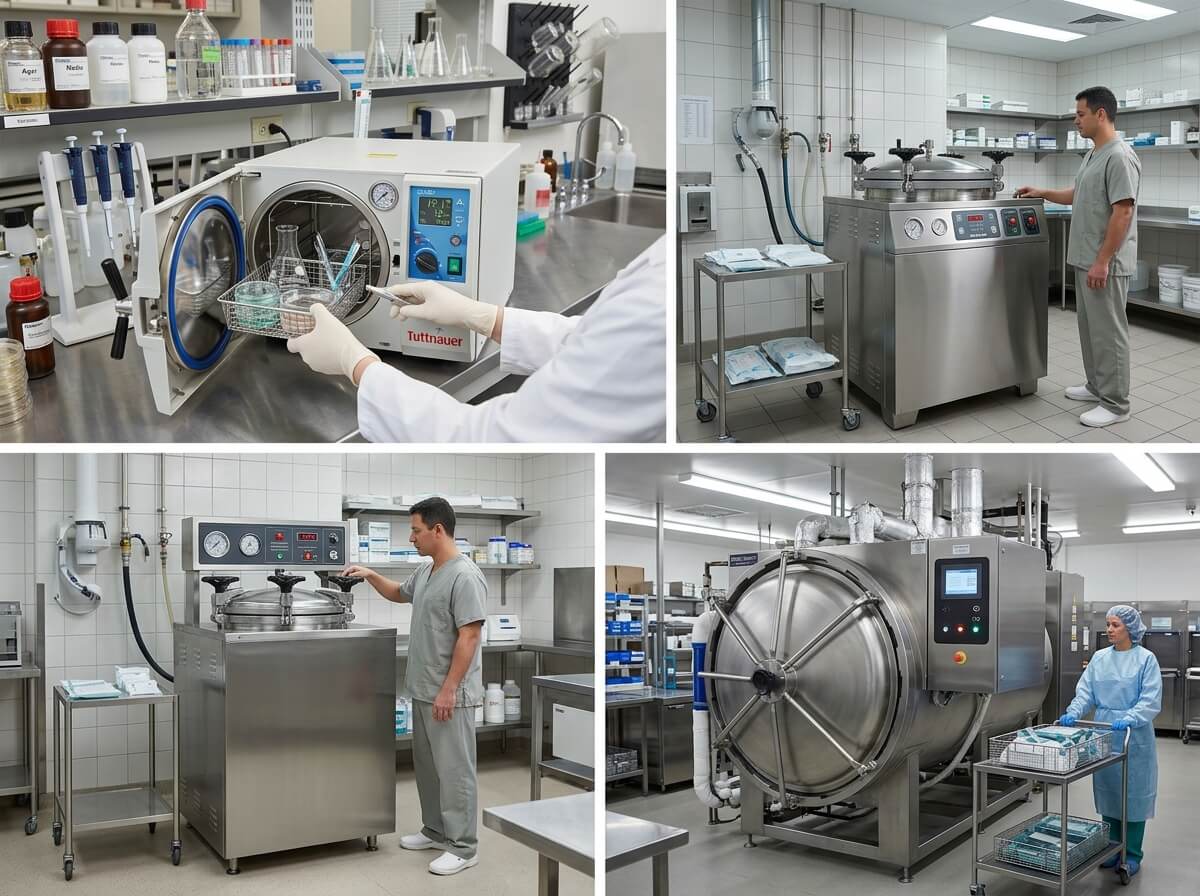
When buying sterilization equipment, medical equipment buyers often search for terms such as autoclave vs sterilizer, steam sterilizer vs autoclave, gravity vs pre-vacuum autoclave, tabletop vs vertical autoclave, autoclave maintenance, autoclave troubleshooting, and sterilization indicators.
Although these terms are closely related, they do not always describe exactly the same thing.
An autoclave is a type of sterilizer that uses saturated steam under pressure. A sterilizer is a broader term that can include steam, dry heat, low-temperature chemical, and other sterilization technologies.
For healthcare facilities, choosing the right sterilization equipment also means understanding the entire process. WHO describes medical-device decontamination as a sequence that includes cleaning, preparation, sterilization, storage, distribution, and quality control.
This guide compares common sterilizer types, explains frequently searched autoclave problems, and covers maintenance, sterilization monitoring, chemical indicators, biological indicators, validation, and troubleshooting.
Autoclave vs Sterilizer: What Is the Difference?
The simplest distinction is:
Autoclave = a steam sterilizer
Sterilizer = a broader category of sterilization equipment
An autoclave uses saturated steam under pressure.
Other sterilization technologies can include:
- Dry heat
- Ethylene oxide
- Hydrogen peroxide-based low-temperature systems
- Other specialized processes
WHO identifies steam sterilization as the preferred method for many heat-stable critical medical devices, while lower-temperature methods may be used when steam is not compatible with the device.
Therefore, when someone searches for a medical sterilizer, they may be looking for an autoclave or another type of sterilization system.
Steam Sterilizer vs Autoclave
In everyday medical equipment purchasing, steam sterilizer and autoclave are often used interchangeably.
Both refer to equipment using steam for sterilization.
However, manufacturers may use different terminology for marketing and product classification.
Common commercial search terms include:
- steam sterilizer
- steam autoclave
- autoclave sterilizer
- medical autoclave
- hospital steam sterilizer
- laboratory autoclave
- dental autoclave
- tabletop steam sterilizer
FDA currently classifies steam sterilizers as a Class II medical-device category in the United States under product code FLE and lists recognized standards for hospital steam sterilizers, tabletop steam sterilizers, water used in medical-device processing, material compatibility, and moist-heat sterilization.
Autoclave vs Dry Heat Sterilizer
Both processes use heat, but the sterilizing environment is different.
| Feature | Steam Autoclave | Dry Heat Sterilizer |
|---|---|---|
| Main agent | Saturated steam | Dry hot air |
| Moisture | Yes | No |
| Pressure | Used in steam sterilization | Not the main principle |
| Heat transfer | Steam condensation | Dry heat |
| Common use | Medical instruments | Selected heat-compatible materials |
| Material compatibility | Heat + moisture resistant | Dry-heat compatible |
The correct method depends on the material and device design.
A medical device that cannot tolerate moisture may require a different sterilization method. WHO specifically recommends selecting the method based on compatibility with the device.
Autoclave vs Low-Temperature Sterilizer
Some medical devices cannot tolerate the high temperature and moisture associated with steam sterilization.
Low-temperature technologies can include:
- Ethylene oxide
- Hydrogen peroxide
- Other chemical low-temperature processes
WHO identifies low-temperature methods such as ethylene oxide and hydrogen peroxide for situations where steam is not suitable because of a device’s material or design.
The right question is therefore not:
Which sterilizer is best?
It is:
Which sterilization method is compatible with the device and validated for the intended use?
Gravity Autoclave vs Pre-Vacuum Autoclave
This is one of the most important comparisons when purchasing a steam sterilizer.
Gravity Autoclave
A gravity-displacement sterilizer uses steam to displace air from the chamber.
It can be suitable for certain:
- Nonporous loads
- Laboratory materials
- Liquids
- Compatible instruments
- Waste applications
Pre-Vacuum Autoclave
A pre-vacuum sterilizer uses active air removal before the exposure phase.
It is commonly used for appropriate:
- Wrapped instruments
- Porous loads
- Hollow devices
- Hospital CSSD applications
WHO explains that air removal is essential for effective steam sterilization and distinguishes dynamic-air-removal systems such as pre-vacuum from passive air-removal systems such as gravity.
Comparison
| Feature | Gravity | Pre-Vacuum |
| Air removal | Steam displacement | Vacuum-assisted |
| System complexity | Lower | Higher |
| Porous loads | More limited | Better suited to many validated loads |
| Wrapped loads | Depends on cycle | Common |
| Vacuum pump | Not necessarily | Usually included |
| Hospital CSSD | Possible | Very common |
| Drying | Model dependent | Often enhanced |
The actual load capability must be confirmed from the sterilizer and device manufacturer’s instructions.
Tabletop vs Vertical Autoclave
Another common purchasing comparison is:
Tabletop vs vertical autoclave
Tabletop Autoclave
Common applications:
- Dental clinics
- Small clinics
- Outpatient facilities
- Small laboratories
Advantages may include:
- Compact footprint
- Easy installation
- Lower capacity
- Convenient operation
Vertical Autoclave
Common applications:
- Laboratories
- Veterinary facilities
- Universities
- Research centers
Advantages may include:
- Larger chamber options
- Efficient use of floor space
- Laboratory-oriented configurations
The best choice depends on the load and available workspace.
Vertical vs Horizontal Autoclave
| Feature | Vertical Autoclave | Horizontal Autoclave |
| Loading | Top | Front |
| Footprint | Moderate | Larger |
| Typical capacity | Small to medium | Medium to large |
| Laboratory use | Common | Common |
| Hospital CSSD | Less common | Very common |
| Large loads | Limited by design | Better suited |
| Loading equipment | Limited | More extensive options |
A horizontal steam sterilizer is often preferred for high-volume hospital applications because it can integrate more easily with trolleys, racks, and structured loading workflows.
Portable vs Fixed Autoclave
A portable or compact autoclave may be useful in:
- Rural clinics
- Mobile healthcare
- Small laboratories
- Field settings
A fixed floor-standing sterilizer may be more appropriate for:
- Hospitals
- CSSD
- Pharmaceutical facilities
- High-volume laboratories
Portability is not just about weight. Buyers should also consider:
- Power
- Water
- Drainage
- Battery capability where applicable
- Installation
- Service access
Basic vs Advanced Autoclave
A basic autoclave may provide:
- Temperature control
- Pressure control
- Automatic timing
- Simple cycle selection
An advanced sterilizer may offer:
- Pre-vacuum
- Vacuum drying
- Programmable cycles
- Data recording
- Multiple sensors
- Centralized data management
- Advanced alarms
- Automated loading systems
FDA’s current steam-sterilizer standards list includes both hospital and tabletop sterilizer standards, reflecting the range of equipment configurations in practical use.
How to Choose Between Different Autoclaves
Start with five questions:
1. What are you sterilizing?
- Surgical instruments?
- Dental instruments?
- Glassware?
- Liquids?
- Waste?
- Pharmaceutical components?
2. Is the load wrapped?
Wrapped loads may require more effective air removal and drying.
3. What is the daily workload?
This determines chamber capacity and throughput.
4. Does the load require vacuum?
Porous and complex loads may require dynamic air removal depending on validated processing requirements.
5. What documentation is required?
Hospitals and regulated facilities may need cycle records, monitoring documentation, validation records, and market-specific compliance documents.
Common Autoclave Problems
An autoclave can experience problems involving:
- Heating
- Pressure
- Vacuum
- Steam generation
- Door sealing
- Drainage
- Sensors
- Water supply
- Drying
- Alarms
- Data communication
Common search queries include:
- autoclave not working
- autoclave not heating
- autoclave not reaching temperature
- autoclave not building pressure
- autoclave vacuum failure
- autoclave cycle failed
- autoclave not drying
- wet packs after autoclave
- autoclave door problem
- autoclave error
- autoclave alarm
The exact troubleshooting procedure depends on the sterilizer manufacturer and model.
Why Is My Autoclave Not Heating?
Possible causes include:
- Insufficient water
- Heating-system problem
- Power-supply problem
- Temperature-sensor fault
- Control-system problem
- Steam-generation problem
- Door-seal problem
Start with the basic checks allowed by the user manual.
Check:
- Power
- Water
- Error messages
- Door status
- Cycle selection
If the machine still does not heat, qualified service personnel should inspect the equipment.
Why Is My Autoclave Not Reaching Temperature?
This problem may occur when:
- Heating is insufficient
- The chamber has an air-removal problem
- Steam generation is inadequate
- A sensor is malfunctioning
- The door is not sealed correctly
- A valve is not operating correctly
Temperature should always be interpreted together with pressure, cycle stage, and the load.
Do not assume that changing the cycle temperature manually will solve the problem.
Why Is My Autoclave Not Building Pressure?
Possible causes include:
- Steam leakage
- Door gasket problem
- Valve issue
- Heating issue
- Sensor problem
- Water shortage
- Steam-generation problem
Check visible leaks and error messages first.
Internal pressure-system problems require qualified technical service.
Why Does an Autoclave Have a Vacuum Failure?
A vacuum failure can result from:
- Vacuum-pump problems
- Door-seal leakage
- Valve malfunction
- Drain blockage
- Air leaks
- Incorrect maintenance
- Sensor problems
For pre-vacuum sterilizers, air-removal performance is particularly important.
WHO states that effective air removal is essential because sterilization cannot occur properly in the presence of trapped air.
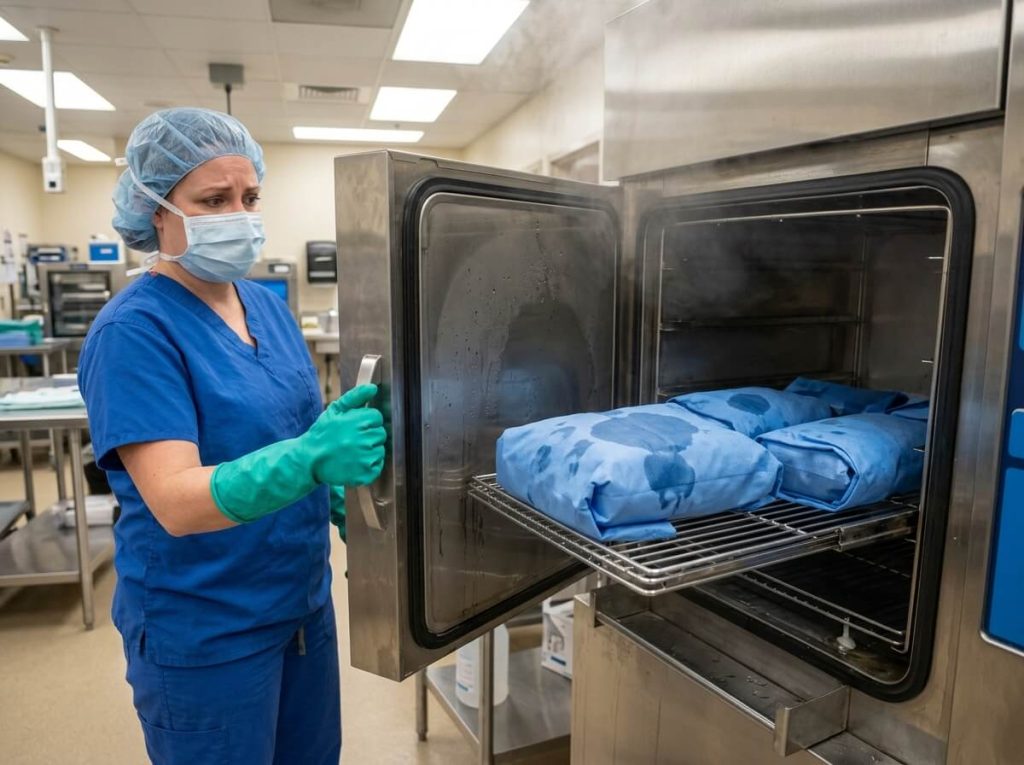
Why Are My Autoclave Packs Wet?
Wet packs are one of the most common steam-sterilization troubleshooting topics.
Possible causes include:
- Inadequate drying
- Overloading
- Incorrect loading
- Condensation
- Packaging problems
- Poor vacuum performance
- Incorrect cycle
- Excessive moisture
WHO recommends inspecting packages for indicator change, damage, and moisture after unloading the sterilizer.
Hospitals should follow their established procedures for handling wet packs rather than treating them as automatically acceptable.
Why Does the Autoclave Door Not Open?
A sterilizer door may remain locked because:
- Chamber pressure has not returned to a safe level
- The cycle is still running
- A safety interlock is active
- A door sensor has detected an abnormal condition
- There is a control-system fault
Never force open a pressurized or locked autoclave.
Follow the manufacturer’s procedure and contact qualified service personnel when necessary.
Common Autoclave Alarm Messages
Alarm messages vary between manufacturers, but common categories include:
- High temperature
- Low temperature
- High pressure
- Low pressure
- Vacuum failure
- Door not locked
- Door seal failure
- Low water
- Sensor fault
- Heating fault
- Drain fault
- Drying fault
- Power failure
- Cycle interruption
The exact error code should be recorded before troubleshooting.
Autoclave Maintenance
Autoclave maintenance is an important part of equipment management.
A maintenance program may include:
- Cleaning
- Chamber inspection
- Door gasket inspection
- Drain inspection
- Filter inspection
- Sensor checks
- Vacuum-system checks
- Safety-system checks
- Electrical checks
- Performance verification
- Data-recording checks
The maintenance interval should follow the manufacturer’s recommendations and applicable facility requirements.
Daily Autoclave Inspection
Routine checks may include:
Chamber
Check for:
- Debris
- Corrosion
- Residue
- Abnormal deposits
Door
Check:
- Gasket
- Locking system
- Seal surface
- Door movement
Utilities
Check:
- Water
- Power
- Drain
- Steam supply where applicable
Control System
Check:
- Display
- Alarms
- Cycle selection
- Error messages
The exact daily inspection checklist should be based on the equipment manufacturer’s instructions.
Weekly or Periodic Autoclave Maintenance
Depending on the model and service schedule, periodic maintenance may include:
- Cleaning filters
- Inspecting valves
- Checking door seals
- Inspecting vacuum systems
- Checking sensors
- Reviewing cycle records
- Checking safety systems
- Inspecting electrical components
Some maintenance tasks require qualified technical personnel.
Autoclave Preventive Maintenance
Preventive maintenance is intended to identify problems before equipment failure affects the sterilization workflow.
A preventive maintenance program can help monitor:
- Door gasket wear
- Vacuum performance
- Heating performance
- Sensor condition
- Water quality
- Drain function
- Alarm operation
- Safety systems
For large hospital fleets, keeping maintenance records for each sterilizer is particularly useful.
Autoclave Cleaning
Cleaning requirements vary by model.
General considerations include:
- Chamber cleaning
- Door-seal cleaning
- Drain cleaning
- Tray cleaning
- Exterior cleaning
- Water-system maintenance
Only cleaning products approved by the manufacturer should be used.
Do not introduce unapproved chemicals into the chamber.
Autoclave Calibration vs Validation
These two terms are often confused.
Calibration
Calibration concerns the accuracy of measurement equipment such as:
- Temperature sensors
- Pressure sensors
- Vacuum sensors
Validation
Validation is broader and concerns demonstrating that a defined sterilization process consistently achieves its intended outcome.
FDA currently recognizes ISO 17665:2024 for the development, validation, and routine control of moist-heat sterilization processes for medical devices.
For regulated facilities, the distinction between calibration, qualification, validation, and routine monitoring is important.
What Is Sterilization Monitoring?
Sterilization monitoring provides evidence that the sterilization process is operating appropriately.
WHO’s current aide-memoire recommends documenting physical parameters such as time, temperature, and pressure, monitoring chemical indicators, and using biological indicators according to the relevant sterilization program.
Common monitoring methods include:
- Mechanical or physical monitoring
- Chemical indicators
- Biological indicators
Each serves a different purpose.
Mechanical Monitoring
Mechanical monitoring involves reviewing the physical parameters recorded by the sterilizer.
Common parameters include:
- Temperature
- Pressure
- Time
- Vacuum
Modern autoclaves may automatically record these values for each cycle.
WHO recommends documenting the physical parameters for each sterilization cycle as part of process monitoring.
Chemical Indicators
A chemical indicator responds to specified sterilization process conditions.
Common examples include:
- Autoclave indicator tape
- Chemical indicator strips
- Internal package indicators
- External process indicators
Chemical indicators can help show whether a package has been exposed to a defined process condition.
However, they should be used as part of a broader monitoring program.
Biological Indicators
A biological indicator, often called a BI, uses resistant microorganisms or spores to challenge the sterilization process.
For steam sterilization, biological indicators are commonly based on Geobacillus stearothermophilus spores.
Common search terms include:
- biological indicator autoclave
- autoclave spore test
- steam sterilizer biological indicator
- BI test autoclave
- biological sterilization monitoring
Biological indicator programs should follow facility procedures and applicable standards.
Chemical vs Biological Indicators
| Feature | Chemical Indicator | Biological Indicator |
| Purpose | Indicates exposure to specified process conditions | Challenges the sterilization process biologically |
| Result | Chemical change | Biological test result |
| Common use | Each package/process as applicable | Routine or special monitoring |
| Information | Process exposure | More direct challenge of the process |
Neither should be viewed in isolation from the facility’s complete quality system.
WHO specifically recommends monitoring and documentation of physical parameters, chemical indicators, and biological indicators as part of sterilization quality control.
What Is a Bowie-Dick Test?
The Bowie-Dick test is associated with dynamic-air-removal steam sterilizers.
It evaluates the ability of the sterilizer to remove air and achieve appropriate steam penetration during a test cycle.
Common SEO searches include:
- Bowie-Dick test
- Bowie-Dick test autoclave
- vacuum sterilizer test
- steam penetration test
- pre-vacuum sterilizer testing
The test is particularly relevant to pre-vacuum sterilization systems.
The exact frequency and procedure should follow the applicable standard, facility policy, and sterilizer manufacturer’s instructions.
What Happens If a Sterilization Cycle Fails?
A failed cycle should not simply be ignored.
Possible causes include:
- Incorrect cycle selection
- Equipment malfunction
- Poor air removal
- Incorrect loading
- Packaging issue
- Temperature problem
- Pressure problem
- Vacuum problem
- Water or steam problem
The facility should follow its established procedure for:
- Identifying the problem
- Quarantining affected loads when required
- Reviewing cycle records
- Inspecting the sterilizer
- Reprocessing affected items as appropriate
- Documenting the event
Positive Biological Indicator: What Should You Do?
A positive biological indicator requires a defined response according to the facility’s sterilization policy and applicable requirements.
CDC guidance describes actions including reviewing operating procedures and cycle records, checking sterilizer operation and loading, repeating testing, and taking the sterilizer out of service when indicated by the investigation. (cdc.gov)
This is not simply a routine maintenance issue.
The facility should follow its infection-control and medical-device reprocessing procedures.
Autoclave Sterilization Failure
A sterilization failure can have several causes.
Equipment-Related
- Sensor failure
- Vacuum fault
- Heating fault
- Door seal failure
- Valve fault
Load-Related
- Overloading
- Incorrect load arrangement
- Incorrect packaging
- Incompatible materials
Process-Related
- Wrong cycle
- Incorrect exposure
- Incorrect temperature
- Poor air removal
WHO emphasizes that effective sterilization depends on the whole decontamination and reprocessing process, not only on the sterilization chamber itself.
Autoclave Troubleshooting Checklist
When an autoclave reports a problem, a simple process can be:
Step 1: Check the Error Message
Record the exact code.
Step 2: Check the Cycle
Confirm that the correct program was selected.
Step 3: Check the Load
Look for:
- Overloading
- Incorrect packaging
- Incorrect arrangement
Step 4: Check Basic Utilities
Verify:
- Power
- Water
- Drain
- Steam supply where applicable
Step 5: Check the Door
Confirm that:
- Door is properly closed
- Seal appears intact
- Locking mechanism works normally
Step 6: Review the Cycle Record
Look for:
- Temperature
- Pressure
- Vacuum
- Exposure time
- Alarm events
Step 7: Contact Technical Service
If the problem persists, qualified service personnel should inspect the equipment.
Common Autoclave Troubleshooting Table
| Problem | Possible Cause | Initial Check |
| Not heating | Power, water, heating system | Power and water |
| Not reaching temperature | Steam/heating/air-removal issue | Cycle record |
| Not building pressure | Leak, heating, valve | Door and pressure |
| Vacuum failure | Pump, seal, valve | Vacuum system |
| Wet packs | Drying/load/condensation | Load arrangement |
| Door locked | Pressure/cycle/interlock | Display status |
| Low-water alarm | Water supply | Reservoir/supply |
| Cycle failure | Wrong cycle/equipment issue | Error code |
| Poor drying | Vacuum/load/drying setting | Drying stage |
| Sensor alarm | Sensor/cable/fault | Sensor status |
These are general possibilities, not a substitute for the manufacturer’s troubleshooting procedure.
When Should an Autoclave Be Repaired?
Professional service may be required when:
- The sterilizer repeatedly fails cycles
- Temperature is unstable
- Pressure is abnormal
- Vacuum performance is poor
- Door seals leak
- Safety alarms appear unexpectedly
- Sensors fail
- The heating system is faulty
- The control system fails
- Data recording does not work
- Water leakage occurs
A medical sterilizer should not remain in service when a safety or sterilization-performance problem has not been resolved.
When Should an Autoclave Be Replaced?
Replacement may be more appropriate when:
- Spare parts are unavailable
- The model is obsolete
- Accessories are discontinued
- Repair costs are high
- The sterilizer cannot meet current workflow requirements
- Required documentation is no longer supported
- The chamber or pressure system has significant damage
- The equipment cannot be integrated into the facility’s current system
For hospital projects, replacement can also be an opportunity to standardize several sterilizers on one platform.
Autoclave Maintenance vs Repair
These terms represent different activities.
Maintenance
Routine actions intended to keep the equipment functioning properly.
Repair
Corrective action taken after a fault has occurred.
Validation / Performance Verification
Activities intended to demonstrate that the equipment and process meet defined requirements.
A well-managed sterilization program needs all three.
Autoclave Spare Parts
Common replacement items may include:
- Door gaskets
- Filters
- Sensors
- Valves
- Heating components
- Vacuum-pump parts
- Fuses
- Printer components
- Seals
- Control-system components
When selecting an autoclave manufacturer, ask how long spare parts will remain available.
This is especially important for hospitals expecting many years of operation.
Autoclave Maintenance for Hospitals
Hospitals may have multiple sterilizers operating every day.
A hospital maintenance program can track:
- Equipment ID
- Serial number
- Department
- Installation date
- Maintenance history
- Cycle failures
- Replacement parts
- Calibration records
- Validation records
- Training records
A centralized record can help biomedical engineering teams identify recurring failures.
Autoclave Maintenance for Dental Clinics
Dental practices generally operate smaller systems, but routine care remains important.
Pay attention to:
- Chamber cleaning
- Door seal
- Water quality
- Trays
- Drain
- Cycle records
- Chemical indicators
- Biological monitoring according to local requirements
A small tabletop sterilizer still requires appropriate preventive maintenance.
Autoclave Maintenance for Laboratories
Laboratory autoclaves may process:
- Liquids
- Media
- Glassware
- Waste
This creates different maintenance requirements.
Laboratory operators should understand:
- Load limitations
- Liquid cycles
- Cooling
- Pressure release
- Container selection
- Waste handling
Laboratory safety procedures should be followed at all times.
Autoclave vs Sterilizer FAQ
Is an autoclave a sterilizer?
Yes. An autoclave is a type of sterilizer that uses pressurized steam.
Is a steam sterilizer the same as an autoclave?
In many medical-equipment contexts, the terms are used interchangeably because both refer to steam sterilization equipment.
Is a pre-vacuum autoclave better than gravity?
Neither is automatically better. The appropriate system depends on the load and validated sterilization process.
Which is better, tabletop or vertical autoclave?
It depends on the application, chamber capacity, available space, and loading requirements.
Which is better, vertical or horizontal autoclave?
Horizontal sterilizers are generally better suited to larger-volume hospital workflows, while vertical units can be practical for laboratories and other facilities.
What is the difference between autoclave and dry heat sterilizer?
An autoclave uses steam, while a dry-heat sterilizer uses dry hot air.
What is the difference between autoclave and low-temperature sterilizer?
An autoclave uses moist heat, while low-temperature sterilizers use other technologies designed for heat- or moisture-sensitive devices.
Why does an autoclave fail to reach temperature?
Possible causes include heating problems, steam problems, air-removal issues, sensor faults, or door-seal problems.
Why does an autoclave fail to reach pressure?
Possible causes include steam leakage, heating problems, valve issues, sensor faults, or inadequate steam generation.
Why does an autoclave fail to create vacuum?
Possible causes include vacuum-pump problems, leaks, valves, drains, seals, or other equipment faults.
Why are autoclave packs wet?
Possible causes include insufficient drying, incorrect loading, condensation, packaging issues, or vacuum/drying problems.
How often should an autoclave be maintained?
Follow the manufacturer’s maintenance schedule, hospital policy, and applicable local requirements.
Does an autoclave need calibration?
Measurement systems such as temperature and pressure sensors may require calibration or verification according to manufacturer and facility procedures.
What is autoclave validation?
It is a broader process for demonstrating that a defined sterilization process consistently meets its intended requirements.
What is a chemical indicator?
It is an indicator that changes in response to defined process conditions.
What is a biological indicator?
It uses resistant microorganisms or spores to challenge a sterilization process.
What is the Bowie-Dick test?
It is a test used with applicable dynamic-air-removal steam sterilizers to assess air removal and steam penetration.
What should I do after a failed sterilization cycle?
Follow the facility’s procedure, review the cycle and load, investigate the cause, and reprocess affected items as required.
What should I compare when buying an autoclave?
Compare application, load type, capacity, cycle type, vacuum, drying, safety, monitoring, utilities, documentation, maintenance, accessories, warranty, and supplier support.
Autoclave Comparison Chart for Buyers
| Buying Factor | Basic Autoclave | Advanced Hospital Sterilizer |
| Application | Small clinic / lab | Hospital / CSSD |
| Capacity | Small | Medium to large |
| Air removal | Gravity | Pre-vacuum / dynamic |
| Drying | Basic / optional | Advanced |
| Cycle programs | Limited | Multiple |
| Data recording | Basic | Advanced |
| Loading | Manual | Trolley / automated options |
| Central connectivity | Limited | More likely |
| Monitoring | Basic | Comprehensive |
| Service | Standard | More extensive |
| Validation needs | Lower | Higher |
| Initial cost | Lower | Higher |
The “better” system depends on the intended use.
How to Choose an Autoclave Supplier
A reliable supplier should be able to discuss:
- Technical specifications
- Application suitability
- Sterilization cycles
- Accessories
- Regulatory documentation
- Installation
- Training
- Maintenance
- Spare parts
- Warranty
For large B2B projects, buyers should ask for:
Technical Proposal + Commercial Quotation + Compliance Documents + Service Plan
This is more useful than comparing price alone.
Key Autoclave SEO Keywords to Target
This final article can naturally capture many long-tail searches, including:
Comparison
- autoclave vs sterilizer
- steam sterilizer vs autoclave
- autoclave vs dry heat sterilizer
- autoclave vs low temperature sterilizer
- gravity vs pre vacuum autoclave
- pre vacuum vs gravity sterilizer
- tabletop vs vertical autoclave
- vertical vs horizontal autoclave
- portable vs fixed autoclave
Troubleshooting
- autoclave not working
- autoclave not heating
- autoclave not reaching temperature
- autoclave not building pressure
- autoclave vacuum failure
- autoclave cycle failed
- autoclave not drying
- wet packs after autoclave
- autoclave door problem
- autoclave error
- autoclave alarm
- autoclave water problem
Maintenance
- autoclave maintenance
- autoclave preventive maintenance
- autoclave cleaning
- autoclave service
- autoclave repair
- autoclave calibration
- autoclave validation
- steam sterilizer maintenance
- autoclave maintenance checklist
Monitoring
- sterilization indicator
- autoclave indicator
- chemical indicator autoclave
- biological indicator autoclave
- autoclave spore test
- Bowie-Dick test
- steam sterilizer monitoring
- sterilization validation
- sterilization cycle monitoring
Commercial
- autoclave manufacturer
- autoclave supplier
- steam sterilizer manufacturer
- medical sterilizer supplier
- autoclave service
- autoclave spare parts
- autoclave technical support
Conclusion
The terms autoclave and sterilizer are closely related, but understanding the differences between sterilization technologies, equipment designs, and applications is important for both users and medical equipment buyers.
Steam autoclaves are widely used for appropriate heat- and moisture-resistant medical devices, while other sterilization technologies may be necessary for sensitive materials. WHO emphasizes device compatibility and the importance of the complete reprocessing workflow, while FDA currently recognizes ISO 17665:2024 for the development, validation, and routine control of moist-heat sterilization processes for medical devices.
For steam sterilizers, buyers may compare:
Gravity vs pre-vacuum
Tabletop vs vertical vs horizontal
Basic vs advanced
Portable vs fixed
But the best configuration depends on the load, workflow, capacity, packaging, required cycle, and facility requirements.
When problems occur, basic troubleshooting can begin with the load, cycle, utilities, door, sensors, and error messages, but safety and sterilization-performance problems should be handled according to the manufacturer’s procedures by qualified personnel.
Sterilization monitoring is equally important. Physical cycle parameters, chemical indicators, biological indicators, and appropriate validation or verification form part of a broader quality system. WHO specifically recommends documenting physical parameters, monitoring chemical indicators, and using biological indicators according to the applicable sterilization program.
For hospitals, dental clinics, laboratories, pharmaceutical facilities, and distributors, the long-term value of an autoclave machine or steam sterilizer depends not only on the purchase price but also on reliability, maintenance, spare parts, accessories, documentation, technical support, and regulatory requirements.
A well-planned sterilization system therefore combines the right equipment, cycle, load preparation, monitoring, maintenance, and quality-control procedures rather than relying on the sterilizer alone.