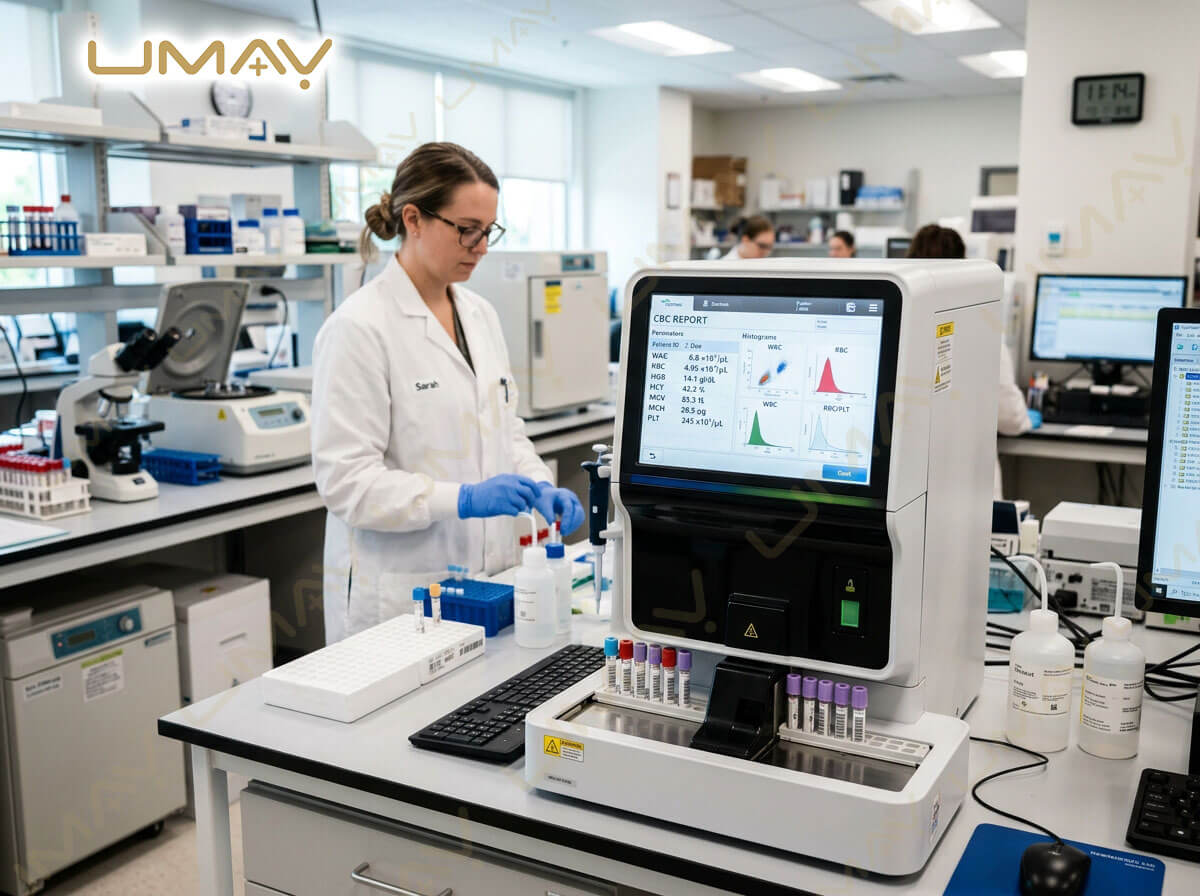
A hematology analyzer is one of the most widely used laboratory instruments for blood cell analysis. Hospitals, clinics, diagnostic laboratories, medical centers, and research facilities use hematology analyzers to perform routine complete blood count (CBC) testing and evaluate important blood cell parameters.
For laboratory professionals and medical equipment buyers, understanding how a hematology analyzer works is important before selecting equipment. Different analyzers offer different levels of automation, testing capacity, differential analysis, sample volume, reagent systems, software functions, and connectivity.
For someone who is simply learning about blood testing, the basic idea is straightforward: a hematology analyzer examines a blood sample and provides numerical information about red blood cells, white blood cells, platelets, hemoglobin, and related parameters.
For laboratories, the decision is more detailed. Buyers may need to compare a 3-part hematology analyzer, a 5-part hematology analyzer, a compact CBC analyzer, or a higher-throughput automated hematology system.
This guide explains the main concepts in simple language and covers the most important questions about hematology analyzers, CBC testing, parameters, applications, specifications, reagents, maintenance, and purchasing.
What Is a Hematology Analyzer?
A hematology analyzer is an automated laboratory instrument designed to analyze blood cells and produce hematological test results.
Depending on the model, a hematology analyzer can measure or calculate a range of parameters related to:
- White blood cells
- Red blood cells
- Hemoglobin
- Hematocrit
- Platelets
- Red blood cell indices
- White blood cell differentials
- Other specialized hematology parameters
The term blood cell analyzer, CBC analyzer, hematology machine, or automated blood analyzer is also commonly used when referring to this type of equipment.
In modern laboratories, automated hematology analyzers help reduce manual counting, standardize routine blood testing, and process a large number of samples more efficiently.
The exact test menu and technology vary by instrument, so buyers should always check the manufacturer’s specifications rather than assuming that all hematology analyzers provide the same parameters.
What Does a Hematology Analyzer Do?
The primary function of a hematology analyzer is to examine the cellular components of a blood sample.
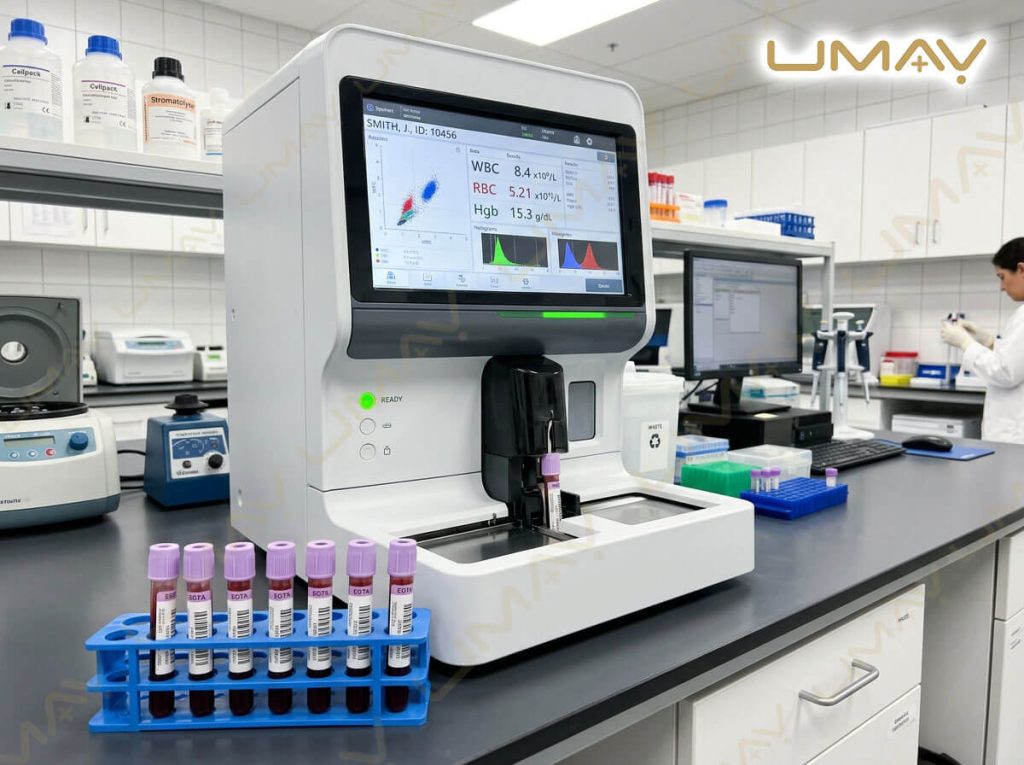
A typical CBC test can provide information about:
- WBC: white blood cell count
- RBC: red blood cell count
- HGB or Hb: hemoglobin concentration
- HCT: hematocrit
- MCV: mean corpuscular volume
- MCH: mean corpuscular hemoglobin
- MCHC: mean corpuscular hemoglobin concentration
- RDW: red cell distribution width
- PLT: platelet count
- MPV: mean platelet volume
Depending on the analyzer type, the system may also provide a differential white blood cell count.
A laboratory may use a hematology analyzer for routine screening, monitoring, preoperative testing, general clinical laboratory work, and many other applications.
What Is a CBC Test?
CBC stands for Complete Blood Count.
A CBC is one of the most common laboratory blood tests. It provides a general overview of the numbers and characteristics of different blood cells.
A CBC analyzer can typically report information about:
Red Blood Cells
Red blood cells transport oxygen through the body. Hematology analyzers commonly provide RBC-related measurements such as RBC count, HGB, HCT, MCV, MCH, MCHC, and RDW.
White Blood Cells
White blood cells are involved in immune system functions. A CBC typically includes the total WBC count. Advanced hematology analyzers may provide a more detailed differential count.
Platelets
Platelets are involved in normal blood clotting. A hematology analyzer can provide platelet-related measurements such as PLT and, depending on the system, MPV and other platelet parameters.
Because CBC testing includes many parameters in one sample, automated CBC analyzers are highly valuable in routine laboratory workflows.
How Does a Hematology Analyzer Work?
Although different instruments use different technologies, the basic process follows a similar sequence.
1. Sample Collection
A blood sample is collected, usually into a tube containing an appropriate anticoagulant for hematological testing.
2. Sample Aspiration
The analyzer takes a defined amount of blood into the system. Some instruments use open-tube sampling, while others support closed-tube or automated sampling workflows.
3. Sample Dilution and Preparation
The blood sample may be mixed with reagents or diluents to prepare the cells for measurement.
4. Cell Detection
The analyzer detects and counts cells using its measurement technology.
Common technologies can include:
- Electrical impedance
- Optical measurement
- Laser-based detection
- Light scatter
- Photometric hemoglobin measurement
- Flow-based cell analysis
The exact combination depends on the analyzer.
5. Data Processing
The analyzer’s software processes the detected signals and calculates the required hematological parameters.
6. Result Display
Results are displayed on the analyzer screen and may also be printed or transferred to a laboratory information system.
The overall purpose is to turn a blood sample into a standardized set of measurable hematology results.
What Is the Coulter Principle?
One of the well-known technologies used in automated cell counting is the electrical impedance principle, often associated with the Coulter principle.
In simple terms, cells pass through a small aperture in a conductive liquid. As a cell passes through the aperture, it changes the electrical resistance of the circuit. These changes can be detected and used to count cells and estimate cell volume.
Electrical impedance is widely associated with automated blood cell counting.
However, not every hematology analyzer uses exactly the same measurement configuration. Some systems combine impedance with optical technologies for additional differentiation and analysis.
What Is Optical or Laser-Based Hematology Analysis?
Some advanced hematology analyzers use optical measurement methods.
A blood cell passes through a detection area where light interacts with the cell. The system can analyze characteristics of the resulting optical signals.
Depending on the analyzer design, optical systems can help distinguish different types of white blood cells and support more advanced differential analysis.
This is one reason why 5-part hematology analyzers typically provide more detailed white blood cell classification than basic 3-part systems.
What Is a 3-Part Hematology Analyzer?
A 3-part hematology analyzer classifies white blood cells into three main groups.
Depending on the analyzer and reporting system, these groups are commonly described as:
- Lymphocytes
- Mid-sized cells
- Granulocytes
A 3-part CBC analyzer is often designed for routine laboratory testing where a basic white blood cell differential is sufficient.
Typical applications include:
- Small clinics
- Primary care laboratories
- Basic diagnostic laboratories
- Smaller hospitals
- Outpatient facilities
Advantages can include:
- Compact size
- Straightforward operation
- Lower initial equipment cost
- Simpler routine workflow
- Lower testing volume requirements
However, suitability depends on the laboratory’s testing needs and local clinical requirements.
What Is a 5-Part Hematology Analyzer?
A 5-part hematology analyzer provides a more detailed white blood cell differential.
A typical 5-part differential separates major white blood cell types such as:
- Neutrophils
- Lymphocytes
- Monocytes
- Eosinophils
- Basophils
This provides more detailed information than a basic 3-part differential analyzer.
5-part systems are commonly considered for:
- Hospital laboratories
- Diagnostic centers
- Medium-volume laboratories
- High-volume laboratories
- Laboratories requiring more detailed differential analysis
Advanced systems may also provide additional flags, histograms, scattergrams, or other parameters.
3-Part vs 5-Part Hematology Analyzer
One of the most common questions from laboratory buyers is:
What is the difference between a 3-part and 5-part hematology analyzer?
The main difference is the level of white blood cell differential analysis.
| Feature | 3-Part Analyzer | 5-Part Analyzer |
|---|---|---|
| WBC count | Yes | Yes |
| RBC count | Yes | Yes |
| HGB | Yes | Yes |
| HCT | Yes | Yes |
| Platelets | Yes | Yes |
| Basic WBC grouping | Yes | Yes |
| Detailed WBC differential | Limited | Yes |
| Neutrophil analysis | Grouped | Detailed |
| Lymphocyte analysis | Grouped | Detailed |
| Monocyte analysis | Grouped | Detailed |
| Eosinophil analysis | Grouped | Detailed |
| Basophil analysis | Grouped | Detailed |
| Typical application | Smaller laboratories | More advanced laboratories |
Neither type is automatically suitable for every laboratory.
A small clinic with a relatively low sample volume may prefer a compact 3-part analyzer, while a hospital or diagnostic laboratory may require a 5-part system for a broader testing workflow.
The correct choice depends on:
- Testing volume
- Required parameters
- Laboratory type
- Available budget
- Reagent system
- Staff experience
- Workflow
- Connectivity requirements
- Service support
For a detailed comparison, see “3-Part vs 5-Part Hematology Analyzer: Differences, Parameters, Technology, Cost, Applications and How to Choose.”
What Sample Does a Hematology Analyzer Use?
Most routine hematology analyzers are designed for blood samples collected using appropriate anticoagulant tubes.
The exact sample requirements vary by manufacturer and model.
Common considerations include:
- Sample volume
- Sample tube type
- Anticoagulant
- Sample stability
- Mixing requirements
- Minimum sample volume
- Open-tube or closed-tube operation
Before purchasing equipment, laboratories should confirm the manufacturer’s sample requirements and operating instructions.
For buyers, low sample volume can be particularly useful in pediatric, outpatient, or resource-limited testing environments.
What Are Hematology Analyzer Reagents?
Hematology analyzers commonly require reagents or consumables for sample preparation and measurement.
Depending on the system, these may include:
- Diluent
- Lyse reagent
- Cleaner
- Rinse solution
- Probe cleaning solution
- Other dedicated consumables
Reagent configuration is an important factor in the total operating cost of a hematology analyzer.
A buyer should not evaluate the purchase price alone.
A more complete evaluation should consider:
Equipment cost + reagent cost + consumable cost + maintenance + service + training + installation + expected testing volume
This provides a better understanding of the laboratory’s long-term operating cost.
What Is Hematology Analyzer Throughput?
Throughput refers to how many samples an analyzer can process within a specified period.
Manufacturers may describe throughput as:
- Samples per hour
- Tests per hour
- CBC tests per hour
For a small clinic, a compact analyzer with moderate throughput may be enough.
For a large hospital laboratory, a high-throughput automated hematology analyzer can help support a larger daily workload.
When comparing analyzer specifications, buyers should consider actual laboratory workload rather than selecting a machine based only on the highest numerical throughput.
Common Applications of Hematology Analyzers
Hematology analyzers are used across many healthcare and laboratory environments.
Hospitals
Hospital laboratories may use hematology analyzers for routine CBC testing and other hematology workflows.
Clinics
Small clinics may use compact hematology analyzers for routine blood testing.
Diagnostic Laboratories
Diagnostic centers may process a wide range of patient samples and therefore may require higher throughput and broader testing capabilities.
Medical Centers
Medical centers can use hematology analyzers as part of integrated laboratory services.
Research Laboratories
Some analyzers are also used for research and laboratory investigations, depending on the product specifications and intended use.
Veterinary Laboratories
Specialized hematology analyzers are also available for veterinary applications.
The right analyzer depends on the intended sample type, workflow, species where applicable, and the manufacturer’s intended use.
How to Choose a Hematology Analyzer
Choosing a hematology analyzer should begin with the laboratory’s actual requirements.
Step 1: Define Testing Volume
Estimate average daily and peak sample volume.
Step 2: Determine Required Parameters
Decide whether basic CBC testing is sufficient or whether a detailed WBC differential is required.
Step 3: Compare 3-Part and 5-Part Systems
Select the differential technology according to workflow and testing needs.
Step 4: Review Reagent Requirements
Check reagent consumption, supply availability, storage requirements, and cost per test.
Step 5: Check Sample Volume
A smaller required sample volume can be useful in certain clinical environments.
Step 6: Evaluate Automation
Consider automated sample processing, user interface, loading method, and workflow.
Step 7: Check LIS Connectivity
For hospitals and larger laboratories, connectivity with laboratory information systems can be an important requirement.
Step 8: Evaluate Service Support
Ask about:
- Installation
- Training
- Warranty
- Preventive maintenance
- Spare parts
- Technical support
Step 9: Calculate Total Cost
Look beyond the equipment quotation and estimate ongoing operating expenses.
Step 10: Verify Intended Use and Local Requirements
The analyzer should match the intended laboratory application and applicable local regulatory requirements.
Hematology Analyzer Maintenance Basics
Regular maintenance helps support stable analyzer operation.
Routine maintenance may include:
- Cleaning sample probes
- Cleaning fluid pathways
- Checking reagent levels
- Running background checks
- Performing quality control
- Following the manufacturer’s cleaning schedule
- Inspecting tubing and consumables
- Reviewing analyzer error messages
Maintenance requirements vary significantly between models.
Operators should always follow the manufacturer’s instructions and service procedures.
For a dedicated guide, see “Hematology Analyzer Applications, Maintenance and Troubleshooting: Reagents, QC, Calibration and Common Problems.”
Hematology Analyzer Quality Control
Quality control (QC) is an important part of laboratory operation.
Laboratories may use hematology control materials to monitor analyzer performance and identify potential changes in measurement stability.
QC procedures can help laboratories monitor:
- Repeatability
- Consistency
- Trend changes
- Instrument performance
- Reagent performance
The exact QC process depends on the laboratory’s quality system, analyzer, control materials, and applicable standards or regulations.
What Should You Look for in a Hematology Analyzer Supplier?
The machine itself is only one part of a successful purchase.
When evaluating a hematology analyzer supplier or medical laboratory equipment manufacturer, consider:
- Product specifications
- Manufacturing capability
- Quality management
- Certifications and documentation
- Technical support
- Installation service
- Operator training
- Spare parts availability
- Reagent supply
- Warranty terms
- After-sales support
- Export experience
- Local distributor support
For international buyers, logistics and technical communication are also important.
A supplier that can provide product documents, operating manuals, installation guidance, training, and technical support can make the purchasing process easier.
Hematology Analyzer FAQ
Is a hematology analyzer the same as a CBC analyzer?
In many routine laboratory contexts, the terms are used similarly. A CBC analyzer performs complete blood count testing, while a hematology analyzer may describe a wider range of automated blood cell analysis systems.
What is a 3-part hematology analyzer?
A 3-part hematology analyzer generally provides a three-group white blood cell differential together with standard CBC parameters.
What is a 5-part hematology analyzer?
A 5-part hematology analyzer provides a more detailed differentiation of major white blood cell types, commonly including neutrophils, lymphocytes, monocytes, eosinophils, and basophils.
How many parameters does a hematology analyzer measure?
The number varies by model. Basic systems may provide a core CBC menu, while advanced analyzers can provide additional differential, platelet, reticulocyte, or research-related parameters.
How much does a hematology analyzer cost?
Pricing varies according to analyzer type, throughput, parameter menu, automation, reagent system, brand, configuration, market, and service package. Buyers should compare total ownership cost rather than looking only at the initial equipment price.
How many samples can a hematology analyzer process?
Throughput depends on the model. Some compact systems are designed for lower-volume laboratories, while automated systems can support much higher workloads.
Which is better, a 3-part or 5-part hematology analyzer?
Neither is universally better. A 3-part system may suit routine lower-volume testing, while a 5-part system may be more appropriate when detailed white blood cell differentiation is required.
Do hematology analyzers need reagents?
Most automated hematology analyzers use dedicated reagents and consumables. The exact reagent configuration depends on the instrument.
Can a hematology analyzer connect to an LIS?
Many modern systems support laboratory information system connectivity, but available interfaces differ by model. Buyers should confirm the specific communication protocol and software capabilities before purchase.
Does a hematology analyzer require regular maintenance?
Yes. Routine cleaning, reagent management, quality control, and preventive maintenance are important parts of laboratory analyzer operation.
Final Thoughts
A hematology analyzer is a key piece of laboratory equipment for automated CBC and blood cell analysis. From a compact 3-part hematology analyzer for a smaller clinic to a higher-throughput 5-part hematology analyzer for a hospital laboratory, different systems are designed for different workflows.
When selecting equipment, buyers should look beyond the machine’s headline specifications. Parameters, throughput, sample volume, reagent consumption, automation, connectivity, maintenance, technical support, and total operating cost should all be considered.
For laboratories planning to purchase a CBC analyzer or automated hematology analyzer, the best starting point is to define the testing workload and required parameters first, then compare equipment options that match those requirements.