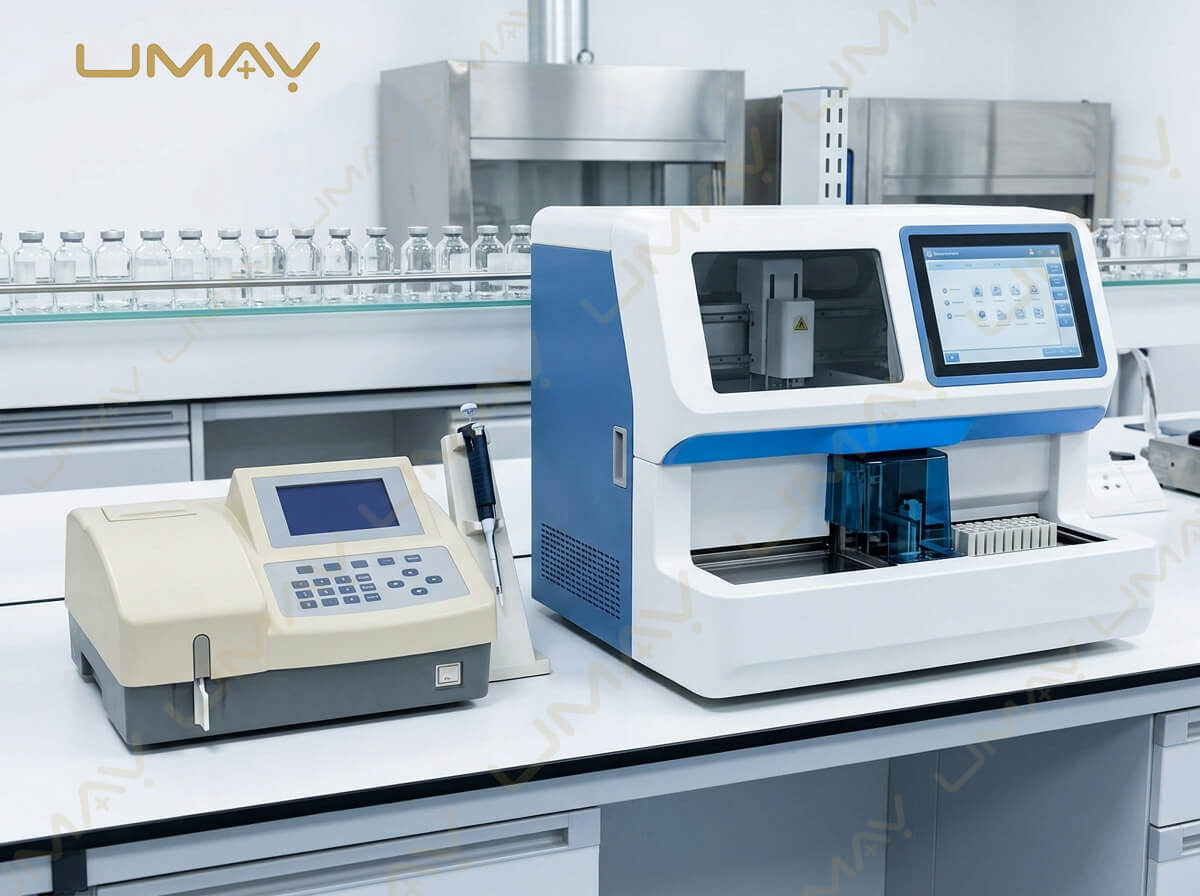
Choosing a biochemical analyzer is an important decision for hospitals, clinics, diagnostic laboratories, medical centers, and laboratory equipment distributors. Different laboratories have different testing volumes, budgets, space limitations, staffing levels, and workflow requirements.
One of the most common purchasing questions is:
Should I choose a semi-automatic or fully automatic biochemistry analyzer?
The answer depends on how the laboratory operates.
A semi-automatic biochemistry analyzer requires the operator to perform some testing steps manually, while a fully automatic biochemistry analyzer can automate more stages of sample processing, reagent dispensing, mixing, incubation, measurement, calculation, and result management.
This article explains the main types of biochemical analyzers, compares semi-automatic and fully automatic systems, and provides a practical guide for laboratories looking for a suitable clinical chemistry analyzer.
What Is a Biochemistry Analyzer?
A biochemistry analyzer, also called a biochemical analyzer, clinical chemistry analyzer, or chemistry analyzer, is laboratory equipment used to measure chemical substances in biological samples.
Common tests include:
- Glucose
- Urea
- Creatinine
- Uric acid
- Cholesterol
- Triglycerides
- HDL cholesterol
- LDL cholesterol
- Total protein
- Albumin
- Bilirubin
- ALT
- AST
- ALP
- Amylase
- Calcium
- Phosphorus
The exact test menu depends on the analyzer model, analytical methods, reagents, and validated applications.
Biochemistry analyzers are used in:
- Hospitals
- Clinical laboratories
- Diagnostic laboratories
- Medical clinics
- Medical centers
- Research laboratories
- Private laboratories
- Laboratory networks
Main Types of Biochemical Analyzers
Biochemical analyzers can be classified in several ways.
The most common categories include:
- Semi-automatic biochemistry analyzer
- Fully automatic biochemistry analyzer
- Benchtop biochemistry analyzer
- Tabletop chemistry analyzer
- Compact biochemical analyzer
- High-throughput chemistry analyzer
- Automatic clinical chemistry analyzer
- Point-of-care chemistry analyzer
These categories can overlap.
For example, a biochemical analyzer can be both fully automatic and benchtop, depending on its design.
What Is a Semi-Automatic Biochemistry Analyzer?
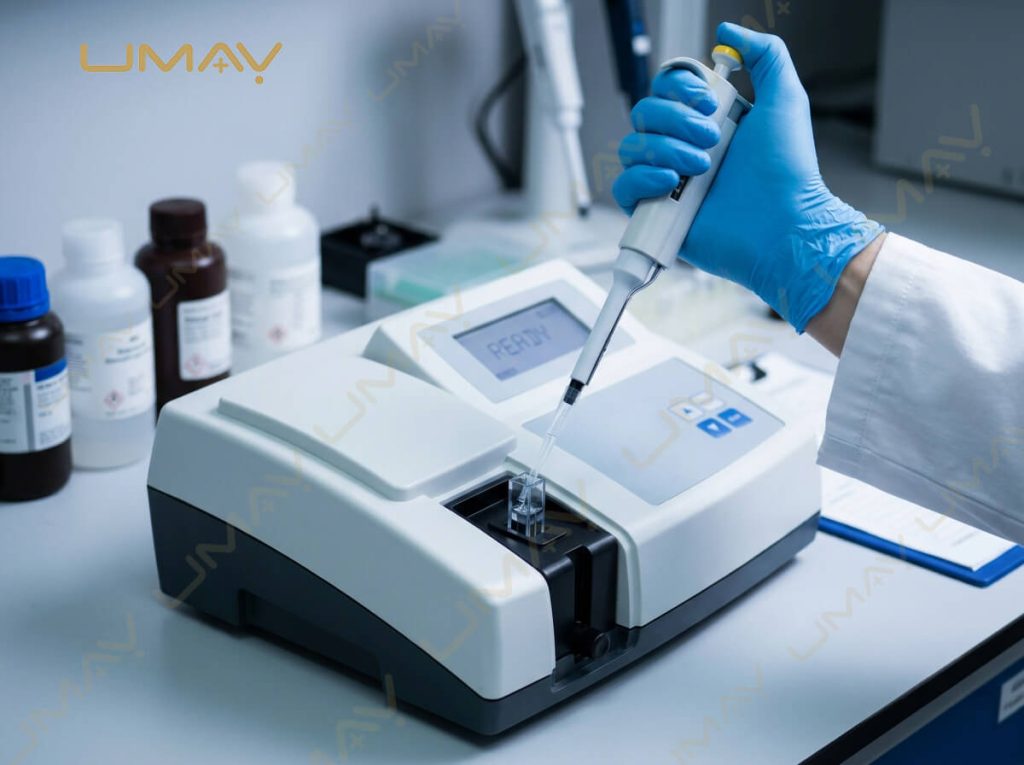
A semi-automatic biochemistry analyzer automates the analytical measurement process but requires the operator to perform some parts of the workflow.
The exact level of manual operation depends on the instrument.
A typical workflow may include:
- Preparing the sample
- Preparing the reagent
- Adding the sample
- Adding the reagent
- Mixing the reaction
- Placing the reaction solution into the analyzer
- Selecting the test
- Starting the measurement
- Reviewing the result
The analyzer then performs the optical measurement and calculates the result according to the selected testing method.
Because some steps remain manual, semi-automatic systems can offer a practical solution for laboratories with lower testing volumes or limited automation requirements.
Advantages of a Semi-Automatic Biochemistry Analyzer
1. Lower Initial Equipment Cost
A semi-automatic chemistry analyzer may have a lower initial purchase cost than a high-end fully automatic system.
However, buyers should evaluate the complete operating cost rather than comparing only the equipment price.
2. Compact Design
Many semi-automatic biochemical analyzers are designed as benchtop or tabletop laboratory analyzers.
This can be useful for laboratories with limited working space.
Common searches include:
- compact biochemistry analyzer
- benchtop biochemical analyzer
- tabletop chemistry analyzer
- small laboratory analyzer
- compact clinical chemistry analyzer
3. Suitable for Lower Testing Volumes
A small clinic or laboratory may not need a high-throughput automated analyzer.
If only a limited number of biochemical tests are performed each day, a semi-automatic system may provide sufficient testing capability.
4. Flexible Testing
Depending on the analyzer and reagent system, operators may be able to select different tests according to daily requirements.
This can be useful for laboratories with changing test volumes.
5. Simple Operation
Semi-automatic systems can have relatively straightforward workflows.
Laboratory staff can manually control important testing steps and monitor the reaction process.
This can be useful in laboratories where operators prefer direct control over sample preparation and testing.
Limitations of Semi-Automatic Biochemistry Analyzers
Semi-automatic systems also have limitations.
More Manual Work
Operators need to perform more steps manually.
Lower Throughput
When sample volumes become high, manual operations can become a bottleneck.
Greater Operator Involvement
The laboratory depends more heavily on consistent operator procedures.
Manual Sample Handling
Sample preparation and transfer may require more attention.
For a small laboratory, these limitations may be acceptable. For a high-volume hospital laboratory, a fully automatic system may be more appropriate.
What Is a Fully Automatic Biochemistry Analyzer?
A fully automatic biochemistry analyzer is designed to automate a larger portion of the laboratory testing workflow.
Depending on the system, automated functions may include:
- Sample identification
- Sample pipetting
- Reagent dispensing
- Mixing
- Incubation
- Optical measurement
- Reaction monitoring
- Cuvette washing
- Calibration
- Quality control
- Result calculation
- Result storage
- Data transmission
Some systems can also support:
- Barcode identification
- STAT testing
- Automatic dilution
- Automatic rerun
- LIS connectivity
- Continuous reagent loading
The exact features vary by analyzer.
Advantages of a Fully Automatic Biochemistry Analyzer
1. Higher Automation
The main advantage is the ability to automate repetitive laboratory procedures.
This can reduce the amount of manual handling required for routine testing.
2. Higher Throughput
Fully automatic clinical chemistry analyzers are often designed for laboratories processing larger numbers of samples.
Throughput may be described as:
- Tests per hour
- Samples per hour
- Tests per day
When comparing analyzers, buyers should understand exactly how the manufacturer defines throughput.
3. Improved Workflow Efficiency
Automation can help laboratories organize sample and reagent handling more efficiently.
A typical automated workflow may involve:
Sample loading → Identification → Sampling → Reagent dispensing → Reaction → Measurement → Calculation → Result
This can reduce repetitive manual operations.
4. Reduced Manual Pipetting
Automated pipetting can reduce the number of repetitive sample transfer steps performed by laboratory staff.
This can be particularly useful when sample volumes are high.
5. Data Connectivity
Many modern clinical chemistry analyzers support connection with laboratory information systems.
Relevant technologies and terms include:
- LIS integration
- Laboratory Information System
- Barcode system
- Result management
- Data transmission
- Laboratory automation
Connectivity can be important for laboratories that want to integrate multiple instruments into a larger workflow.
Limitations of Fully Automatic Biochemistry Analyzers
Automation also introduces additional considerations.
Higher Initial Investment
Fully automatic analyzers can require a larger initial investment than basic semi-automatic systems.
More Complex System
More automated functions can mean more components and more sophisticated software.
Maintenance Requirements
Automated systems require routine maintenance, cleaning, calibration, and technical support.
Laboratory Space
Some high-throughput analyzers require more installation space than compact benchtop systems.
Reagent Requirements
The analyzer may require specific reagent configurations and storage conditions.
For these reasons, the laboratory should select automation based on actual requirements rather than simply choosing the most automated instrument available.
Semi-Automatic vs Fully Automatic Biochemistry Analyzer
The following comparison provides a simple overview.
| Feature | Semi-Automatic Analyzer | Fully Automatic Analyzer |
|---|---|---|
| Automation | Partial | High |
| Sample handling | More manual | More automated |
| Reagent handling | Operator-assisted | Automated |
| Throughput | Generally lower | Generally higher |
| Manual workload | Higher | Lower |
| Initial investment | Often lower | Often higher |
| Laboratory space | Usually compact | Varies |
| Operation | Operator-assisted | Automated workflow |
| Suitable workload | Low to medium | Medium to high |
| LIS integration | Depends on model | Common on many systems |
| Maintenance | Generally straightforward | Requires systematic maintenance |
| Workflow | Flexible | Standardized and automated |
This table is a general comparison. Actual analyzer performance depends on the manufacturer’s specifications and configuration.
Semi-Automatic vs Fully Automatic: Which Is Better?
There is no universal answer.
Instead of asking:
Which analyzer is better?
A better question is:
Which analyzer is more suitable for my laboratory?
A semi-automatic analyzer may be suitable when:
- Daily sample volume is low
- Laboratory space is limited
- Budget is limited
- Staff can perform manual operations
- A smaller test menu is required
- The laboratory wants a compact system
A fully automatic analyzer may be suitable when:
- Daily sample volume is high
- Consistent workflow is important
- Manual handling should be reduced
- Multiple tests are performed routinely
- Higher throughput is required
- LIS integration is needed
- The laboratory needs greater automation
Biochemical Analyzer for Small Laboratories
Small laboratories usually have different requirements from large hospitals.
A small laboratory may prioritize:
- Compact design
- Easy operation
- Lower sample volume
- Lower initial investment
- Flexible test selection
- Simple maintenance
- Reliable reagent supply
A small biochemical analyzer or semi-automatic chemistry analyzer can therefore be considered.
Common search terms include:
- biochemical analyzer for small laboratory
- small laboratory chemistry analyzer
- compact biochemical analyzer
- benchtop chemistry analyzer
- tabletop biochemical analyzer
- semi automatic analyzer for small laboratory
- clinical chemistry analyzer for small laboratory
The final selection should be based on the laboratory’s actual workload and testing menu.
Biochemical Analyzer for Hospitals
Hospitals may have higher and more complex laboratory workloads.
A hospital laboratory may need:
- Higher throughput
- Automated sample handling
- Multiple reagent positions
- Large test menus
- STAT testing
- Barcode identification
- Quality control functions
- LIS connectivity
- Automatic calibration
- Automatic dilution
- Rerun capability
For high-volume clinical laboratories, a fully automatic clinical chemistry analyzer can provide a more automated workflow.
However, hospitals may also use different analyzer configurations for different departments or testing volumes.
Biochemical Analyzer for Diagnostic Laboratories
Diagnostic laboratories often process a large number of samples and may therefore pay close attention to:
- Tests per hour
- Sample capacity
- Reagent capacity
- Test menu
- Automation
- Workflow
- Cost per test
- Maintenance
- Data connectivity
Relevant searches include:
- biochemical analyzer for diagnostic laboratory
- diagnostic chemistry analyzer
- clinical chemistry analyzer for diagnostic lab
- automatic chemistry analyzer for laboratory
- high throughput biochemical analyzer
- laboratory chemistry analyzer
For diagnostic laboratories, throughput should be evaluated together with the laboratory’s actual test mix.
Benchtop Biochemical Analyzer
A benchtop biochemical analyzer is a compact analyzer designed for installation on a laboratory workbench.
Benchtop systems can be useful where laboratory space is limited.
Potential applications include:
- Clinics
- Small laboratories
- Medical centers
- Private diagnostic laboratories
- Satellite laboratories
Important specifications to check include:
- Instrument dimensions
- Sample volume
- Test menu
- Throughput
- Reagent capacity
- Reaction positions
- Optical system
- Display
- Data storage
- Connectivity
- Power requirements
A compact analyzer should not be evaluated only by its physical size. Its analytical performance and workflow should also match the laboratory’s requirements.
High-Throughput Biochemistry Analyzer
A high-throughput biochemistry analyzer is designed for laboratories that need to process many tests within a limited period.
Common purchasing terms include:
- high throughput chemistry analyzer
- high throughput biochemical analyzer
- automatic chemistry analyzer
- clinical chemistry analyzer high throughput
- laboratory analyzer high throughput
- chemistry analyzer tests per hour
However, “high throughput” does not automatically mean that the analyzer is suitable for every laboratory.
A laboratory should estimate:
Daily samples × Average tests per sample = Approximate daily testing workload
For example, if a laboratory processes 200 samples per day and performs an average of 5 biochemical tests per sample, the approximate workload is 1,000 tests per day.
The laboratory can then compare this workload with the analyzer’s actual throughput and operating workflow.
Random Access vs Batch Biochemistry Analyzers
Another important distinction is the analyzer’s testing workflow.
Random Access Chemistry Analyzer
A random access analyzer allows different tests to be performed on different samples according to the laboratory’s test requests.
For example:
- Sample A → Glucose
- Sample B → Creatinine
- Sample C → ALT
- Sample D → Cholesterol
This provides flexibility for routine clinical chemistry testing.
Relevant keywords include:
- random access chemistry analyzer
- random access biochemical analyzer
- random access clinical chemistry analyzer
Batch Testing
Batch testing processes a group of tests or samples according to a defined workflow.
The appropriate approach depends on laboratory requirements.
Open Reagent vs Closed Reagent System
The reagent system is another important consideration when buying a biochemical analyzer.
Open Reagent System
An open reagent system may allow laboratories greater flexibility in selecting compatible reagents, depending on the analyzer’s specifications and validation requirements.
Potential advantages include:
- Reagent flexibility
- More supplier choices
- Potential purchasing flexibility
However, compatibility and assay validation should always be confirmed.
Closed Reagent System
A closed reagent system is designed around specific reagent configurations.
Potential benefits may include:
- Standardized reagent workflow
- Defined system configuration
- Simplified setup
Before purchasing, buyers should ask the supplier:
- What reagents are required?
- Is the system open or closed?
- Which reagent brands are supported?
- How are reagents stored?
- What is the reagent stability?
- What is the average reagent consumption per test?
What Tests Can Semi-Automatic and Fully Automatic Analyzers Perform?
Both analyzer types can support many common biochemical tests.
The exact test menu depends on the model and reagent applications.
Common tests include:
Glucose
- Glucose
- Blood glucose testing
Kidney-Related Tests
- Urea
- Creatinine
- Uric acid
Liver-Related Tests
- ALT
- AST
- ALP
- Total bilirubin
- Direct bilirubin
- Albumin
- Total protein
Lipid Tests
- Total cholesterol
- Triglycerides
- HDL cholesterol
- LDL cholesterol
Other Tests
- Calcium
- Phosphorus
- Amylase
- Other biochemical parameters
The test menu should be confirmed before purchasing rather than assumed from the product category.
Important Specifications to Compare
When comparing two biochemical analyzers, buyers should create a specification checklist.
1. Throughput
Check:
- Tests per hour
- Samples per hour
- Continuous or batch operation
2. Sample Volume
Check:
- Minimum sample volume
- Sample cup requirements
- Sample tube compatibility
3. Reagent Capacity
Check:
- Number of reagent positions
- Reagent volume
- Refrigerated reagent storage
- Reagent loading method
4. Reaction System
Check:
- Reaction positions
- Reaction volume
- Incubation temperature
- Reaction time
5. Optical System
Check:
- Wavelengths
- Light source
- Photometric range
- Optical measurement method
6. Calibration
Check:
- Calibration methods
- Calibration frequency
- Automatic or manual calibration
- Calibration storage
7. Quality Control
Check:
- QC software
- Control levels
- Levey-Jennings charts, where applicable
- QC data storage
8. Connectivity
Check:
- USB
- Ethernet
- LIS
- Barcode reader
- Printer
- Laboratory network compatibility
What Is STAT Testing?
STAT refers to urgent testing.
Hospitals and emergency departments may need certain laboratory tests processed quickly.
A biochemical analyzer with STAT functionality may allow urgent samples to be prioritized within the normal workflow.
When evaluating STAT capability, buyers should ask:
- Can urgent samples be inserted during routine operation?
- Is a dedicated STAT position available?
- How quickly can STAT samples be processed?
- Does STAT testing interrupt routine testing?
- How are urgent results displayed?
STAT functionality can be particularly important for hospital laboratories.
Biochemical Analyzer Calibration
Calibration is an important part of biochemical analyzer operation.
Calibration establishes the relationship between the analyzer’s measurement signal and the expected analytical result for a specific test system.
Calibration requirements depend on:
- Analyzer design
- Reagent system
- Analytical method
- Calibrator
- Manufacturer recommendations
When comparing analyzers, buyers should understand:
- Calibration frequency
- Calibration procedure
- Calibrator requirements
- Calibration storage
- Automatic calibration functions
Correct calibration is essential for reliable laboratory testing.
Quality Control for Biochemistry Analyzers
Laboratories use quality control (QC) procedures to monitor analytical performance.
Common QC-related terms include:
- biochemical analyzer quality control
- chemistry analyzer QC
- laboratory quality control
- clinical chemistry QC
- analyzer QC software
A laboratory may monitor control materials at different levels and review results over time.
When purchasing an analyzer, buyers should ask what QC functions are included and how QC results can be stored or exported.
Maintenance of Semi-Automatic and Fully Automatic Analyzers
Maintenance requirements vary between models.
Common maintenance activities can include:
- Cleaning
- Probe cleaning
- Cuvette cleaning
- Waste management
- Optical system inspection
- Reagent system maintenance
- Calibration checks
- Replacement of consumables
Semi-automatic analyzers may have fewer automated components, but operators still need to follow the manufacturer’s maintenance procedures.
Fully automatic systems may require more structured preventive maintenance because they contain more automated components.
Before purchasing, ask the supplier for:
- Daily maintenance requirements
- Weekly maintenance requirements
- Monthly maintenance requirements
- Consumable replacement schedule
- Troubleshooting instructions
- Service support
- Spare parts availability
Biochemical Analyzer Cost
The cost of a biochemical analyzer can vary widely.
Factors affecting the overall cost include:
- Automation level
- Throughput
- Test menu
- Sample capacity
- Reagent system
- Optical system
- Software
- LIS connectivity
- Installation
- Training
- Warranty
- Service
- Spare parts
Buyers should consider total cost of ownership, not only the initial equipment price.
For example:
Total operating cost = Equipment + Reagents + Consumables + Maintenance + Service + Other operating expenses
The cost per test can also be useful when comparing different analyzer configurations.
How to Choose the Right Biochemical Analyzer
A simple purchasing process can help laboratories avoid unnecessary equipment costs.
Step 1: Calculate Daily Workload
Estimate:
- Samples per day
- Tests per sample
- Peak workload
- Emergency testing requirements
Step 2: List Required Tests
Create a test menu before contacting suppliers.
Step 3: Decide the Automation Level
Ask whether your laboratory needs:
- Manual operation
- Semi-automatic testing
- Fully automatic testing
Step 4: Check Available Space
Measure:
- Laboratory bench space
- Instrument footprint
- Reagent storage space
- Waste area
- Operator access area
Step 5: Compare Reagent Systems
Review reagent compatibility and long-term supply.
Step 6: Evaluate Connectivity
Determine whether LIS or barcode integration is required.
Step 7: Review Service Support
Check:
- Installation
- Training
- Warranty
- Technical support
- Spare parts
- Preventive maintenance
Step 8: Compare Total Cost
Consider both purchase cost and ongoing operating expenses.
Biochemical Analyzer Buying Checklist
Before placing an order, buyers can use the following checklist:
-
Required biochemical tests
-
Expected daily sample volume
-
Average tests per sample
-
Required throughput
-
Sample volume
-
Sample positions
-
Reagent positions
-
Reagent compatibility
-
Automation level
-
Optical wavelengths
-
Reaction system
-
Calibration system
-
Quality control functions
-
STAT capability
-
Barcode support
-
LIS connectivity
-
Laboratory space
-
Power requirements
-
Maintenance requirements
-
Warranty
-
Technical support
-
Spare parts
-
Training
-
Reagent supply
-
Total cost of ownership
This checklist can also be used when requesting a biochemical analyzer quotation from multiple suppliers.
Questions to Ask a Biochemical Analyzer Manufacturer
For hospitals, laboratories, and distributors, technical questions can help make supplier comparisons easier.
Product Questions
- What is the analyzer’s throughput?
- How many samples can it process?
- How many reagent positions are available?
- What is the minimum sample volume?
- What tests are supported?
- What analytical methods are used?
Reagent Questions
- Is the reagent system open or closed?
- Which reagents are compatible?
- How much reagent is consumed per test?
- How are reagents stored?
- What is the reagent shelf life?
Service Questions
- Is installation included?
- Is operator training available?
- What warranty is provided?
- Is remote technical support available?
- Are spare parts available?
- What is the recommended preventive maintenance schedule?
Connectivity Questions
- Does the analyzer support LIS?
- Does it support barcode identification?
- Can results be exported?
- What communication interfaces are available?
Who Should Buy a Semi-Automatic Biochemistry Analyzer?
A semi-automatic analyzer may be considered by:
- Small clinics
- Small laboratories
- Medical centers
- Low-volume diagnostic laboratories
- Rural laboratories
- Teaching laboratories
- Laboratories with limited automation needs
It can be particularly practical when the laboratory needs biochemical testing but does not have enough workload to justify a large automated system.
Who Should Buy a Fully Automatic Biochemistry Analyzer?
A fully automatic system may be considered by:
- Large hospitals
- Central laboratories
- High-volume diagnostic laboratories
- Medical laboratory networks
- Large private laboratories
- Facilities requiring greater workflow automation
For these users, automation and throughput can help manage larger workloads.
Frequently Asked Questions
What is the difference between a semi-automatic and fully automatic biochemistry analyzer?
A semi-automatic analyzer requires more operator involvement, while a fully automatic analyzer automates more steps such as sample handling, reagent dispensing, mixing, incubation, measurement, and result processing.
Is a fully automatic biochemical analyzer better?
Not necessarily. A fully automatic analyzer may be more suitable for high-volume laboratories, while a semi-automatic analyzer may be practical for smaller laboratories.
Which biochemical analyzer is suitable for a small laboratory?
A compact or semi-automatic biochemical analyzer may be suitable when sample volume, laboratory space, and testing requirements are relatively limited.
Which analyzer is suitable for a hospital?
The choice depends on the hospital’s workload, test menu, automation requirements, laboratory space, budget, and connectivity requirements. High-volume laboratories may consider fully automatic systems.
What is a benchtop chemistry analyzer?
A benchtop chemistry analyzer is a compact clinical chemistry system designed to fit on a laboratory workbench.
What does analyzer throughput mean?
Throughput refers to the amount of testing an analyzer can process within a specific period, often expressed as tests per hour or samples per hour.
What is a random access biochemical analyzer?
A random access analyzer can process different tests for different samples according to individual test requests rather than requiring every sample to follow exactly the same test sequence.
How much does a biochemical analyzer cost?
The price varies according to automation, throughput, configuration, test menu, reagent system, connectivity, and supplier. Operating costs should also be included in the purchasing evaluation.