The Capital Investment Perspective
Lighting accounts for a fraction of an operating room’s overall construction budget, yet it dictates 100% of the room’s clinical efficiency. If a multimillion-dollar imaging system goes offline, a surgery might be delayed. If the surgical lights fail or drift out of position mid-procedure, the surgery halts completely, directly jeopardizing patient safety.
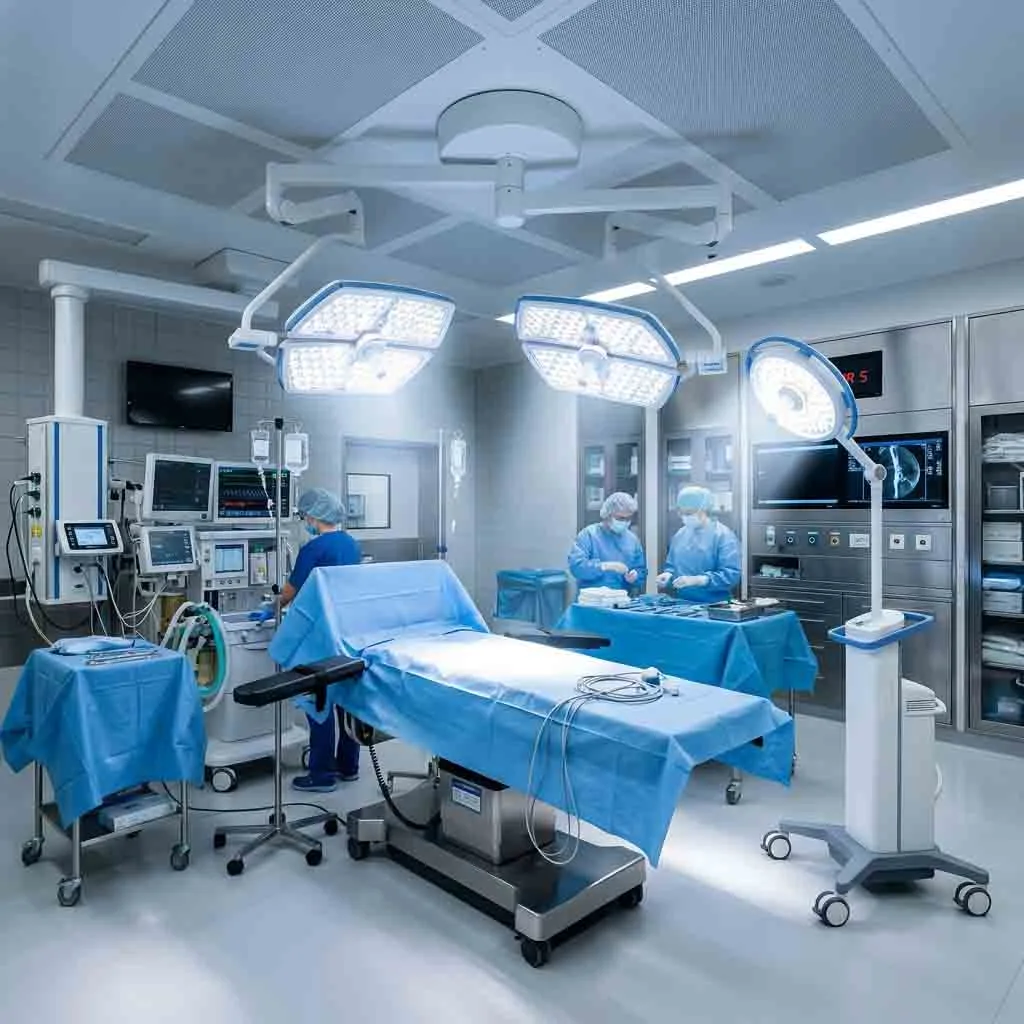
For hospital Chief Financial Officers (CFOs), facility planners, and medical equipment distributors, procuring surgical lights is not just about buying lamps; it is about investing in long-term architectural infrastructure. Once an overhead suspension arm is bolted to structural steel beams in the ceiling, replacing it requires tearing open the sterile envelope of the operating room, resulting in costly facility downtime.
Therefore, procurement teams must evaluate surgical lighting platforms based on architectural compatibility, payload scalability, and the true financial footprint over a 15-year lifecycle.
1. Architectural Configurations: Selecting the Right Mount
The layout of the clinical space dictates the physical configuration of the surgical light. Procurement officers must match the mounting style to the specific surgical discipline and the physical constraints of the room.
Ceiling Mounted Surgical Light Systems
The undisputed standard for major hospital operating theaters. The suspension arms are anchored directly to a reinforced mounting plate above the sterile ceiling grid.
-
Single Dome: Used in minor procedure rooms, labor and delivery suites, and dermatology clinics. Provides focused light but lacks the multi-angle shadow dilution required for deep cavity surgeries.
-
Dual Dome Surgical Light: The gold standard for general surgery, orthopedics, and neurosurgery. A dual-head configuration features one large main dome (typically 160,000 Lux) and a slightly smaller satellite dome (130,000 to 160,000 Lux). By angling two overlapping light beams into the surgical cavity from opposite sides, surgeons achieve maximum shadow dilution.
-
Triple Dome & Monitor Suspensions: For advanced hybrid operating rooms and teaching hospitals, a third central axis can support large 4K surgical display monitors or radiation shields, keeping all equipment off the floor.
Mobile Surgical Floor Light
A mobile unit features a heavy, anti-tip caster base supporting an articulated counterbalanced arm and a single surgical dome.
-
Primary Use Case: Ambulatory surgery centers (ASCs), veterinary clinics, and outpatient plastic surgery centers where ceiling installations are not structurally feasible.
-
Disaster Backup: Many major hospitals procure mobile units specifically as emergency backups. If a dedicated OR ceiling light fails or a natural disaster disrupts infrastructure, a mobile surgical floor light powered by an internal backup battery ensures procedures can finish safely.
Wall Mounted Operating Light
Wall-mounted units attach to a heavy-duty wall bracket, featuring a long, folding extension arm.
-
Primary Use Case: Emergency department trauma bays, Intensive Care Units (ICUs), and dental surgery suites. These rooms have crowded ceilings (due to ceiling-mounted supply booms and patient lifts) or limited floor space. A wall mounted operating light provides surgical-grade illumination that can be instantly pushed flat against the wall when not in use.
2. Calculating Surgical Light Total Cost of Ownership (TCO)
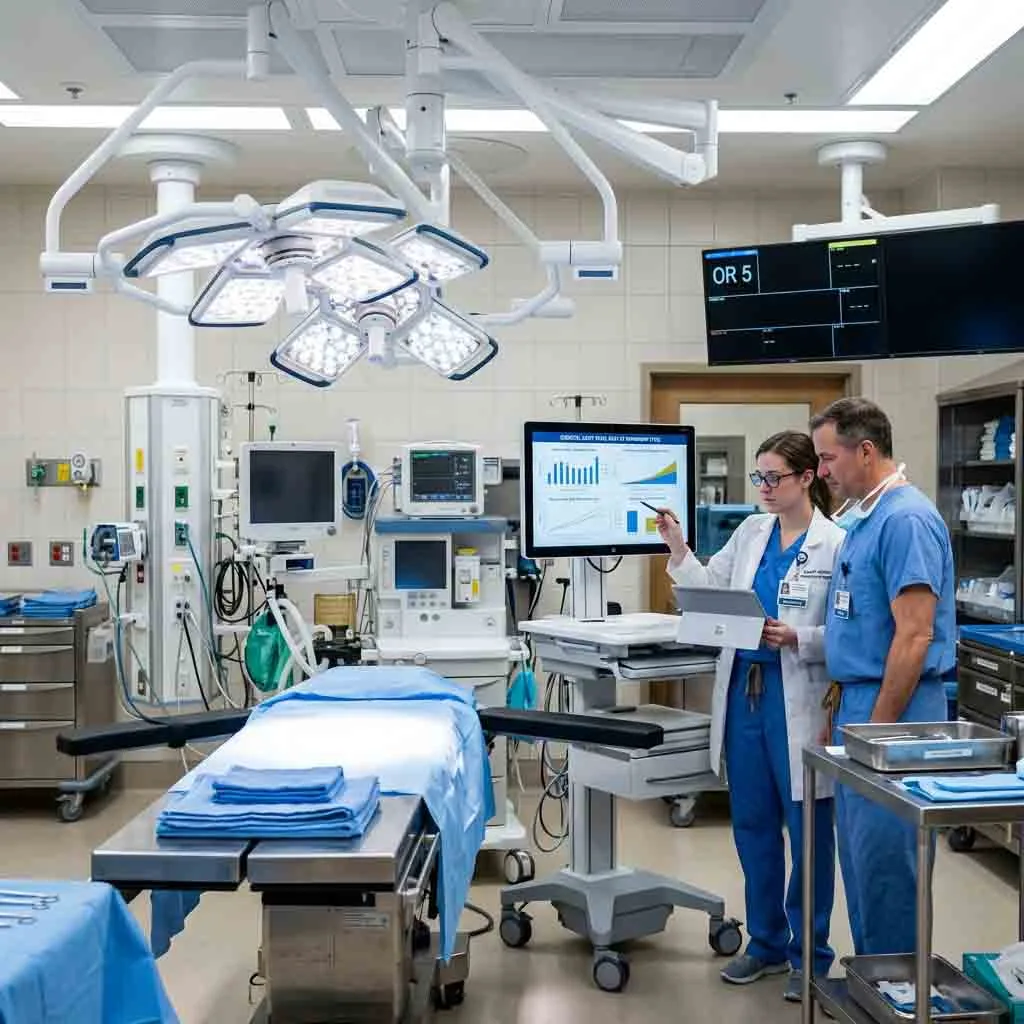
The most common mistake made during B2B medical tenders is focusing exclusively on the initial purchase price (CAPEX). A surgical light operates for thousands of hours a year; its true financial footprint is its surgical light Total Cost of Ownership (TCO) over a 10 to 15-year period.
Plaintext
                     10-YEAR TCO BREAKDOWN
+-------------------------------------------------------------------------+
| CAPEX (Initial Investment)    | OPEX (Operating Expenses)               |
+-------------------------------+-----------------------------------------+
| - Light Domes & Suspensions   | - Replacement bulbs (if not LED)        |
| - Ceiling Mounting Plates     | - Electricity consumption               |
| - Wall Control Panels         | - Annual mechanical balancing service   |
| - Installation / Rigging      | - Sterile handle replacements           |
+-------------------------------------------------------------------------+
Eliminating the Maintenance Drain
Historically, hospitals spent tens of thousands of dollars annually replacing burned-out halogen bulbs across their OR fleet.
By mandating an LED lifespan of 50,000 hours, procurement teams effectively drive lighting maintenance costs to zero. In an OR running 10 hours a day, 5 days a week, a 50,000-hour LED will last approximately 19 years before the diodes degrade. The light fixture will outlast the mechanical joints of the suspension arm.
Energy Efficiency and HVAC Load Reduction
Legacy halogen domes consumed massive amounts of electricity (often 300 to 400 watts per dome) and converted 80% of that energy into heat. This forced the hospital’s HVAC system to run continuously to cool the operating room.
Modern LED domes consume a fraction of the power (typically 50 to 80 watts per dome) and emit zero infrared heat. For a hospital with 20 operating rooms, upgrading to LED surgical lights yields massive annual savings in both direct electricity usage and HVAC cooling requirements.
3. The B2B Procurement Tender Checklist
When drafting an RFP (Request for Proposal) for surgical lighting, hospital supply chain directors should standardize vendor submissions using this technical checklist:
| Specification Requirement | Target Metric for Premium OR Lighting |
| Maximum Central Illuminance | 160,000 Lux (per main dome) |
| Dimming Range | Adjustable from 10% to 100% without flickering |
| Color Rendering Index (CRI) | > 95 (Crucial for identifying red vascular tissue) |
| R9 Value (Deep Red Rendering) | > 95 (To detect tissue hypoxia) |
| Color Temperature Range | Adjustable from 3800K (Warm) to 5500K (Daylight) |
| LED Rated Lifespan | Minimum 50,000 hours |
| Shadow Dilution Standard | Must pass strict cavity shadow dilution tests with masks |
| Endo-Light Mode | Dedicated green/blue ambient mode for endoscopic screen viewing |
| Laminar Airflow Compliance | Open-center or aerodynamic design to maintain sterile airflow |
4. Future-Proofing: Suspension Payloads and Camera Integration
A surgical light is only as good as the mechanical arm holding it. Inside the sleek white casing of the suspension arm is a complex system of heavy-duty springs or gas struts designed to perfectly counterbalance the weight of the light dome.
The Payload Trap
A frequent procurement error is buying a suspension system maxed out at its current weight capacity. Five years later, the hospital’s surgical teaching program may decide to add heavy 4K digital cameras and wireless transmitters to the center of the surgical domes. If the suspension arms were not engineered with a high-capacity payload reserve, adding the cameras will cause the arms to drift downward, requiring a complete replacement of the ceiling suspension.
-
Best Practice: Always specify suspension arms with adjustable load capacities that can accommodate an additional 3 to 5 kilograms of future technology upgrades.
In-Light Surgical Cameras
Modern procurement tenders for teaching hospitals should require “camera-ready” light domes. Even if the hospital does not purchase the camera immediately, the light dome should have a pre-wired central hub. This allows a biomedical engineer to snap a high-definition, auto-focusing camera directly into the center of the light dome at a later date, providing an unobstructed, bird’s-eye view of the surgical cavity for medical residents watching from a remote lecture hall.
Summary
Sourcing surgical lighting is a major infrastructural decision that bridges clinical performance with facility economics.
By carefully matching the configuration—whether a dual dome surgical light for a major OR, a wall mounted operating light for trauma, or a mobile surgical floor light for backups—facilities can optimize their clinical spaces. Furthermore, by rigorously calculating the surgical light Total Cost of Ownership (TCO) and demanding an LED lifespan of 50,000 hours, hospital CFOs ensure their capital budgets are protected from hidden maintenance traps and excessive energy consumption for decades to come.
But even the most advanced overhead lighting system has physical limitations. To achieve absolute visual perfection in the OR, overhead domes must be paired with wearable optics.