Executive Overview: Navigating Modern Ultrasound Form Factors
Choosing between a cart-based console ultrasound machine, a portable laptop ultrasound scanner, and a handheld wireless probe is one of the foundational decisions in medical equipment acquisition. While all three form factors rely on high-frequency acoustic waves to generate diagnostic images, they differ substantially in signal processing horsepower, physical footprint, probe connectivity, workflow speed, and overall capital outlay.
Historically, cart-based systems held a complete monopoly on premium diagnostic image quality. However, breakthroughs in micro-beamforming microchips, battery efficiency, and high-density transducer design have closed the performance gap significantly. Today, healthcare facilities can select a form factor specifically tailored to their clinical application—whether that means high-throughput hospital radiology, fast point-of-care emergency triage, or mobile outpatient diagnostics.
1. Cart-Based (Console / Trolley) Ultrasound Systems
Cart-based ultrasound systems remain the gold standard for comprehensive diagnostic imaging, high-end cardiology, and complex obstetric evaluations. Built into heavy-duty wheeled chassis, these machines house large power supplies, advanced multi-channel beamformers, and dedicated GPU processing boards.
Core Advantages & Performance Strengths
-
Uncompromising Diagnostic Image Resolution: High hardware channel counts (128 to 256+ channels) allow cart systems to deliver exceptional spatial, contrast, and temporal resolution at greater penetration depths.
-
Multi-Probe Connectivity: Cart systems feature 3 to 5 active transducer probe ports simultaneously, allowing clinicians to switch instantly between convex, linear, transvaginal, and phased array probes without disconnecting cables.
-
Superior Ergonomics & Display Real Estate: Equipped with large 19-inch to 24-inch high-definition or OLED displays mounted on flexible articulating arms, along with dedicated touchscreens and motorized height adjustments.
-
Advanced Clinical Software Suites: Unrestricted processing capacity supports complex real-time 3D/4D volume rendering, elastography, automated cardiac strain analysis, and contrast-enhanced ultrasound (CEUS).
Limitations & Trade-Offs
-
Zero True Portability: Weighing between 50 kg and 110 kg, these units are restricted to stationary exam rooms or limited trolley movement within a single floor.
-
Higher Capital Outlay: Unit prices range from $16,000 for mid-tier cart units to over $80,000 for premium tertiary-care consoles.
2. Portable (Laptop / Clamshell) Ultrasound Machines
Portable laptop-style ultrasound scanners strike the ultimate balance between high-level diagnostic performance and mobility. Designed in a compact clamshell housing similar to a heavy-duty laptop, these systems provide near-console-level imaging in a unit that can be easily hand-carried or mounted on a slim mobile docking cart.
Core Advantages & Performance Strengths
-
Versatile Point-of-Care Mobility: Weighing between 4.5 kg and 8 kg, portable laptop units are effortlessly transported between examination rooms, emergency bays, intensive care units, or satellite clinic locations.
-
Rapid Boot Times & Battery Standby: Modern laptop ultrasound machines boot up in under 30 seconds and feature built-in lithium batteries supporting 2 to 4 hours of active scanning.
-
High Signal-to-Noise Ratio & Color Doppler Sensitivity: Mid-to-high-end portable color doppler ultrasound scanners feature digital beamformers capable of clear vascular flow detection, MSK nerve tracking, and basic echocardiography.
-
Flexible Docking Configurations: When attached to an optional height-adjustable trolley cart with probe extenders, a laptop unit functions as a space-saving cart system; when unclipped, it becomes a mobile diagnostic station.
Limitations & Trade-Offs
-
Limited Simultaneous Probe Ports: Main units typically feature 1 or 2 active probe connectors directly on the chassis (requiring a docking cart for 3 active ports).
-
Compact Display Size: Screen sizes are capped at 15 to 17 inches, which may be less ideal for group teaching environments or complex fetal anatomy reviews.
3. Handheld & Wireless Ultrasound Probe Scanners
Handheld ultrasound devices—often termed “pocket ultrasound” or “wireless transducer scanners”—represent the newest evolution in bedside imaging. These systems integrate the entire beamforming hardware into the transducer handle itself, transmitting image data via high-speed Wi-Fi or Direct USB-C to a smartphone or tablet.
Core Advantages & Performance Strengths
-
Ultimate Mobility & Pocket Portability: Weighing under 300 grams, a handheld probe fits directly into a lab coat pocket, eliminating the need for equipment carts or dedicated transport.
-
Ultra-Fast Bedside Triage: Allows physicians to perform instant bedside examinations (“visual stethoscopes”) for rapid fluid checks, cardiac motion checks, and vascular access guidance.
-
Accessible Price Point: Ranging from $1,500 to $4,500, handheld scanners drastically lower the entry barrier for small clinics, emergency responders, and individual practitioners.
-
Cloud Architecture Integration: Images and video loops are recorded directly onto smart tablet apps and can be instantly uploaded to HIPAA-compliant cloud storage for remote tele-ultrasound consultation.
Limitations & Trade-Offs
-
Thermal & Processing Constraints: Compact probe housings generate heat quickly under heavy continuous use, limiting continuous scanning sessions to approximately 20–30 minutes before thermal throttling occurs.
-
Fixed Transducer Architecture: Many handheld units feature fixed dual-head or single-head arrays, meaning you cannot swap out custom specialty probes (such as 4D volume probes or TEE cardiac transducers).
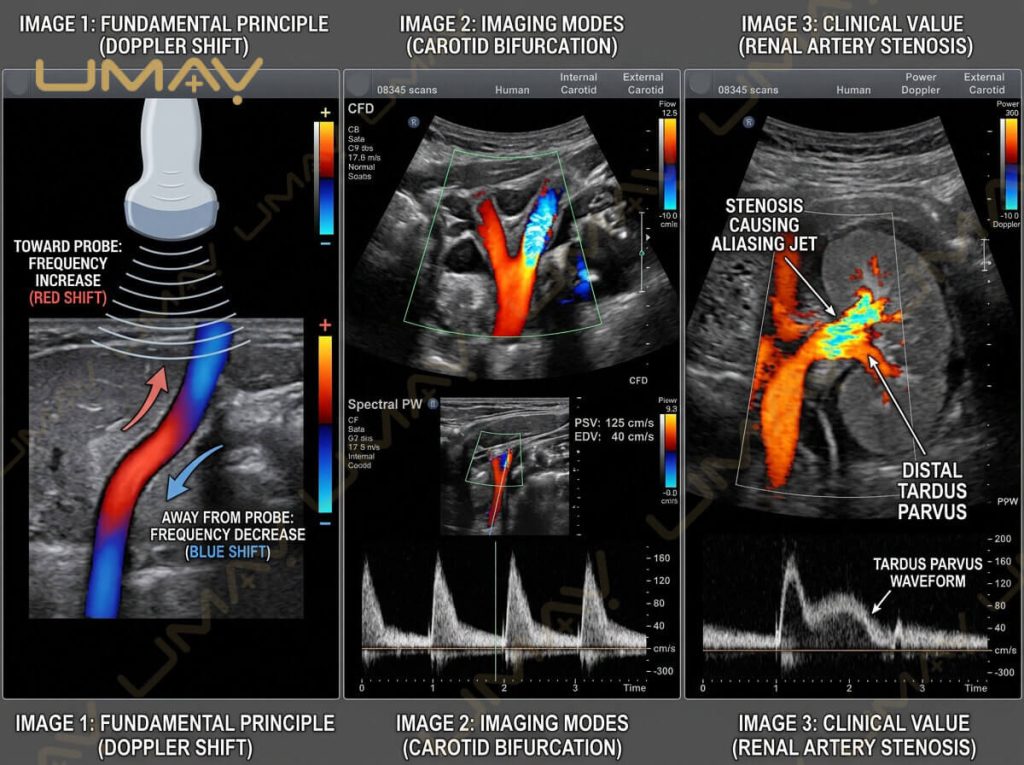
Three-panel technical diagram illustrating Doppler shift principles, carotid bifurcation color flow, and renal artery stenosis waveform analysis.
4. Comprehensive Side-by-Side Feature Comparison
| Feature / Metric | Cart-Based Console | Portable Laptop System | Handheld Probe Scanner |
| Primary Portability | Stationary / Room-to-Room | High (Vehicle / Multi-Room) | Ultra-High (Pocket Size) |
| Average Weight | 50 kg – 110 kg | 4.5 kg – 8 kg | 150 g – 350 g |
| Display Size | 19″ – 24″ High-Res Display | 15″ – 17″ LCD Display | 6″ – 12″ (Phone/Tablet) |
| Active Probe Ports | 3 to 5 Active Ports | 1 to 2 Ports (3 via Dock) | Integrated / Fixed Head |
| Processing Channels | 128 – 256+ Channels | 64 – 128 Channels | 32 – 64 Channels |
| Continuous Scanning Time | Mains Power (Unlimited) | 2 – 4 Hours (Battery) | 1 – 2 Hours (Thermal Limit) |
| Advanced Software (4D/Elasto) | Full Support (Standard) | Moderate Support (Optional) | Basic Color Doppler / 2D |
| Price Range (USD) | $16,000 – $80,000+ | $6,000 – $18,000 | $1,500 – $4,500 |
💡 Strategic Purchasing Insight: For high-volume multi-specialty clinics, the optimal equipment mix is often a hybrid model: utilizing a high-performance Cart System in the primary radiology suite alongside 1 or 2 Portable Laptop Color Doppler units mounted on quick-release carts for emergency, anesthesia, and overflow patient exam rooms.
5. Clinical Application Matching: Which Form Factor Fits Your Practice?
A. Dedicated Radiology & Tertiary OB/GYN Centers
Recommended Form Factor: Cart-Based Console
Radiologists and obstetric specialists require maximum spatial resolution, deep tissue penetration, and specialized probe connectivity (such as transvaginal 4D volume probes and high-density linear transducers). The ergonomic adjustability and large displays of cart systems are essential for physicians performing 6 to 8 hours of continuous diagnostic examinations daily.
B. Emergency Medicine, ICU & Anesthesiology (POCUS)
Recommended Form Factor: Portable Laptop Ultrasound Machine
Point-of-Care Ultrasound (POCUS) demands rapid mobilization to bedside emergencies, high Color Doppler sensitivity for internal bleeding evaluation, and durable physical construction. A portable laptop ultrasound mounted on a slim height-adjustable trolley cart allows clinicians to maneuver through crowded ICU bays without sacrificing diagnostic confidence.
C. Musculoskeletal (MSK), Orthopedics & Pain Management
Recommended Form Factor: Portable Laptop or High-End Handheld
MSK clinicians require high-frequency linear imaging (8–15 MHz) for tendon, nerve, and joint visualization, combined with needle enhancement software for guided injections. A high-end portable laptop system provides superior spatial resolution for fine anatomical structures, while a wireless linear handheld probe offers exceptional convenience for quick outpatient joint checks.
D. Outpatient Clinics, Mobile Medical Units & Field Work
Recommended Form Factor: Handheld Probe Scanner or Lightweight Portable
Facilities operating mobile health vans, rural outreach programs, or sports medicine teams benefit immensely from the pocket-sized footprint and low weight of handheld probe scanners and compact laptop units. The ability to run on battery power without relying on external power outlets is critical for field applications.
6. Total Cost of Ownership (TCO) & Long-Term Value Considerations
When presenting purchase proposals to hospital management or clinic financial officers, look beyond the initial purchase price and evaluate total operating expenses across a 5-year lifecycle:
-
Transducer Replacement & Repair Costs: Cart and portable systems utilize detachable transducers ($1,500 – $4,000 per probe). If a probe cable degrades or a crystal cracks, only the probe is replaced. On handheld units, a damaged transducer often requires replacing the entire scanner assembly.
-
Software Updates & Feature Upgrades: Cart and laptop systems usually support future software license add-ons (such as automatic EF measurement or strain imaging). Ensure your supplier guarantees free software bug patches and reasonable firmware upgrade fees over the machine’s operational life.
-
Service Contracts & Maintenance Disruption: Portable systems can be shipped via express courier to regional service centers for maintenance, significantly reducing clinic downtime compared to cart systems, which require on-site field engineer visits.
7. Frequently Asked Questions (FAQ)
Q1: Can a portable laptop ultrasound fully replace a cart-based machine in a general clinic?
Yes. For general practice, basic abdominal screening, routine OB/GYN checks, and MSK evaluations, modern mid-to-high-tier portable color doppler ultrasound machines offer image clarity and software tools fully capable of replacing traditional cart systems.
Q2: How many active probe connectors are needed on a portable ultrasound system?
For most multi-specialty clinics, 2 active probe connectors directly on the portable machine chassis (or 3 active ports via a docking cart) are ideal. This allows simultaneous connection of a convex probe for abdominal scans and a linear probe for superficial/vascular scans.
Q3: Are wireless handheld ultrasound probes secure for hospital network integration?
Yes. Premium commercial wireless ultrasound probes utilize encrypted Wi-Fi protocols (such as WPA2/WPA3 Enterprise) and DICOM 3.0 TLS encryption to transmit images securely to PACS servers and electronic medical record (EMR) systems in compliance with HIPAA and GDPR regulations.
Q4: What is the typical lifespan of portable vs cart ultrasound systems?
High-quality cart-based systems typically operate for 7 to 10 years with proper routine maintenance. Portable laptop systems have an average operational lifespan of 5 to 8 years, while handheld probes average 3 to 5 years due to intensive battery usage cycles and compact component wear.
Conclusion: Selecting the Optimal Imaging Solution
Selecting the optimal ultrasound form factor requires aligning your clinic’s primary clinical requirements, diagnostic volume, mobility demands, and long-term capital budget. By carefully weighing the raw diagnostic power of cart-based consoles, the versatile performance of portable laptop systems, and the unmatched convenience of handheld probes, medical procurement teams can invest in imaging technology that maximizes diagnostic accuracy, streamlines clinical workflow, and yields strong long-term ROI.