A modern patient monitor can display several physiological parameters on one screen. Depending on the model, a multiparameter patient monitor may monitor ECG, heart rate, SpO2, pulse rate, NIBP, respiration, temperature, IBP, EtCO2, and other measurements.
For hospitals and medical equipment buyers, understanding these parameters is important when selecting a patient monitoring system. A general ward may only need basic vital signs, while an ICU or operating room may require a wider range of parameters.
Current patient monitor configurations show how flexible these systems can be. For example, some monitors combine ECG, SpO2, NIBP, temperature, respiration, and pulse rate as standard parameters, with IBP, EtCO2, additional temperature channels, and other modules available as options.
This guide explains the most common patient monitor parameters in simple terms and helps buyers understand which parameters may be relevant for different healthcare applications.
What Are Patient Monitor Parameters?
Patient monitor parameters are physiological measurements collected from a patient and displayed by a monitoring device.
A patient monitor may show both:
- Numerical values
- Waveforms
- Trends
- Alarm information
Common patient monitoring parameters include:
- ECG
- Heart Rate
- SpO2
- Pulse Rate
- NIBP
- MAP
- RESP
- Temperature
- IBP
- EtCO2
- ST Segment
- Arrhythmia information
Advanced systems can support additional measurements depending on their design and optional modules. FDA documentation for multiparameter monitors lists combinations including ECG, respiration, temperature, SpO2, pulse rate, NIBP, IBP, CO2 and other physiological measurements.
The important point is that not every patient monitor includes every parameter.
When comparing products, buyers should always check the manufacturer’s actual technical specifications.
1. ECG Monitoring
ECG stands for electrocardiography.
ECG monitoring records the electrical activity of the heart through electrodes attached to the patient’s body.
It is one of the most common parameters in a multiparameter patient monitor.
An ECG patient monitor may display:
- ECG waveform
- Heart rate
- Cardiac rhythm information
- Lead information
- ST segment information on supported models
- Arrhythmia information on supported models
Depending on the monitor, ECG may use:
- 3-lead ECG
- 5-lead ECG
- 6-lead ECG
- 10-lead or 12-lead ECG
The exact ECG lead configuration depends on the application and monitor design.
For example, some multiparameter monitors provide 3/5-lead ECG for routine monitoring and optional 12-lead ECG for additional diagnostic applications.
Why Is ECG Important in Patient Monitoring?
ECG is particularly useful when continuous cardiac observation is required.
It is commonly found in:
- ICU patient monitors
- CCU monitors
- Emergency patient monitors
- Operating room monitors
- Anesthesia monitors
- Recovery room monitors
- Transport monitors
Some patient physiological monitors also include arrhythmia detection and alarms. FDA guidance specifically identifies patient physiological monitors with arrhythmia detection and alarm functions as a recognized device category.
2. Heart Rate Monitoring
Heart rate, commonly abbreviated as HR, represents the number of heartbeats per minute.
When ECG monitoring is available, heart rate can commonly be calculated from the ECG signal.
A patient monitor may display HR as:
HR: 75 bpm
where bpm means beats per minute.
Heart rate is commonly displayed together with:
- ECG waveform
- SpO2
- Pulse rate
- NIBP
- Respiratory rate
Heart rate monitoring is common in ICU, emergency, operating room, recovery, and general hospital monitoring.
It is important to understand that heart rate and pulse rate are related but are not always identical measurements. A monitor may derive them from different signals.
3. SpO2 Monitoring
SpO2 means peripheral oxygen saturation.
SpO2 is commonly measured using a pulse oximeter sensor.
The sensor is usually placed on an appropriate measurement site such as a finger, depending on the patient and sensor type.
A patient monitor may display:
- SpO2 percentage
- Pulse rate
- Plethysmographic waveform
- Signal or pulse strength on some models
For example:
SpO2: 98%
The SpO2 parameter is widely used because oxygen saturation monitoring is relevant across many hospital departments.
Common applications include:
- ICU
- Emergency room
- Operating room
- PACU
- General ward
- Clinic
- Patient transport
FDA documentation for multiparameter monitoring describes SpO2 monitoring for arterial oxygen saturation and pulse rate across adult, pediatric, and neonatal patient populations for supported applications.
4. Pulse Rate Monitoring
Pulse Rate, or PR, is usually displayed as beats per minute.
A patient monitor may calculate pulse rate from the SpO2 signal.
For example:
PR: 76 bpm
The monitor can display both:
HR: 75 bpm
and
PR: 76 bpm
depending on the available monitoring channels.
Pulse rate is commonly used with SpO2 monitoring and is therefore a standard feature on many vital signs monitors and multiparameter patient monitors.
5. NIBP Monitoring
NIBP means Non-Invasive Blood Pressure.
It is one of the most common parameters in hospital patient monitoring.
An inflatable cuff is used to obtain blood pressure measurements without invasive catheterization.
NIBP commonly provides:
- SYS — Systolic Blood Pressure
- DIA — Diastolic Blood Pressure
- MAP — Mean Arterial Pressure
For example:
SYS: 120 mmHg
DIA: 80 mmHg
MAP: 93 mmHg
The monitor may offer several NIBP measurement modes, depending on the model:
- Manual
- Automatic
- Continuous or frequent measurement modes on supported systems
- STAT measurement
Some hospital specifications also require different adult, pediatric, and infant NIBP cuffs because cuff size needs to match the patient population.
6. MAP Monitoring
MAP stands for Mean Arterial Pressure.
It is commonly displayed together with systolic and diastolic blood pressure.
A patient monitor may therefore show:
NIBP: 120/80 (93) mmHg
where:
- 120 = systolic pressure
- 80 = diastolic pressure
- 93 = mean arterial pressure
MAP can be useful when reviewing blood pressure trends, particularly in critical care settings.
For procurement purposes, buyers should confirm whether the patient monitor displays SYS, DIA, and MAP as part of its NIBP function.
7. RESP Monitoring
RESP refers to respiratory monitoring, commonly displayed as respiratory rate.
Respiratory rate represents the number of breaths per minute.
A patient monitor may display:
RESP: 18 rpm
depending on the manufacturer’s display convention.
Respiratory monitoring may be derived from thoracic impedance through ECG electrodes or another supported method.
It is often displayed as:
- Respiratory rate
- Respiratory waveform
- Trend information
- Alarm information
RESP monitoring is commonly integrated into multiparameter patient monitors.
Some current monitor specifications describe respiration measurement through thoracic impedance, while other systems may provide additional respiration measurement methods.
8. Temperature Monitoring
TEMP refers to body temperature monitoring.
A patient monitor can support one or more temperature channels depending on its configuration.
Temperature monitoring may be used in:
- ICU
- Operating room
- Recovery room
- Emergency department
- General ward
- Pediatric care
- Neonatal care
Some monitors provide:
- One temperature channel
- Dual temperature channels
- Additional temperature channels through optional modules
Advanced configurations may allow comparison between two temperature measurement sites.
For buyers, it is important to check:
- Number of temperature channels
- Compatible probes
- Measurement range
- Probe type
- Adult/pediatric/neonatal compatibility
9. IBP Monitoring
IBP stands for Invasive Blood Pressure.
Unlike NIBP, IBP uses an invasive pressure monitoring setup and is generally associated with more advanced patient monitoring applications.
Depending on the monitor, IBP can support different pressure channels.
Examples may include:
- Arterial pressure
- Central venous pressure
- Other pressure channels depending on the clinical setup
An advanced patient monitor may offer:
- 1 IBP channel
- 2 IBP channels
- 4 IBP channels
- Additional pressure channels
The actual number depends on the monitor and available modules.
For example, current multi-parameter monitor specifications may offer dual or quad IBP as optional configurations.
IBP is more commonly associated with:
- ICU
- Critical care
- Operating room
- Anesthesia
- Specialized clinical monitoring
Because IBP involves an invasive clinical setup, hospitals should select the appropriate accessories and compatible pressure transducers according to their clinical requirements.
10. EtCO2 Monitoring
EtCO2 means End-Tidal Carbon Dioxide.
EtCO2 monitoring measures carbon dioxide in exhaled gas, particularly at the end of exhalation.
A patient monitor with EtCO2 can display:
- EtCO2 value
- CO2 waveform
- Respiratory rate
- Trend information
EtCO2 monitoring is commonly associated with:
- Anesthesia
- Operating rooms
- Emergency care
- Critical care
- Procedural monitoring
- Patient transport in supported applications
FDA documentation identifies EtCO2 monitoring as a function that can provide continuous measurement of end-tidal carbon dioxide and respiration rate in supported adult, pediatric, and neonatal applications.
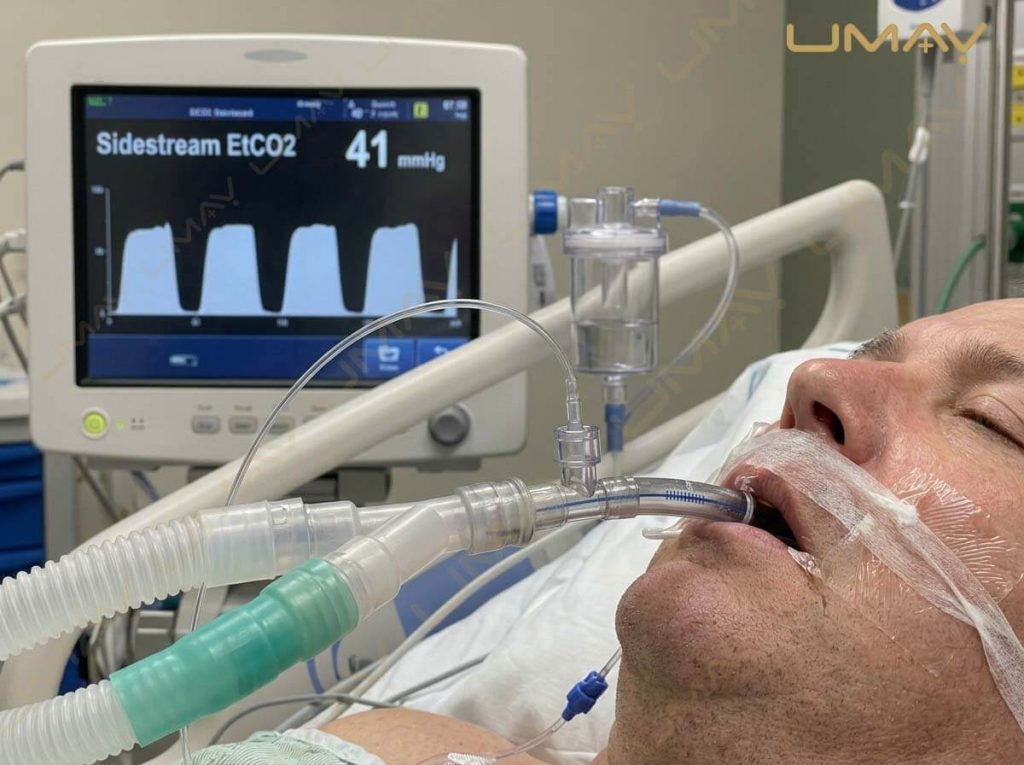
Mainstream vs Sidestream EtCO2
EtCO2 modules can use different measurement arrangements.
Two commonly discussed approaches are:
Mainstream Capnography
The sensor is positioned close to the airway.
Sidestream Capnography
A sample of exhaled gas is drawn through a sampling line to the measurement module.
For medical equipment buyers, the important questions include:
- Which EtCO2 technology is used?
- Is EtCO2 standard or optional?
- What accessories are required?
- Is the module removable?
- What patient populations are supported?
Some procurement specifications specifically identify side-stream capnography as an EtCO2 configuration.
11. ST Segment Monitoring
Some advanced ECG patient monitors provide ST segment monitoring.
ST analysis examines selected portions of the ECG waveform.
It can be particularly relevant to advanced cardiac monitoring applications.
However, buyers should distinguish between:
ECG monitoring
and
diagnostic ECG functions.
Not every ECG monitor is designed for the same clinical purpose.
The monitor’s regulatory documentation, intended use, ECG configuration, and technical specifications should be reviewed before procurement.
12. Arrhythmia Monitoring
Some patient monitors provide arrhythmia detection.
Arrhythmia monitoring uses ECG information to identify selected rhythm patterns according to the device’s algorithms and intended use.
Depending on the monitor, features may include:
- Arrhythmia detection
- Arrhythmia alarms
- ECG waveform review
- Event storage
- Trend information
FDA identifies patient physiological monitors with arrhythmia detection or alarms as a specific medical device category.
For buyers, the important point is that arrhythmia analysis capabilities vary between models.
Do not assume that every patient monitor with ECG provides the same arrhythmia functions.
13. Cardiac Output Monitoring
Some advanced patient monitors can support cardiac output (CO) monitoring.
Cardiac output modules are generally found in more advanced configurations.
Depending on the system, cardiac output may be available through:
- An optional module
- An invasive measurement method
- A non-invasive technology
- An external connected device
This parameter is more relevant to specialized critical care and hemodynamic monitoring than to basic vital signs monitoring.
For this reason, a hospital should not automatically select a monitor with cardiac output capability unless its clinical workflow requires it.
14. Additional Advanced Parameters
High-end patient monitoring systems can support additional parameters or modules.
Depending on the model, these may include:
- Cardiac output
- Anesthetic gas
- BIS
- ICG
- Additional CO2 measurements
- Additional temperature channels
- Additional IBP channels
- Respiratory mechanics
For example, FDA documentation for an advanced bedside monitor lists ECG, SpO2, NIBP, IBP, temperature, BIS, cardiac output, CO2, EtCO2, respiratory rate, anesthetic gases and other physiological measurements.
These advanced parameters are generally application-specific.
A general ward may not need them, while an operating room or ICU may benefit from a more modular monitoring platform.
Patient Monitor Parameters by Department
Different clinical departments have different monitoring requirements.
| Department | Common Parameters |
|---|---|
| General Ward | NIBP, SpO2, PR, TEMP, RESP |
| Clinic | NIBP, SpO2, PR, TEMP |
| Emergency | ECG, SpO2, NIBP, RESP, TEMP |
| ICU | ECG, SpO2, NIBP, RESP, TEMP, IBP, EtCO2 |
| Operating Room | ECG, SpO2, NIBP, EtCO2, TEMP, IBP |
| PACU | ECG, SpO2, NIBP, RESP, TEMP |
| Transport | ECG, SpO2, NIBP, RESP, depending on application |
| NICU | SpO2, ECG, RESP, NIBP, TEMP, depending on clinical needs |
This table is a general purchasing guide rather than a universal clinical standard. The actual configuration should be based on the facility’s clinical requirements and applicable regulations.
Basic vs Advanced Patient Monitor Parameters
A useful way to understand patient monitors is to divide parameters into basic and advanced groups.
Basic Monitoring
A basic vital signs monitor may include:
- NIBP
- SpO2
- PR
- TEMP
- RESP
Standard Multiparameter Monitoring
A common hospital multiparameter configuration may include:
- ECG
- SpO2
- NIBP
- RESP
- TEMP
Advanced Monitoring
An advanced patient monitor may add:
- IBP
- EtCO2
- Additional temperature
- Advanced ECG analysis
- Cardiac output
- Anesthetic gas
- Other optional modules
Current commercial monitor specifications demonstrate this modular approach, with standard ECG/RESP/SpO2/NIBP/TEMP configurations and optional IBP, EtCO2, cardiac output, and other modules.
3-Parameter Patient Monitor
The term 3-parameter patient monitor is commonly used in the medical equipment market.
However, the exact three parameters can vary by manufacturer.
Therefore, a buyer should not select a device based only on the number “3”.
Instead, check the exact specification:
- What are the three parameters?
- Is the monitor designed for adult patients?
- Is pediatric monitoring supported?
- Is neonatal monitoring supported?
- Is the device designed for bedside or portable use?
- What accessories are included?
This approach also applies to 4-parameter, 5-parameter, and 6-parameter patient monitors.
5-Parameter Patient Monitor
A 5-parameter patient monitor is one of the most common search terms in the multiparameter monitor market.
A typical configuration may include:
- ECG
- SpO2
- NIBP
- RESP
- TEMP
However, terminology can vary.
Some manufacturers may count heart rate or pulse rate differently in their product descriptions.
Therefore:
Always compare the parameter list rather than the number alone.
A current multi-parameter monitor specification, for example, lists ECG, RESP, SpO2, NIBP, PR and temperature in its standard configuration, while additional IBP and EtCO2 functions can be optional.
6-Parameter and 7-Parameter Patient Monitors
Buyers may also search for:
- 6 parameter patient monitor
- 7 parameter patient monitor
- 8 parameter patient monitor
- 10 parameter patient monitor
- advanced multiparameter patient monitor
Again, there is no universal rule that every manufacturer uses the same counting method.
For example, one specification may count ECG, SpO2, NIBP, RESP, TEMP, and PR, while another may describe a seven-parameter system using ECG, NIBP, SpO2, respiration, dual IBP, and dual temperature channels.
This is why procurement teams should always request the complete technical specification.
How to Choose the Right Patient Monitor Parameters
The best configuration is not necessarily the one with the largest number of parameters.
Instead, start with five questions.
1. What Is the Clinical Application?
Is the monitor intended for:
- ICU
- Emergency
- OR
- Ward
- Clinic
- PACU
- Ambulance
- Patient transport?
2. Which Patients Will Be Monitored?
Consider:
- Adult
- Pediatric
- Neonatal
3. Which Parameters Are Required?
For example:
General Ward
NIBP + SpO2 + PR + TEMP
Emergency
ECG + SpO2 + NIBP + RESP + TEMP
ICU
ECG + SpO2 + NIBP + RESP + TEMP + IBP + EtCO2, depending on clinical requirements
4. Is Future Expansion Important?
A modular monitor may allow additional functions to be added later.
This can be useful for hospitals that want one platform to support different departments.
5. What Accessories Are Required?
Do not forget to check:
- ECG cables
- ECG electrodes
- SpO2 sensors
- NIBP cuffs
- Temperature probes
- IBP accessories
- EtCO2 sampling lines
- Batteries
- Mounting accessories
The accessories are an important part of the complete patient monitoring solution.
Patient Monitor Alarms
Another important function related to patient monitor parameters is the alarm system.
Patient monitors can provide visual and audible alarms according to the device’s configuration.
Alarm-related functions can include:
- High parameter alarm
- Low parameter alarm
- Technical alarm
- Sensor disconnection alarm
- ECG alarm
- SpO2 alarm
- NIBP alarm
- RESP alarm
- Temperature alarm
- EtCO2 alarm
Some systems allow users to configure alarm limits.
For example:
SpO2 low limit → configured threshold
HR high limit → configured threshold
The exact alarm behavior depends on the monitor.
FDA documentation describes patient monitoring systems that generate audible and/or visual alarms when measured values fall outside preset limits.
Patient Monitor Trends
Besides real-time measurements, many patient monitors provide trend monitoring.
Trend information allows users to review changes over time rather than looking at one measurement alone.
Common trend parameters include:
- HR
- SpO2
- NIBP
- RESP
- TEMP
- IBP
- EtCO2
Trend data can be displayed as:
- Trend graphs
- Trend tables
- Historical measurements
- Alarm events
For procurement, buyers should check:
- Trend storage duration
- Number of stored measurements
- Alarm event storage
- Waveform storage
- Patient data storage
Some commercial systems specify hours of trend storage and separate storage for NIBP and alarm events.
Patient Monitor Waveforms
A patient monitor does not only display numbers.
It can also display physiological waveforms.
Common waveforms include:
- ECG waveform
- SpO2 pleth waveform
- RESP waveform
- IBP waveform
- EtCO2 waveform
The number of simultaneously displayed waveforms depends on the monitor.
Advanced monitors may display many waveforms at the same time.
For example, some current hospital patient monitors support up to 12 waveforms depending on configuration.
For buyers, waveform display can be an important consideration when selecting a monitor for ICU or operating room use.
Patient Monitor Parameter FAQ
What are the main patient monitor parameters?
The most common parameters are ECG, SpO2, NIBP, heart rate, pulse rate, respiration, temperature, IBP, and EtCO2.
What is ECG in a patient monitor?
ECG records the electrical activity of the heart and can provide heart rate and waveform information.
What is SpO2 in a patient monitor?
SpO2 is peripheral oxygen saturation measured using an appropriate pulse oximetry sensor.
What is NIBP?
NIBP means non-invasive blood pressure. It generally provides systolic, diastolic, and mean pressure measurements.
What is IBP?
IBP means invasive blood pressure and is generally used in advanced clinical monitoring applications.
What is EtCO2?
EtCO2 means end-tidal carbon dioxide and measures carbon dioxide in exhaled gas.
What does RESP mean on a patient monitor?
RESP generally refers to respiratory monitoring and respiratory rate.
What does TEMP mean on a patient monitor?
TEMP refers to temperature monitoring.
What is PR on a patient monitor?
PR means pulse rate and is generally displayed in beats per minute.
What is HR on a patient monitor?
HR means heart rate and is generally displayed in beats per minute.
What is MAP?
MAP means mean arterial pressure and is commonly displayed with systolic and diastolic blood pressure.
Do all patient monitors have ECG?
No. Some basic vital signs monitors may not include ECG.
Do all patient monitors have SpO2?
Many hospital patient monitors include SpO2, but buyers should confirm the specific product configuration.
Does every patient monitor have EtCO2?
No. EtCO2 is generally an optional or advanced parameter on many patient monitors.
Does every patient monitor support IBP?
No. IBP is generally available on advanced monitors or through optional modules.
What is a 5-parameter patient monitor?
It generally refers to a monitor offering five primary monitoring parameters, but the exact definition can vary between manufacturers.
What parameters are commonly used in an ICU patient monitor?
ICU configurations commonly include ECG, SpO2, NIBP, RESP, TEMP and, depending on clinical requirements, IBP and EtCO2.
Conclusion
Understanding patient monitor parameters is essential when choosing medical monitoring equipment.
The most common parameters include:
ECG, HR, SpO2, PR, NIBP, MAP, RESP, TEMP, IBP and EtCO2.
Basic vital signs monitors may focus on NIBP, SpO2, pulse rate, temperature, and respiration. A standard multiparameter patient monitor may add ECG, while advanced ICU and operating room monitors can support IBP, EtCO2, additional temperature channels, cardiac output, anesthetic gas, and other specialized modules.
For hospitals and medical equipment buyers, the goal should not simply be to choose a monitor with the highest number of parameters. The better approach is to match the monitoring parameters to the clinical application, patient population, department, accessories, connectivity requirements, and future expansion needs.
When comparing patient monitoring equipment, always review the complete technical specification rather than relying only on terms such as “5-parameter,” “6-parameter,” or “7-parameter.”
The right parameter configuration can make a patient monitoring system more practical, easier to operate, and better matched to the workflow of a hospital or healthcare facility.