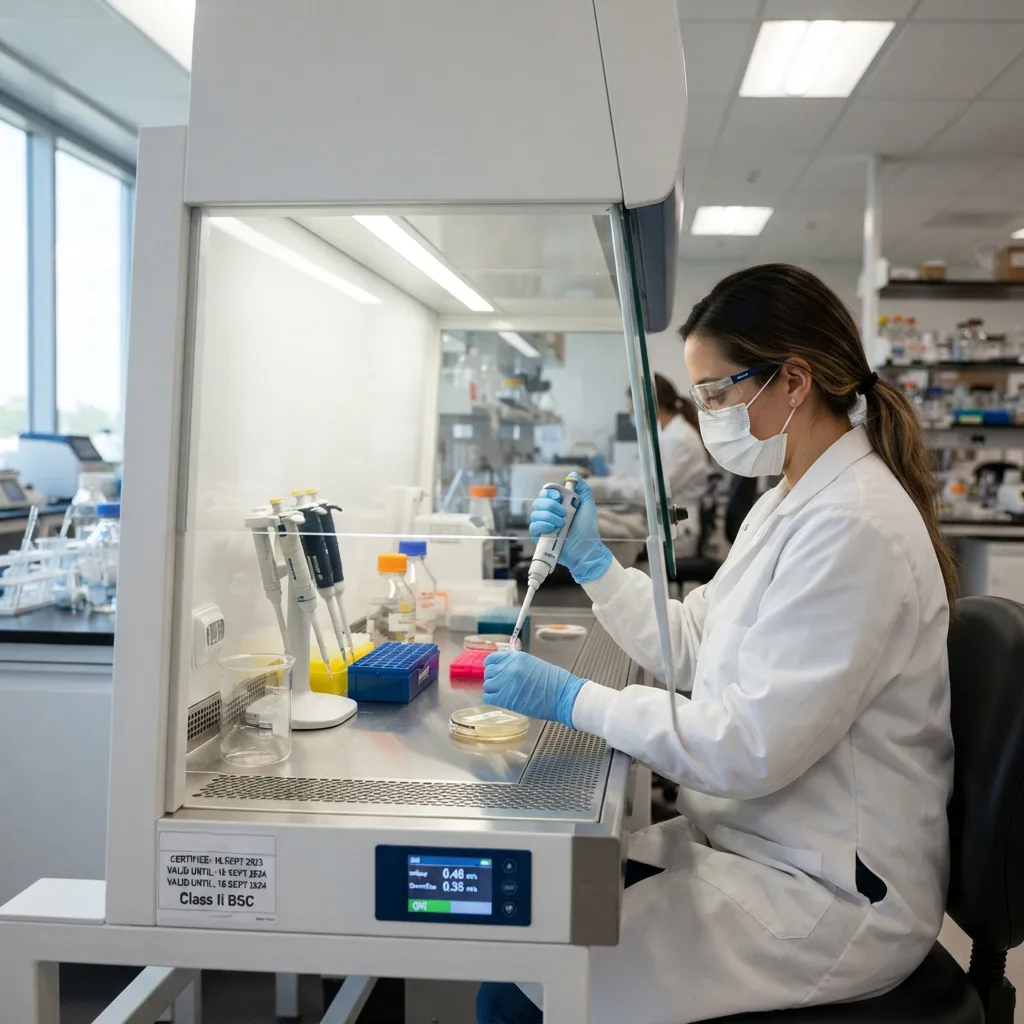
Installation Problems Often Start Before the Cabinet Is Switched On
A microbiological safety cabinet can be a technically well-designed piece of laboratory equipment and still perform poorly when it is installed in the wrong location, used incorrectly, or not maintained properly.
For this reason, purchasing a biosafety cabinet, biological safety cabinet, or microbiological safety cabinet should not be treated as the final step. The cabinet needs an appropriate location, correct commissioning, regular certification and a practical maintenance program.
This is particularly important for hospitals, clinical laboratories, microbiology laboratories, research institutes, pharmaceutical laboratories and biotechnology facilities.
The current CDC-NIH Biosafety in Microbiological and Biomedical Laboratories, 6th Edition emphasizes protocol-driven risk assessment as the basis for selecting and applying biosafety controls. The sixth edition was updated on March 18, 2026. It is guidance rather than a regulatory document, so local requirements still need to be considered. 疾控中心
A useful lifecycle is:
Select → Site → Install → Certify → Operate → Clean → Maintain → Re-certify
Each stage affects the next.
Where Should a Biosafety Cabinet Be Installed?
The first installation question is not:
“Where can we fit the cabinet?”
It should be:
“Where can the cabinet operate with minimal disruption to its airflow?”
Open-front biosafety cabinets rely on controlled air movement at the front opening. Nearby airflow can interfere with this pattern.
Potential sources of disturbance include:
- Laboratory doors
- Open windows
- Supply-air diffusers
- Fans
- Heavy pedestrian traffic
- Nearby equipment
- Strong air currents
- Poorly planned room ventilation
WHO guidance specifically warns that activities such as opening doors, walking near a BSC and airflow from ventilation outlets can disrupt the cabinet’s inward airflow.
This creates an important installation rule:
Avoid high-traffic locations
A cabinet positioned beside a frequently used doorway may experience repeated airflow disturbances.
Avoid strong direct air currents
Do not assume that a location is suitable simply because there is enough physical space.
Leave appropriate service space
Technicians need access for filter replacement, testing, maintenance and repairs.
Follow the manufacturer’s installation instructions
Different cabinet designs can have different requirements for clearances, exhaust connections and environmental conditions.
The exact installation layout should therefore be reviewed before the equipment is shipped.
Why Site Planning Should Happen Before Purchase
A laboratory may already have a preferred location for a BSC, but that location may not be suitable for the selected cabinet model.
Before ordering, check:
Room dimensions
Will the cabinet physically fit without creating access problems?
Door and traffic patterns
Will people regularly walk behind or in front of the cabinet?
HVAC layout
Are air supply outlets located close to the cabinet?
Ceiling height
Is there enough room for service, exhaust connections or canopy arrangements where applicable?
Electrical supply
Does the cabinet match the local voltage and frequency?
Exhaust requirements
Does the selected BSC recirculate air, use a canopy connection or require hard ducting?
Maintenance access
Can technicians reach filters, blowers, sensors and other components?
Future relocation
Could the cabinet need to be moved when the laboratory is expanded?
These questions are especially important for buyers ordering a Class II biosafety cabinet, Class II A2 BSC, Class II B2 biosafety cabinet, or another application-specific configuration.
A BSC Is Part of the Laboratory, Not Just a Cabinet
One reason buyers experience problems after installation is that they evaluate the BSC separately from the laboratory.
A biosafety cabinet interacts with its surroundings.
Room airflow affects the front opening.
The building exhaust system may affect cabinet operation.
The laboratory’s working practices affect the airflow inside.
Maintenance affects filters and moving components.
Certification checks whether the installed cabinet is still performing as intended.
This is why a professional laboratory project should treat the BSC as part of a broader laboratory biosafety system.
For procurement teams, this also means asking the manufacturer for:
- Installation drawings
- Utility requirements
- Electrical specifications
- Exhaust information
- Service clearance requirements
- Certification recommendations
- Maintenance instructions
- Replacement-part information
Commissioning a New Microbiological Safety Cabinet
A cabinet should not simply be plugged in and placed into service immediately after delivery.
Commissioning provides an opportunity to verify that the equipment is installed correctly and functioning as expected.
The process can include checking:
Physical Installation
Is the cabinet level and stable?
Electrical System
Are power connections appropriate for the model and destination market?
Airflow
Is airflow behaving according to the manufacturer’s design?
Filters
Are the filters installed correctly and free from damage?
Alarms
Do monitoring and alarm systems operate correctly?
Sash
Does the sash or viewing window operate smoothly?
Internal Work Area
Are grilles and airflow pathways unobstructed?
Exhaust
Where external exhaust is required, is the building connection correct?
Certification
Has the cabinet been evaluated according to the applicable certification program?
The exact commissioning procedure depends on the BSC class, manufacturer, installation and applicable standards.
WHO recommends that the function and integrity of each BSC be certified at installation, after relocation and regularly thereafter, at least annually, by qualified technicians.
What Is Biosafety Cabinet Certification?
Biosafety cabinet certification is the process of checking that the installed cabinet meets defined performance requirements.
It is different from simply receiving a certificate from the manufacturer.
Once the cabinet arrives at the laboratory, its performance can be affected by:
- Building airflow
- Exhaust conditions
- Installation position
- Filter condition
- Mechanical components
- Repairs
- Relocation
Certification helps verify the condition of the cabinet in its actual working environment.
For international buyers, this is one of the most important questions to ask:
Who will perform field certification after installation?
WHO recommends certification at installation, after relocation and at least annually thereafter.
CDC-NIH BMBL guidance similarly describes field performance verification for Class II BSCs at installation and at least annually thereafter, with recertification after events such as HEPA or ULPA filter replacement, internal repairs and relocation.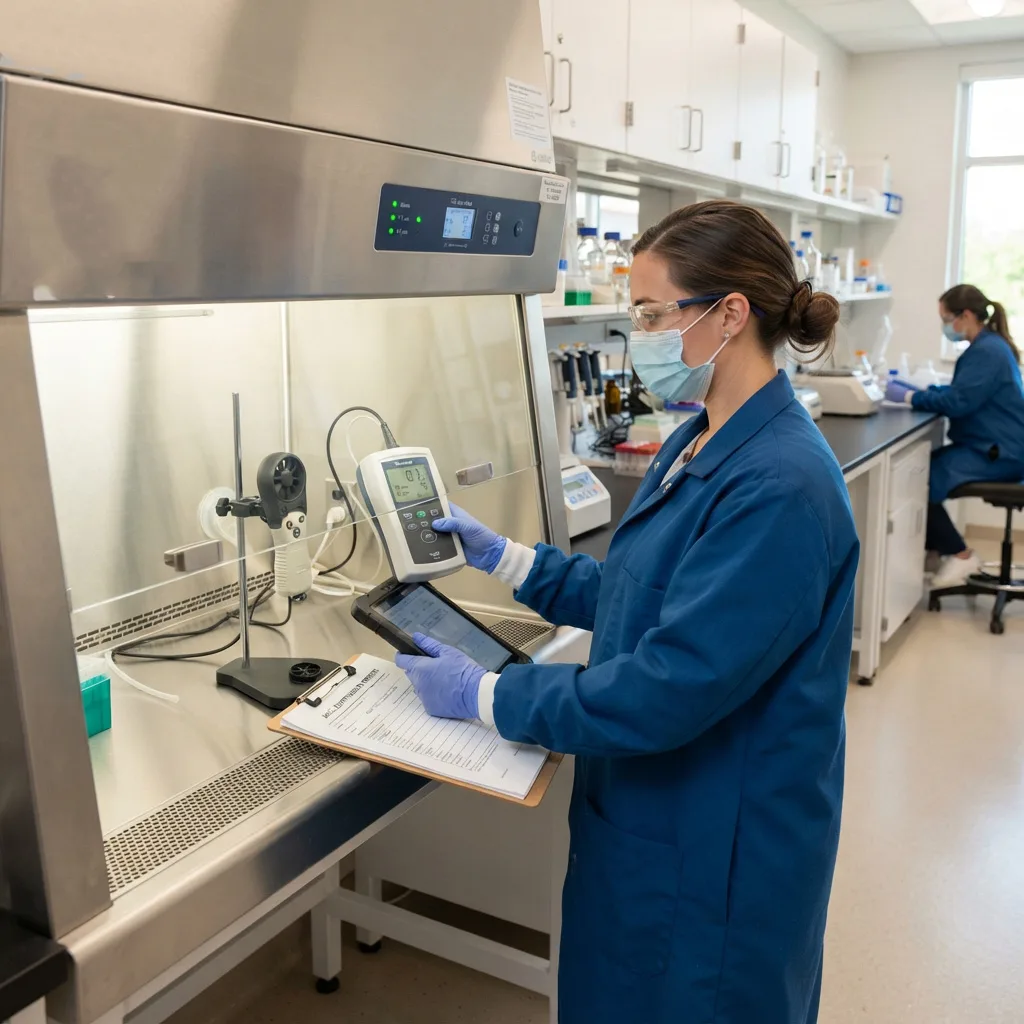
Who Should Certify a Biosafety Cabinet?
BSC certification should be performed by appropriately qualified personnel using calibrated testing equipment and procedures appropriate to the applicable standard.
NSF operates accreditation programs for individuals who perform field certification of biosafety cabinets, including programs covering certifiers outside North America.
This distinction matters for international procurement.
A manufacturer may supply the cabinet.
A local service company may install it.
A qualified field certifier may perform the on-site certification.
In some markets, one organization may provide several of these services. In others, they may be separate.
Therefore, buyers should identify the post-installation service pathway before placing a large equipment order.
What Tests Are Performed on a Biosafety Cabinet?
The exact certification package depends on the cabinet type, standard and testing program.
Common performance checks can include:
Inflow velocity
Measures airflow entering through the front opening.
Downflow velocity
Evaluates the vertical airflow through the work zone of applicable Class II cabinets.
HEPA filter integrity
Checks for filter leakage.
Airflow smoke pattern
Visualizes airflow behavior.
Cabinet integrity
Checks the physical containment structure where applicable.
Negative pressure
Relevant to certain cabinet configurations.
Alarms and interlocks
Confirms that important warning and control functions operate properly.
WHO lists cabinet integrity, HEPA filter leakage, downflow velocity, face velocity, pressure, airflow smoke patterns, alarms and interlocks among certification-related evaluations.
For Class II cabinets, NSF/ANSI 49 is a major reference in the U.S. and international BSC industry. NSF states that the standard covers design, construction and performance requirements and includes detailed test procedures and information related to installation, field certification and decontamination.
NSF/ANSI 49: An Important 2026 Update
For content targeting current BSC buyers, an important update should not be missed.
The NSF standards committee published a new:
NSF/ANSI 49-2026 — Biosafety Cabinetry: Design, Construction, Performance, and Field Certification
The September 2026 standards posting identifies it as the newly published revision and states that it applies to Class II biosafety cabinetry designed to minimize hazards associated with work involving biological agents at Biosafety Levels 1 through 4.
Therefore, older articles that only mention NSF/ANSI 49-2018 or NSF/ANSI 49-2019 should not automatically be treated as describing the latest edition.
For procurement documents, it is better to ask the supplier and certification provider:
Which edition of NSF/ANSI 49 applies to this project?
That keeps the purchasing specification clear and current.
EN 12469 and European BSC Projects
European buyers may encounter the EN 12469 family of standards.
BSI currently lists:
BS EN 12469-1:2025
for classes and basic requirements,
BS EN 12469-2:2025
for Class II biological safety cabinets,
and
BS EN 12469-5:2025
for installation, commissioning and routine testing.
The existence of a separate installation and testing standard is particularly relevant to this article because it reinforces the concept that laboratory safety cabinets should be evaluated throughout their operating life rather than only when manufactured.
For international projects, buyers should identify the standards applicable to the destination market rather than requesting every international standard at once.
What Happens During a BSC Certification?
A field certification visit may begin with a review of the cabinet and its installation condition.
The technician may examine:
- Model and cabinet identification
- Physical condition
- Filter status
- Airflow
- Cabinet pressure
- Alarms
- Electrical safety
- Exhaust connection where applicable
- Smoke patterns
- Other parameters defined by the applicable certification method
The outcome should be documented.
The documentation can be valuable for:
- Laboratory managers
- Biosafety officers
- Quality departments
- Hospital administrators
- Pharmaceutical companies
- Research institutions
- Audits
- Equipment maintenance records
NSF describes field certification as a key part of maintaining proper Class II BSC performance and has an accreditation pathway for professionals performing those tests.
Daily BSC Operation: Small Habits Have a Big Effect
Even a certified BSC can be used incorrectly.
The user plays an important role in maintaining its airflow.
Before starting work:
Check the cabinet
Confirm that it is operating normally.
Check the airflow indicator
Make sure there is no alarm or abnormal indication.
Check the work area
Do not block the front intake grille.
Organize materials
Place items logically before starting the procedure.
Allow airflow to stabilize
Follow the manufacturer’s instructions for cabinet startup and preparation.
WHO guidance recommends ensuring that BSC airflow is established before work and emphasizes that the front intake grille should not be blocked.
How Should a BSC Work Area Be Organized?
Organization matters because the cabinet has a defined airflow pattern.
A common principle is:
clean → work → contaminated
For example:
Clean materials should be positioned so that they do not need to cross through heavily contaminated areas.
Waste should be handled in a way that avoids unnecessary movement across clean working areas.
WHO guidance recommends organizing the BSC work area to minimize cross-contamination and describes a clean-to-dirty workflow for Class II BSCs.
The exact arrangement depends on the procedure.
There should also be enough space for airflow to function correctly.
Why Should the Front Grille Never Be Blocked?
The front grille is part of the cabinet’s airflow system.
Blocking it can change the airflow pattern and reduce the cabinet’s intended containment performance.
Common items that can cause problems include:
- Paper
- Plastic bags
- Containers
- Equipment
- Laboratory racks
- Waste materials
A large working area does not mean the entire surface can be filled with equipment.
The cabinet needs open airflow pathways.
Cleaning a Microbiological Safety Cabinet
Cleaning and disinfection are essential parts of BSC operation.
The procedure should follow:
laboratory biosafety procedures + organism risk + disinfectant compatibility + cabinet manufacturer’s instructions
Before selecting a cleaning agent, consider:
- Biological material
- Cabinet materials
- Stainless steel surfaces
- Painted surfaces
- Seals
- Electronics
- Corrosion risk
Using an unsuitable chemical can damage the cabinet.
WHO recommends cleaning and decontaminating BSC work areas according to laboratory procedures and using an effective disinfectant in a way that minimizes aerosol generation.
How to Clean the BSC Work Surface
Routine cleaning generally focuses on the internal work surface and accessible interior areas.
A typical workflow is:
Remove unnecessary items
Keep only the materials needed for the procedure.
Remove waste
Dispose of or decontaminate materials according to the laboratory protocol.
Clean visible contamination
Do not allow residues to accumulate.
Apply the appropriate disinfectant
Use a product suitable for the biological hazard and the cabinet’s construction materials.
Allow the required contact time
The laboratory’s approved disinfection procedure should define this.
Remove residues where required
Some disinfectants may need removal after the appropriate contact period, particularly where material compatibility is a concern.
The exact procedure must be based on the organism and laboratory protocol rather than a generic internet checklist.
What About a Spill Inside a BSC?
A spill should be handled according to the laboratory’s established spill procedure.
WHO guidance specifically states that after a spill inside a BSC, cleanup should begin promptly while the cabinet continues operating, using an effective disinfectant and methods that minimize aerosol generation. Materials exposed to the spill should be disinfected and disposed of appropriately.
For laboratory managers, this highlights the need to keep a written spill response procedure available to users.
The equipment alone cannot provide a complete biosafety program.
Should You Use Open Flames Inside a BSC?
Open flames can create airflow disruption and additional hazards inside a BSC.
WHO recommends using electric microincinerators or other suitable alternatives instead of open flames for sterilization of bacteriological loops.
For buyers, this is another reason to ask about the cabinet’s intended workflow before specifying accessories.
A laboratory may need:
- Electrical outlets
- Small sterilization equipment
- Waste containers
- Vacuum systems
- Gas connections in some designs
Not all accessories are appropriate for every BSC application.
BSC HEPA Filter Maintenance
The HEPA filter is one of the most important components of many biosafety cabinets.
However, a buyer should not think of the filter as a routine user-replaceable component.
Filter replacement can involve:
- Decontamination
- Removal procedures
- Specialized service
- Airflow adjustment
- Post-maintenance testing
- Recertification
CDC-NIH BMBL guidance identifies HEPA or ULPA filter replacement as an event requiring recertification for Class II BSCs.
That means a laboratory should not select a cabinet based only on the initial filter specification.
Consider the entire filter lifecycle:
Filter type → operating life → service access → replacement procedure → disposal → recertification
What Causes BSC Airflow Problems?
A change in cabinet airflow can have many causes.
Blocked Intake Grille
Materials or equipment may interfere with the airflow path.
Incorrect Installation
The cabinet may be positioned where surrounding airflow causes disturbance.
Exhaust Problems
Externally exhausted cabinets can be affected by building exhaust conditions.
Dirty or Damaged Components
Accumulated contamination or mechanical problems can affect operation.
Filter Condition
Filter loading or damage can change cabinet performance.
Blower Problems
A malfunctioning blower or control system can affect airflow.
Room HVAC Changes
Building ventilation may be modified after the BSC is installed.
Cabinet Relocation
Moving the cabinet can change its installation environment.
The important point is that an airflow alarm does not automatically mean the cabinet itself is defective.
The cabinet and its environment should be investigated together.
What Should You Do When a BSC Airflow Alarm Appears?
An airflow alarm should be treated as a meaningful warning.
The laboratory’s established operating and emergency procedure should determine the immediate response.
The user should not simply silence the alarm and continue normal work.
CDC-NIH and WHO guidance emphasize the importance of maintaining verified airflow and cabinet performance. WHO also identifies alarms and interlocks as part of certification-related evaluation.
For maintenance teams, investigate:
Was the room ventilation changed?
Was the cabinet moved?
Are the intake grilles clear?
Is there an exhaust problem?
Is maintenance overdue?
Has the filter been replaced?
Is a sensor or blower malfunctioning?
Formal testing should be arranged when the cause is not obvious.
BSC Maintenance After Relocation
Relocating a biosafety cabinet is not like moving a normal laboratory table.
Moving can affect:
- Cabinet alignment
- Filter integrity
- Internal components
- Airflow
- Room relationship
- Exhaust connections
WHO recommends certification after relocation.
BMBL guidance also identifies relocation as an event requiring recertification for Class II BSCs.
Therefore, before moving a cabinet:
Plan the move → Decontaminate as required → Move correctly → Reinstall → Re-certify → Return to service
BSC Maintenance Schedule
A practical maintenance program can be divided into several levels.
Before Routine Work
The user checks:
- Cabinet operation
- Airflow indication
- Work-area condition
- Intake grilles
- Visible damage
- Alarms
Routine Cleaning
The work surface and accessible internal areas are cleaned according to laboratory procedures.
Periodic Service
Qualified maintenance personnel inspect:
- Blowers
- Controls
- Sensors
- Sash components
- Electrical systems
- Filter-related components
- Other mechanical parts
Certification
The cabinet is tested according to the applicable standard and laboratory program.
Event-Based Recertification
Additional certification may be needed after:
- Relocation
- Filter replacement
- Certain repairs
- Significant maintenance
- Changes to exhaust configuration
WHO and BMBL guidance both support regular certification and additional checks after important equipment changes.
BSC Cleaning vs BSC Decontamination
These terms are sometimes used interchangeably, but they are not identical.
Cleaning generally refers to removing dirt, residues or contaminants from surfaces.
Disinfection refers to using an appropriate process or chemical to reduce or eliminate certain microorganisms on surfaces.
Decontamination is a broader term and can refer to rendering a cabinet safe for service, filter replacement, relocation or decommissioning.
The exact decontamination method depends on the material handled, cabinet type, service activity and laboratory procedures.
This is particularly important before major maintenance.
A technician should not begin internal service simply because the cabinet has been switched off.
What Happens Before HEPA Filter Replacement?
Filter replacement can be a specialized procedure.
The laboratory should consider:
Cabinet decontamination
The cabinet may need an appropriate decontamination procedure before internal access.
Qualified service personnel
Filter replacement should be performed according to the cabinet manufacturer’s requirements and applicable procedures.
Waste handling
Used filters may require specific handling and disposal procedures.
Airflow adjustment
New filters can change system resistance.
Certification
The cabinet needs appropriate post-maintenance performance verification.
BMBL guidance explicitly lists HEPA or ULPA filter replacement among events that require Class II BSC recertification.
How Long Does a Biosafety Cabinet Last?
There is no single replacement age that applies to every BSC.
Useful service life depends on:
- Manufacturing quality
- Operating hours
- Laboratory environment
- Maintenance
- Filter condition
- Availability of spare parts
- Control-system age
- Structural condition
- Ability to pass certification
- Changes in laboratory applications
A cabinet may continue operating for many years with appropriate maintenance, while another may become unsuitable sooner because of damage, outdated components or changing laboratory requirements.
Instead of asking:
“How many years can a BSC last?”
a laboratory manager should also ask:
“Can this cabinet still meet its current application and required performance?”
When Should a Biosafety Cabinet Be Replaced?
Replacement can become appropriate when:
- The cabinet cannot pass required performance tests
- Structural damage is significant
- Replacement parts are unavailable
- Controls are obsolete
- The cabinet no longer matches the laboratory application
- The building exhaust arrangement has changed
- Maintenance costs are becoming disproportionate
- Certification becomes difficult to maintain
- The laboratory’s risk assessment has changed
A newer model is not automatically safer simply because it is newer.
Replacement should be based on performance, risk, application and lifecycle considerations.
BSC Documentation Every Laboratory Should Keep
Good records make laboratory equipment easier to manage.
Recommended information includes:
Equipment identification
Manufacturer, model and serial number.
Installation record
Installation date and location.
Certification records
Test results and certification dates.
Maintenance records
Repairs, inspections and service activities.
Filter history
Filter replacement dates and relevant records.
Decontamination records
Where required by laboratory procedure.
Relocation records
Previous and current locations.
Training records
Relevant user training.
These records can help quality teams, biosafety personnel and laboratory managers identify trends before small problems become major equipment failures.
Common Biosafety Cabinet Mistakes
Putting the BSC in a Busy Location
High traffic can disturb front-opening airflow.
Blocking the Front Grille
Equipment and supplies can interfere with airflow.
Overloading the Work Area
More equipment means less usable space and potentially more airflow disruption.
Using the BSC Like a Storage Cabinet
The work area should support the procedure, not become permanent storage.
Ignoring Airflow Alarms
An alarm may indicate that the expected protection is no longer available.
Forgetting Recertification After Relocation
A moved cabinet needs appropriate verification before returning to service.
Using the Wrong Disinfectant
Some chemicals can damage cabinet surfaces or components.
Replacing Filters Without a Certification Plan
Filter replacement can change system performance and requires appropriate post-maintenance testing.
Assuming Every Class II BSC Is the Same
A2, B1, B2 and C1 systems can have different airflow and exhaust configurations.
How to Build a BSC Maintenance Program for a New Laboratory
A simple program can follow this structure:
Step 1: Define the Application
Understand the biological procedures and hazards.
Step 2: Select the Cabinet
Choose the appropriate class and configuration.
Step 3: Review the Site
Check airflow, room layout, utilities and exhaust requirements.
Step 4: Install
Follow the manufacturer’s installation instructions.
Step 5: Certify
Complete appropriate field performance testing.
Step 6: Train Users
Teach correct startup, work organization, cleaning and shutdown.
Step 7: Monitor
Use routine inspections and certification records.
Step 8: Maintain
Perform scheduled cleaning and technical service.
Step 9: Re-certify
Repeat certification at required intervals and after specified events.
Step 10: Review
Reassess the equipment when laboratory procedures, room layout or risk profiles change.
This lifecycle approach is much more reliable than treating biosafety cabinet maintenance as an occasional repair task.
Why Supplier Support Matters After Delivery
For a domestic laboratory purchase, technicians may be readily available nearby.
For an international buyer, the situation can be different.
A medical or laboratory equipment supplier may ship the cabinet across borders, while local service providers handle installation and certification.
This makes pre-sale technical communication important.
A buyer should have access to:
- Technical drawings
- Installation instructions
- Electrical specifications
- Exhaust information
- User manuals
- Maintenance recommendations
- Replacement-part information
- Certification guidance
For larger hospital and laboratory projects, these documents should ideally be available before shipment so that local contractors can prepare the installation site.
This is particularly important for Class II B2 biosafety cabinets and other externally exhausted configurations where the relationship between the cabinet and building ventilation system is more involved.
What Makes a Good BSC Maintenance Program?
A strong program has five characteristics:
Predictable
Scheduled inspections and certification are planned rather than performed only after problems occur.
Documented
Maintenance and testing records are retained.
Application-specific
The program reflects the laboratory’s biological work.
Technically supported
Qualified personnel are available for testing and service.
Adaptable
The cabinet is reassessed when laboratory procedures or facility conditions change.
This approach helps maintain the intended performance of a microbiological safety cabinet throughout its operating life.
Final Takeaway
A microbiological safety cabinet does not become a reliable containment system simply because it has been delivered and installed.
Its long-term performance depends on:
Correct site selection
Proper installation
Commissioning
Field certification
Good laboratory practices
Cleaning and disinfection
Routine maintenance
Filter management
Post-maintenance testing
User training
The most important lesson for buyers is that BSC performance is a lifecycle issue.
Before purchasing, understand where the cabinet will be installed, how it will be certified, who will service it, how filters will be replaced and what documentation will be available.
Current international guidance and standards reinforce this approach. CDC-NIH BMBL 6th Edition continues to emphasize risk assessment, while WHO recommends certification at installation, after relocation and at least annually.
For Class II biosafety cabinet projects, buyers should also check the applicable edition of NSF/ANSI 49 or EN 12469 requirements instead of relying on outdated product descriptions. NSF has published the new NSF/ANSI 49-2026 revision, while BSI lists the 2025 EN 12469 series for current European requirements.
A well-selected and properly maintained biosafety cabinet is therefore more than a laboratory workstation. It is an important part of the laboratory’s overall containment strategy.
Frequently Asked Questions
How often should a biosafety cabinet be certified?
WHO recommends certification at installation, after relocation and regularly thereafter, at least annually, by qualified technicians. CDC-NIH BMBL guidance similarly recommends installation and annual verification for Class II BSCs, with additional certification after certain maintenance, filter replacement and relocation events.
What is biosafety cabinet certification?
Biosafety cabinet certification is a performance and integrity verification process used to confirm that the installed cabinet is operating according to applicable requirements.
Who can certify a biosafety cabinet?
Certification should be performed by appropriately qualified personnel using suitable and calibrated testing equipment. NSF operates field-certifier accreditation programs for biosafety cabinet technicians.
What is checked during BSC certification?
Testing can include airflow, downflow, inflow velocity, filter integrity, smoke patterns, pressure conditions, alarms, interlocks and cabinet integrity, depending on the cabinet and applicable certification method.
Does a BSC need certification after moving?
Yes. WHO recommends certification after relocation, and BMBL guidance identifies relocation as an event requiring recertification for Class II BSCs.
How often should a HEPA filter be replaced?
There is no universal replacement interval. Filter condition should be assessed according to cabinet performance, manufacturer guidance and laboratory service requirements.
Does replacing a HEPA filter require BSC recertification?
For Class II BSCs, BMBL guidance identifies HEPA or ULPA filter replacement as an event requiring recertification.
How do you clean a microbiological safety cabinet?
Clean and disinfect the work area using procedures appropriate for the biological material and compatible with the cabinet materials. The laboratory’s approved procedure and manufacturer’s instructions should determine the exact process.
Can alcohol be used to clean a biosafety cabinet?
The appropriate disinfectant depends on the biological hazard, laboratory procedure and cabinet materials. A disinfectant should not be selected solely because it is commonly used in laboratories.
Can you use bleach inside a BSC?
A suitable disinfectant can depend on both the biological hazard and the construction materials. Corrosive disinfectants may require careful use and appropriate residue removal according to the manufacturer’s instructions and laboratory procedures.
Should a BSC be cleaned every day?
Routine cleaning frequency depends on laboratory use and procedures. Work surfaces should be cleaned and disinfected according to the laboratory’s biosafety program and after relevant work or contamination events.
Can a BSC be used as a storage cabinet?
The BSC work area should be organized around the laboratory procedure. Permanent storage can obstruct airflow and reduce usable working space.
Why should the front grille of a BSC remain clear?
The front grille is part of the airflow path. Blocking it can disturb airflow and affect containment. WHO specifically advises against blocking the front intake grille.
Where should a microbiological safety cabinet be placed?
It should be positioned away from significant airflow disturbances such as busy doors, strong air supply outlets and high-traffic areas, while still allowing adequate maintenance access.
Can a BSC be placed near a door?
A cabinet near a frequently used door may experience airflow disturbances. The location should be evaluated according to manufacturer instructions and laboratory airflow conditions.
Why is room ventilation important for a BSC?
Room airflow can interfere with the controlled airflow at the cabinet opening. This can affect containment performance.
What should be checked before installing a Class II BSC?
Review room dimensions, airflow conditions, electrical supply, cabinet clearances, exhaust requirements, service access and certification arrangements.
What is NSF/ANSI 49?
NSF/ANSI 49 is a major standard covering Class II biosafety cabinet design, construction, performance and field certification. NSF published a new 2026 revision in September 2026.
What is the latest NSF biosafety cabinet standard?
NSF’s standards committee published NSF/ANSI 49-2026 in September 2026 as a new revision for Class II biosafety cabinetry.
What is EN 12469 for biosafety cabinets?
EN 12469 is the European standard family for microbiological safety cabinets. BSI currently lists BS EN 12469-2:2025 for Class II BSCs and BS EN 12469-5:2025 for installation, commissioning and routine testing.
Does a BSC require maintenance even when it passes certification?
Yes. Certification is a performance verification process, while maintenance is an ongoing activity. A passing certification does not remove the need for routine cleaning, inspection and servicing.
What can cause a biosafety cabinet airflow alarm?
Possible causes include airflow obstruction, building ventilation changes, exhaust problems, filter condition, blower problems, sensor problems or installation-related disturbances.
What should I do when my BSC airflow alarm turns on?
Follow the laboratory’s established operating procedure and do not simply ignore or silence the alarm. The cause should be investigated and the cabinet should be evaluated before normal work resumes.
Can I repair a biosafety cabinet myself?
Internal repairs that affect airflow, filters, containment or critical components should be handled by appropriately trained service personnel following the manufacturer’s procedures.
What should be included in BSC maintenance records?
Useful records include equipment identification, installation information, certification results, maintenance work, filter replacement, repairs, relocation and decontamination records where applicable.
How long does a biological safety cabinet last?
Service life varies by model, operating conditions, maintenance, availability of spare parts and ability to continue meeting performance requirements.
When should a biosafety cabinet be replaced?
Consider replacement when the cabinet can no longer reliably meet its required performance, has significant structural or control-system problems, cannot be maintained economically, or no longer matches the laboratory’s application.
What should I ask a biosafety cabinet supplier before purchasing?
Ask about cabinet classification, airflow, filters, installation, applicable standards, certification, field-service requirements, maintenance, spare parts, technical documentation and after-sales support.