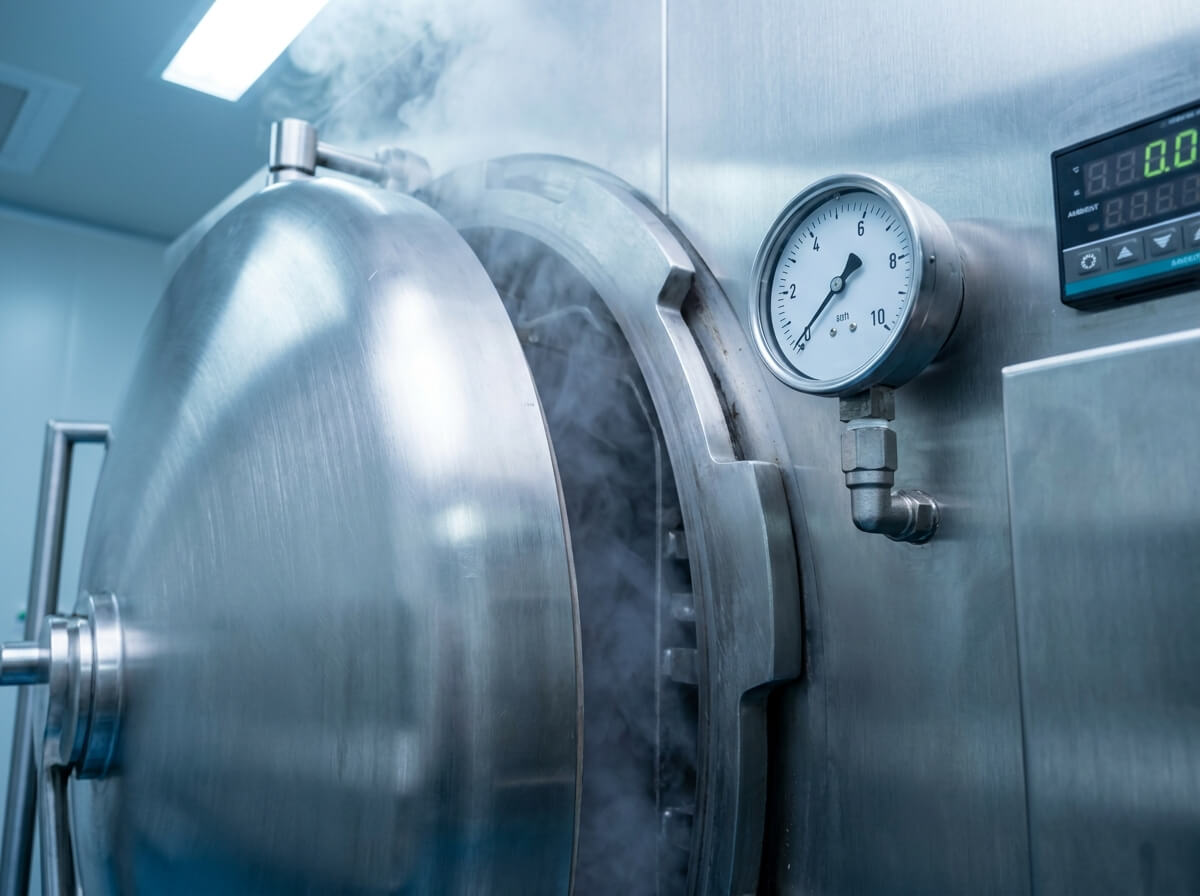
An autoclave is a sterilization device that uses pressurized steam to process equipment and materials that are suitable for moist heat. It is widely used in hospitals, dental clinics, laboratories, pharmaceutical facilities, veterinary facilities, research centers, and other healthcare environments.
You may also see terms such as autoclave sterilizer, steam sterilizer, steam autoclave, medical sterilizer, laboratory autoclave, and sterilization machine. These terms can refer to related equipment, although the exact product category and intended use vary.
For medical equipment buyers, understanding the difference between autoclave types, sterilization cycles, chamber capacity, applications, and technical specifications is important before selecting equipment.
Steam sterilization is based on exposure to saturated steam under pressure. CDC identifies gravity displacement and dynamic-air-removal, such as pre-vacuum, sterilizers as two basic types of steam sterilizers. The appropriate cycle depends on the sterilizer, load, packaging, and materials being processed.
This guide explains what an autoclave is, how it works, the main types of autoclaves, common applications, important parameters, and what hospitals and distributors should consider when selecting a steam sterilizer.
What Is an Autoclave?
An autoclave is a machine designed to sterilize suitable materials using saturated steam under pressure.
The basic concept is:
Water → Steam → Pressure → Heat Transfer → Sterilization
The steam transfers heat efficiently to the surfaces of the load. When the required conditions are maintained for the required exposure period, microorganisms are inactivated.
A typical autoclave includes:
- Sterilization chamber
- Steam generation or steam supply system
- Door and locking system
- Temperature sensors
- Pressure monitoring
- Control system
- Valves
- Drain
- Safety devices
- Display or control panel
Depending on the model, an autoclave may also include:
- Vacuum pump
- Water reservoir
- Drying system
- Printer
- Data recording
- Automatic loading programs
- Multiple sterilization cycles
- Touchscreen controls
FDA currently classifies steam sterilizers as a medical device category in the United States and recognizes separate standards for hospital steam sterilizers and tabletop steam sterilizers.
What Is a Sterilizer?
A sterilizer is a broader term for equipment used to achieve sterilization.
There are several sterilization technologies, including:
- Steam sterilization
- Dry heat sterilization
- Ethylene oxide sterilization
- Hydrogen peroxide vapor or plasma-based processes
- Other specialized technologies
An autoclave specifically refers to equipment using pressurized steam for sterilization.
Therefore:
Autoclave = a type of sterilizer
but:
Sterilizer ≠ always an autoclave
This distinction is useful when searching for medical sterilization equipment because buyers may use both terms.
Common commercial search terms include:
- autoclave sterilizer
- steam sterilizer
- steam autoclave
- medical sterilizer
- sterilization equipment
- sterilizer machine
- hospital sterilizer
- laboratory sterilizer
Autoclave vs Sterilizer
The simplest difference is the sterilization method.
| Term | Meaning |
|---|---|
| Autoclave | Sterilizer using pressurized steam |
| Steam Sterilizer | Sterilizer using saturated steam |
| Dry Heat Sterilizer | Uses hot dry air |
| Gas Sterilizer | Uses a sterilizing gas |
| Hydrogen Peroxide Sterilizer | Uses vaporized hydrogen peroxide or related processes |
For heat- and moisture-resistant critical medical instruments, steam is an important sterilization method. WHO guidance emphasizes matching the sterilization method to the device risk category and material properties.
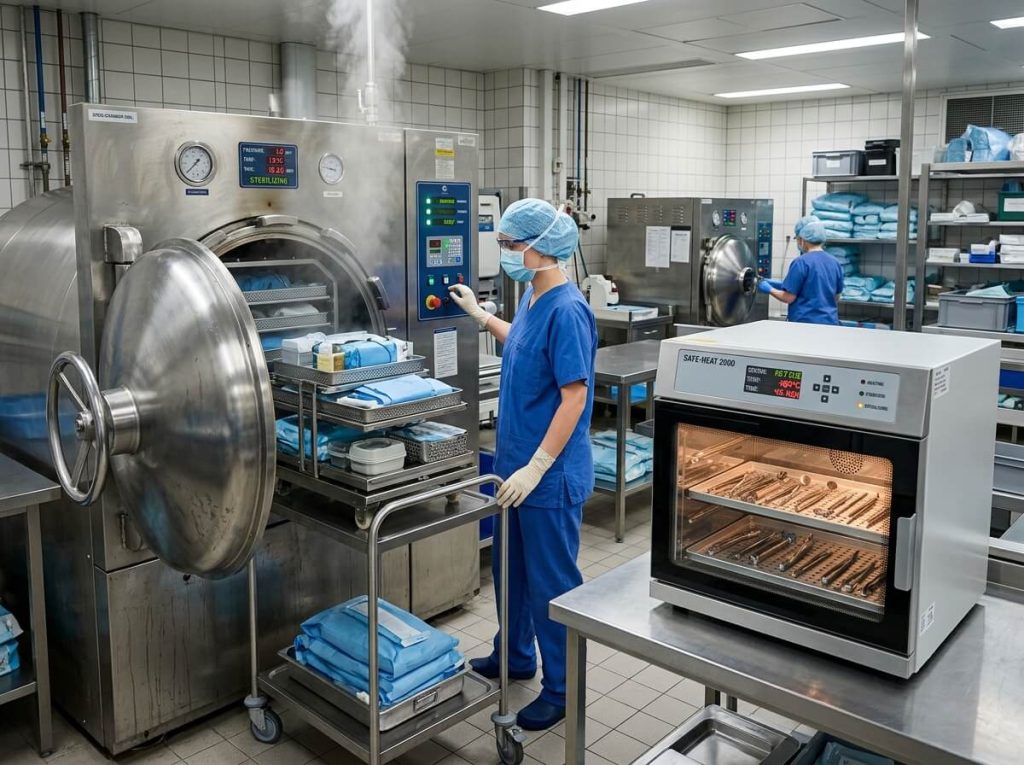
How Does an Autoclave Work?
The basic working principle of an autoclave can be divided into several stages.
1. Loading
The items to be sterilized are placed inside the chamber.
The load must be arranged according to the equipment’s instructions so that steam can reach the appropriate surfaces.
Overloading a chamber can interfere with steam circulation and air removal.
2. Air Removal
Depending on the autoclave design, air may be removed by:
- Gravity displacement
- Pre-vacuum
- Other dynamic-air-removal methods
Air removal matters because trapped air can interfere with steam contact and heat transfer.
3. Steam Admission
Steam enters the chamber.
The chamber temperature and pressure rise toward the selected cycle conditions.
4. Exposure
The load is maintained at the required sterilization conditions for the specified exposure period.
5. Exhaust
After the exposure phase, steam is removed according to the selected cycle.
6. Drying
Some autoclaves include a drying phase.
Drying can be particularly important for packaged or wrapped instruments where moisture may affect handling and storage.
The actual cycle sequence varies according to the autoclave model, load, cycle type, and manufacturer instructions.
How Does Steam Sterilization Work?
Steam sterilization works by exposing microorganisms to saturated steam at controlled temperature, pressure, and time.
WHO describes saturated steam sterilization as exposure to steam under pressure and emphasizes precise control of time, temperature, and pressure.
The process is based on efficient heat transfer.
Because steam carries a large amount of thermal energy, condensation on a cooler load transfers heat efficiently to the surface.
For steam sterilization to work correctly, several conditions matter:
- Steam quality
- Temperature
- Exposure time
- Air removal
- Load configuration
- Packaging
- Instrument design
- Cycle selection
This is why simply reaching a certain chamber temperature does not automatically mean every load has been appropriately sterilized.
What Are the Main Autoclave Sterilization Parameters?
The most important parameters include:
Temperature
Common steam sterilization temperatures include approximately:
- 121°C
- 132°C
- 134°C
However, the appropriate temperature and exposure time depend on the sterilizer, load, cycle, packaging, and validated process.
CDC notes that sterilization time varies with factors including item type, wrapped or unwrapped condition, porous or nonporous characteristics, lumens, and sterilizer type.
Pressure
Pressure allows the chamber to achieve the required saturated steam temperature.
Pressure and temperature therefore need to be considered together rather than as independent numbers.
Time
The load must remain at the specified sterilization conditions for the required exposure period.
Steam Quality
Steam should reach the load appropriately and provide effective heat transfer.
Air Removal
Air must be adequately removed for appropriate steam contact, especially for porous and complex loads.
Common Autoclave Temperature Settings
People often search for:
- 121°C autoclave
- 134°C autoclave
- 132°C autoclave
- autoclave temperature
- steam sterilizer temperature
- sterilization temperature
These are important search terms, but they should not be treated as universal settings.
Different loads require different cycles.
For example, CDC provides examples of sterilization parameters that vary with sterilizer type, load configuration, temperature, and exposure time.
Therefore, the correct cycle should be determined according to the manufacturer’s validated instructions for the sterilizer, instruments, packaging, and load.
Main Types of Autoclaves
There are several ways to classify autoclaves.
They can be categorized by:
- Air-removal method
- Chamber orientation
- Capacity
- Application
- Automation level
- Installation method
The main types include:
- Gravity displacement autoclave
- Pre-vacuum autoclave
- Tabletop autoclave
- Vertical autoclave
- Horizontal autoclave
- Floor-standing autoclave
- Portable autoclave
- Laboratory autoclave
- Medical autoclave
- Waste sterilization autoclave
1. Gravity Displacement Autoclave
A gravity displacement autoclave removes air by allowing steam to enter the chamber and displace the cooler air.
CDC identifies gravity displacement autoclaves as one of the basic types of steam sterilizers. They are commonly used for items where steam can directly contact the surfaces and are often found in laboratory and other applications.
Gravity autoclaves can be suitable for:
- Laboratory media
- Water
- Some pharmaceutical materials
- Regulated medical waste
- Nonporous instruments
- Suitable heat-resistant items
The load should always match the validated capabilities of the machine.
2. Pre-Vacuum Autoclave
A pre-vacuum autoclave, also called a pre-vacuum steam sterilizer, uses a vacuum stage to remove air from the chamber before steam exposure.
This can improve steam penetration into:
- Porous materials
- Wrapped instruments
- Loads with challenging air removal requirements
- Some devices with internal spaces
CDC identifies high-speed pre-vacuum sterilizers as dynamic-air-removal systems and explains that air removal improves steam penetration into porous loads.
Pre-vacuum systems are commonly associated with hospital sterilization and larger CSSD environments.
3. Tabletop Autoclave
A tabletop autoclave is a compact sterilizer designed to fit on or near a work surface.
Common applications include:
- Dental clinics
- Small clinics
- Outpatient facilities
- Small laboratories
- Primary healthcare facilities
Typical search terms include:
- tabletop autoclave
- benchtop autoclave
- dental tabletop autoclave
- small autoclave sterilizer
- compact steam sterilizer
- portable tabletop sterilizer
FDA specifically recognizes a separate standard category for table-top steam sterilizers, which reflects their established use as a distinct equipment type.
4. Vertical Autoclave
A vertical autoclave has a chamber that is generally loaded from the top.
Vertical autoclaves are commonly used in:
- Laboratories
- Research facilities
- Universities
- Small medical facilities
- Veterinary facilities
A vertical design can provide a relatively compact footprint while offering useful chamber capacity.
Buyers often search for:
- vertical autoclave
- vertical steam sterilizer
- laboratory vertical autoclave
- automatic vertical autoclave
- electric vertical autoclave
When comparing vertical models, check:
- Chamber volume
- Inner dimensions
- Maximum load
- Control system
- Heating method
- Safety features
- Drying options
- Water requirements
5. Horizontal Autoclave
A horizontal autoclave usually has a larger chamber and front-loading configuration.
It is often used for:
- Hospitals
- CSSD departments
- Large laboratories
- Pharmaceutical facilities
- Central sterilization departments
Common search terms include:
- horizontal autoclave
- horizontal steam sterilizer
- hospital horizontal sterilizer
- large capacity autoclave
- CSSD autoclave
- hospital steam sterilizer
A horizontal sterilizer can be suitable for higher-volume processing where larger chamber capacity and loading efficiency are important.
6. Floor-Standing Autoclave
A floor-standing autoclave is designed for installation directly on the floor.
It can offer more capacity than a tabletop unit and may be used in:
- Hospitals
- Laboratories
- Research centers
- Veterinary facilities
- Industrial environments
The required footprint and utility connections should be checked before installation.
7. Portable Autoclave
A portable autoclave is designed to provide greater mobility than a traditional fixed installation.
Portable units may be useful in:
- Field healthcare
- Small clinics
- Mobile laboratories
- Rural healthcare
- Veterinary applications
- Educational environments
However, portability should not be confused with universal use.
The machine must still be appropriate for the intended load and operating environment.
Autoclave Types by Application
Another useful way to classify autoclaves is according to their users.
Medical Autoclave
Designed for healthcare environments.
Hospital Autoclave
Usually associated with larger-scale medical instrument sterilization.
Dental Autoclave
Designed for dental practices and clinics.
Laboratory Autoclave
Used for laboratory media, glassware, instruments, and other compatible materials.
Pharmaceutical Autoclave
Designed for controlled sterilization processes in pharmaceutical environments.
Veterinary Autoclave
Used in veterinary clinics and animal hospitals.
Waste Autoclave
Used for treating certain types of medical or regulated waste according to applicable requirements.
What Can an Autoclave Sterilize?
An autoclave can sterilize many heat- and moisture-resistant materials, depending on the device, load, and manufacturer’s validated instructions.
Potential examples include:
- Stainless steel surgical instruments
- Certain glassware
- Laboratory glassware
- Some rubber materials
- Certain silicone products
- Compatible textiles
- Suitable laboratory media
- Some reusable medical devices
WHO materials classify devices partly according to infection risk and material properties and identify thermoresistant critical items as candidates for steam sterilization when appropriate.
However, not every material can be safely steam sterilized.
What Should Not Be Steam Sterilized?
Some materials may be damaged by:
- Heat
- Moisture
- Pressure
- Steam exposure
Potential examples can include certain:
- Heat-sensitive plastics
- Electronic devices
- Materials not rated for steam
- Certain chemicals
- Oils
- Powders
- Moisture-sensitive components
Some devices may also contain materials that are incompatible with the selected sterilization process.
The correct decision should always come from the device manufacturer’s instructions.
Do not assume that an object is suitable for autoclaving simply because it physically fits inside the chamber.
Autoclave for Surgical Instruments
One of the most common applications is sterilization of reusable surgical instruments that are compatible with steam sterilization.
Examples may include:
- Stainless steel instruments
- Surgical trays
- Forceps
- Scissors
- Retractors
- Other compatible reusable instruments
For healthcare use, the complete reprocessing workflow is more than the sterilization cycle itself.
It can include:
Cleaning → Inspection → Packaging → Sterilization → Storage
WHO’s medical-device reprocessing guidance emphasizes the broader workflow and infrastructure required for safe processing of reusable devices.
Autoclave for Dental Instruments
A dental autoclave is commonly used to sterilize suitable reusable dental instruments.
Potential items include:
- Dental hand instruments
- Dental forceps
- Dental mirrors
- Scalers
- Surgical dental instruments
- Other steam-compatible items
Compact tabletop autoclaves are particularly relevant to dental clinics because they can provide sterilization within a limited working space.
When purchasing a dental autoclave, consider:
- Chamber capacity
- Cycle selection
- Drying function
- Instrument compatibility
- Packaging requirements
- Water quality
- Maintenance
- Regulatory documentation
Autoclave for Laboratory Use
Laboratory autoclaves are widely used in research, microbiology, education, and testing facilities.
Potential laboratory applications include:
- Culture media
- Glassware
- Laboratory instruments
- Suitable liquid loads
- Laboratory waste
- Certain research materials
A laboratory autoclave may have different requirements from a hospital instrument sterilizer.
For example, liquid sterilization requires careful consideration of load type and cycle design.
Therefore, laboratory buyers should tell the supplier exactly what materials will be processed.
Autoclave for Pharmaceutical Applications
Pharmaceutical facilities may use steam sterilization for appropriate heat- and moisture-resistant materials and products.
The equipment may require:
- Controlled process parameters
- Data recording
- Validation
- Documentation
- Monitoring
- Appropriate chamber design
- Qualified installation
Pharmaceutical sterilization is highly process-specific, so procurement should involve the quality and validation teams rather than simply selecting equipment by chamber volume.
Autoclave for Veterinary Use
Veterinary clinics and animal hospitals may use steam sterilizers for suitable reusable instruments.
Typical applications include:
- Surgical instruments
- Dental veterinary instruments
- Animal-care instruments
- Laboratory materials
A veterinary autoclave may have different capacity requirements depending on the clinic size and surgical workload.
Autoclave for Medical Waste
Some autoclaves are designed to treat specific types of medical or regulated waste.
Applications can include certain:
- Infectious waste
- Laboratory waste
- Contaminated materials
However, waste treatment requirements vary substantially by country and waste category.
A hospital should select a waste sterilization system specifically designed and approved for its intended waste stream.
The machine used for surgical instruments should not automatically be assumed to be suitable for medical waste.
Main Components of an Autoclave
Understanding the main components can help buyers compare different models.
Sterilization Chamber
The chamber holds the load.
Important specifications include:
- Chamber volume
- Chamber material
- Working dimensions
- Maximum load
- Operating pressure
- Operating temperature
Door
The door provides access to the chamber and helps maintain pressure during the cycle.
Hospital units may use:
- Single-door design
- Double-door design
Double-door systems can support controlled workflows in certain CSSD environments.
Steam Generation System
The steam may come from:
- Built-in electric heating
- External steam supply
- Integrated steam generator
The choice affects installation requirements.
Vacuum System
A vacuum pump or dynamic-air-removal system may be included in pre-vacuum autoclaves.
Sensors
Common sensors monitor:
- Temperature
- Pressure
- Vacuum
Control System
The controller manages:
- Cycle selection
- Heating
- Vacuum
- Steam admission
- Exposure
- Exhaust
- Drying
- Alarms
Safety System
Safety features may include:
- Door interlock
- Pressure protection
- Temperature protection
- Overpressure protection
- Alarm system
Exact safety functions vary by manufacturer.
Automatic vs Manual Autoclave
Autoclaves can also be classified according to their control system.
Manual Autoclave
The operator may need to control more parts of the process manually.
Potential advantages include:
- Simpler system
- Lower purchase cost in some cases
- Suitable for certain basic applications
Potential disadvantages include:
- More operator involvement
- Greater dependence on correct operation
- Less automated data recording
Automatic Autoclave
Automatic models can control programmed cycles.
Potential features include:
- Automatic heating
- Automatic pressure control
- Automatic sterilization timing
- Automatic exhaust
- Automatic drying
- Alarm notifications
- Cycle records
The right level of automation depends on the application and operating environment.
Digital and Touchscreen Autoclaves
Modern autoclaves may use:
- Digital display
- LCD screen
- Touchscreen
- Microprocessor control
- Programmable cycles
- Automatic alarms
A digital autoclave can make it easier to:
- Select cycles
- View temperature
- View pressure
- Monitor remaining time
- Review alarms
- Record cycle information
For larger hospitals and regulated environments, data recording can be especially useful for documentation and quality management.
Autoclave Chamber Capacity
Autoclave capacity is one of the first specifications buyers compare.
Common search terms include:
- 8L autoclave
- 12L autoclave
- 18L autoclave
- 23L autoclave
- 24L autoclave
- 50L autoclave
- 100L autoclave
- 150L autoclave
- 200L autoclave
- large capacity autoclave
Capacity should not be selected based only on the number of liters.
Also consider:
- Chamber dimensions
- Instrument size
- Tray dimensions
- Packaging
- Load weight
- Daily workload
- Cycle frequency
A larger chamber is not automatically better if the facility rarely needs the extra capacity.
How to Choose Autoclave Capacity
A simple approach is to estimate:
Number of loads per day × load size × required cycle frequency
For a dental clinic with a relatively small number of instruments, a compact tabletop autoclave may be sufficient.
A large hospital CSSD may need several large horizontal steam sterilizers.
Laboratories may require larger chambers when processing media, glassware, waste, or research materials.
The key is to match capacity to actual workflow.
Autoclave Water Requirements
Steam sterilizers require water for steam generation or processing depending on their design.
Buyers should check:
- Water type
- Water quality requirements
- Water consumption
- Built-in reservoir
- External water supply
- Drain requirements
For some equipment, water quality can affect chamber components and sterilizer performance.
FDA’s current steam-sterilizer classification page identifies AAMI ST108:2023 regarding water for the processing of medical devices among recognized consensus standards.
The exact water specification should therefore be taken from the sterilizer manufacturer’s documentation.
Autoclave Power Requirements
Electrical requirements vary by model.
Check:
- Voltage
- Frequency
- Rated power
- Phase
- Plug type
- Current requirement
For international projects, these specifications are especially important.
A manufacturer may offer different electrical configurations for different markets.
Before ordering, the buyer should provide:
Target country + local voltage + frequency + installation environment
This helps avoid configuration problems.
Autoclave Safety Features
Safety is an essential consideration when purchasing steam sterilization equipment.
Potential safety features include:
- Door interlock
- Overpressure protection
- Temperature protection
- Automatic pressure release
- Cycle alarms
- Water-level protection
- Fault detection
- Emergency stop
- Chamber monitoring
The exact safety design varies by equipment category and applicable standards.
The buyer should request the manufacturer’s safety specification and applicable compliance documentation.
Autoclave Monitoring and Sterilization Control
A sterilization process should be monitored appropriately.
CDC describes three categories of monitoring:
Mechanical Monitoring
Monitoring physical parameters such as:
- Time
- Temperature
- Pressure
Chemical Indicators
Indicators can provide evidence that the process conditions were reached at the indicator location.
Biological Indicators
Biological indicators use resistant microorganisms to evaluate sterilization effectiveness.
CDC recommends mechanical, chemical, and biological monitoring as part of sterilization quality control.
The exact monitoring program depends on the sterilizer type, healthcare facility, load, standards, and applicable procedures.
Sterilization Validation
Sterilization validation is an important topic for hospitals, pharmaceutical companies, and other regulated environments.
Validation can involve demonstrating that a sterilization process consistently achieves the intended outcome under defined conditions.
It may involve:
- Equipment qualification
- Process development
- Cycle verification
- Load configuration
- Temperature mapping
- Biological indicators
- Chemical indicators
- Documentation
- Revalidation
FDA’s current steam sterilizer classification recognizes ISO 17665:2024 for sterilization of healthcare products by moist heat and requirements for developing, validating, and routinely controlling sterilization processes for medical devices.
Autoclave vs Dry Heat Sterilizer
Both technologies use heat, but the mechanisms differ.
Steam Autoclave
Uses:
- Moist heat
- Saturated steam
- Pressure
Suitable for many heat- and moisture-resistant materials.
Dry Heat Sterilizer
Uses:
- Hot dry air
- Higher temperatures
- Longer exposure in many applications
Dry heat can be useful for certain materials that are compatible with dry heat but should not be exposed to moisture.
The appropriate technology depends on the load.
Autoclave vs Other Sterilization Technologies
For moisture-sensitive instruments, steam may not be suitable.
Other sterilization methods include:
- Ethylene oxide
- Hydrogen peroxide-based systems
- Dry heat
- Other low-temperature technologies
The selection depends on:
- Device material
- Temperature sensitivity
- Moisture sensitivity
- Device geometry
- Intended use
- Manufacturer instructions
- Facility requirements
WHO emphasizes selecting a suitable method based on the type and material of the reusable medical device.
Advantages of Steam Autoclave Sterilization
Steam sterilization is widely used because it can provide several practical advantages for compatible loads.
These can include:
- Established technology
- Effective heat transfer
- No need for chemical sterilant in the chamber
- Suitable for many reusable instruments
- Multiple equipment configurations
- Broad range of chamber sizes
- Automated cycle options
- Applications across healthcare and laboratories
It is one of the most established sterilization approaches for suitable heat- and moisture-resistant materials.
Limitations of Autoclaves
An autoclave is not suitable for every material.
Possible limitations include:
- Heat-sensitive devices
- Moisture-sensitive materials
- Certain electronics
- Some plastics
- Certain chemical substances
- Oils
- Powders
- Improperly packaged loads
Another limitation is that sterilization quality depends on:
- Correct cleaning
- Correct loading
- Air removal
- Steam quality
- Correct cycle
- Appropriate packaging
- Routine monitoring
Therefore, the autoclave should always be considered as part of the complete reprocessing process.
How to Choose an Autoclave Manufacturer
International buyers often search for:
- autoclave manufacturer
- autoclave supplier
- autoclave factory
- steam sterilizer manufacturer
- medical sterilizer supplier
- hospital autoclave supplier
- dental autoclave manufacturer
- laboratory autoclave manufacturer
When evaluating suppliers, consider:
- Manufacturing experience
- Production capability
- Quality management
- Product range
- Regulatory documentation
- OEM/ODM capability
- Technical support
- Spare parts
- Warranty
- Export experience
For larger hospital projects, buyers may also want:
- Installation support
- Operator training
- Maintenance training
- Validation support
- Documentation
- Long-term service
Autoclave Accessories
A complete autoclave system can include more than the sterilizer itself.
Common accessories include:
- Stainless steel trays
- Sterilization baskets
- Instrument racks
- Tray holders
- Loading carts
- Drain accessories
- Water treatment systems
- Printer
- Data recording accessories
- Packaging supports
Large hospital sterilizers may also require:
- Loading trolley
- Transfer trolley
- Loading system
- Pass-through configuration
- Double-door operation
The appropriate accessories depend on the equipment type and workflow.
Common Autoclave Applications
An autoclave can be found in many environments.
Healthcare
- Hospitals
- Clinics
- Dental clinics
- Surgical centers
- CSSD
- Emergency facilities
Laboratory
- Research laboratories
- Microbiology laboratories
- University laboratories
- Testing laboratories
Pharmaceutical
- Pharmaceutical production
- Research and development
- Sterile processing environments
Veterinary
- Veterinary clinics
- Animal hospitals
- Veterinary laboratories
Other
- Medical waste processing
- Research institutions
- Educational institutions
This wide application range creates many SEO opportunities for manufacturers and suppliers.
Autoclave Frequently Asked Questions
What is an autoclave?
An autoclave is a sterilization device that uses pressurized steam to process suitable heat- and moisture-resistant materials.
Is an autoclave the same as a sterilizer?
An autoclave is a type of sterilizer. The term sterilizer is broader and can describe equipment using other sterilization technologies.
How does an autoclave work?
An autoclave removes or displaces air, introduces steam, reaches the required temperature and pressure, holds the load for the required exposure time, and then exhausts and may dry the load according to the selected cycle.
What is a steam sterilizer?
A steam sterilizer uses saturated steam under pressure to sterilize compatible materials.
What temperature does an autoclave use?
Common steam sterilization temperatures include approximately 121°C, 132°C, and 134°C, but the correct cycle depends on the equipment, load, packaging, and validated manufacturer instructions.
How long does an autoclave take?
Cycle time varies according to the load, temperature, sterilizer type, packaging, air-removal method, exposure time, and drying requirements.
What is a pre-vacuum autoclave?
A pre-vacuum autoclave removes air from the chamber before steam exposure to improve steam penetration into suitable loads.
What is a gravity autoclave?
A gravity autoclave uses incoming steam to displace air from the chamber rather than relying on a dedicated pre-vacuum stage.
What is a tabletop autoclave?
A tabletop autoclave is a compact steam sterilizer commonly used in smaller healthcare, dental, laboratory, and outpatient environments.
What is a vertical autoclave?
A vertical autoclave is generally loaded from the top and is commonly used in laboratory and smaller institutional applications.
What is a horizontal autoclave?
A horizontal autoclave is generally front-loaded and is commonly used for higher-volume hospital, laboratory, and industrial applications.
Can I sterilize surgical instruments in an autoclave?
Suitable heat- and moisture-resistant surgical instruments may be steam sterilized according to the instrument and sterilizer manufacturer’s validated instructions.
Can plastic be autoclaved?
Some plastics are compatible with steam sterilization and others are not. Always verify compatibility with the material or instrument manufacturer.
Can glass be autoclaved?
Some laboratory glassware and other suitable glass materials can be steam sterilized. Compatibility should be confirmed before processing.
Can liquids be sterilized in an autoclave?
Some compatible liquids can be steam sterilized, but liquid loads require appropriate cycle selection and handling procedures.
Can all medical devices be autoclaved?
No. Devices that are sensitive to heat, moisture, pressure, or steam may require another method.
What is a hospital autoclave?
A hospital autoclave is a steam sterilizer designed for healthcare applications, often with larger capacity and advanced cycle, monitoring, and workflow functions.
What is a dental autoclave?
A dental autoclave is generally a compact steam sterilizer designed for suitable reusable dental instruments and related healthcare applications.
What is a laboratory autoclave?
A laboratory autoclave is used to sterilize compatible laboratory materials such as media, glassware, instruments, and certain waste.
What is a medical waste autoclave?
A medical waste autoclave is a sterilization system designed specifically for compatible healthcare or regulated waste streams.
What should I consider when buying an autoclave?
Consider the application, chamber capacity, sterilization method, cycles, temperature, drying, utilities, safety features, regulatory documentation, accessories, maintenance, and supplier support.
How often should an autoclave be maintained?
The maintenance schedule depends on the manufacturer, model, usage, facility procedures, and applicable regulations.
Does an autoclave need sterilization monitoring?
Appropriate monitoring is an important part of sterilization quality control. CDC describes mechanical, chemical, and biological monitoring approaches.
Conclusion
An autoclave sterilizer is a widely used piece of sterilization equipment for healthcare, dental, laboratory, pharmaceutical, veterinary, and other suitable applications.
The basic principle is straightforward:
Saturated steam + controlled temperature + pressure + exposure time = steam sterilization process
However, selecting and operating an autoclave involves more than choosing a temperature or chamber size.
The right equipment depends on:
- Application
- Load type
- Material compatibility
- Capacity
- Air-removal method
- Sterilization cycle
- Drying requirements
- Water and power requirements
- Monitoring
- Safety
- Regulatory requirements
- Maintenance
- Supplier support
The main autoclave categories include gravity displacement, pre-vacuum, tabletop, vertical, horizontal, portable, laboratory, hospital, dental, and waste sterilizers.
For hospitals and medical equipment buyers, the most important rule is simple: select the sterilization method and cycle according to the manufacturer’s validated instructions for the device, sterilizer, packaging, and load. WHO and CDC both emphasize that sterilization parameters and procedures depend on the specific equipment and load rather than one universal setting.
For procurement teams, a good autoclave supplier should provide clear specifications, applicable regulatory documentation, compatible accessories, installation guidance, training, warranty coverage, spare parts, and technical support.
Understanding these fundamentals provides a strong starting point for comparing autoclave machines, steam sterilizers, medical sterilization equipment, and laboratory autoclaves.
The next step is to examine the autoclave sterilization cycle in more detail, including temperature, pressure, time, vacuum, steam penetration, drying, cycle selection, and sterilization monitoring.