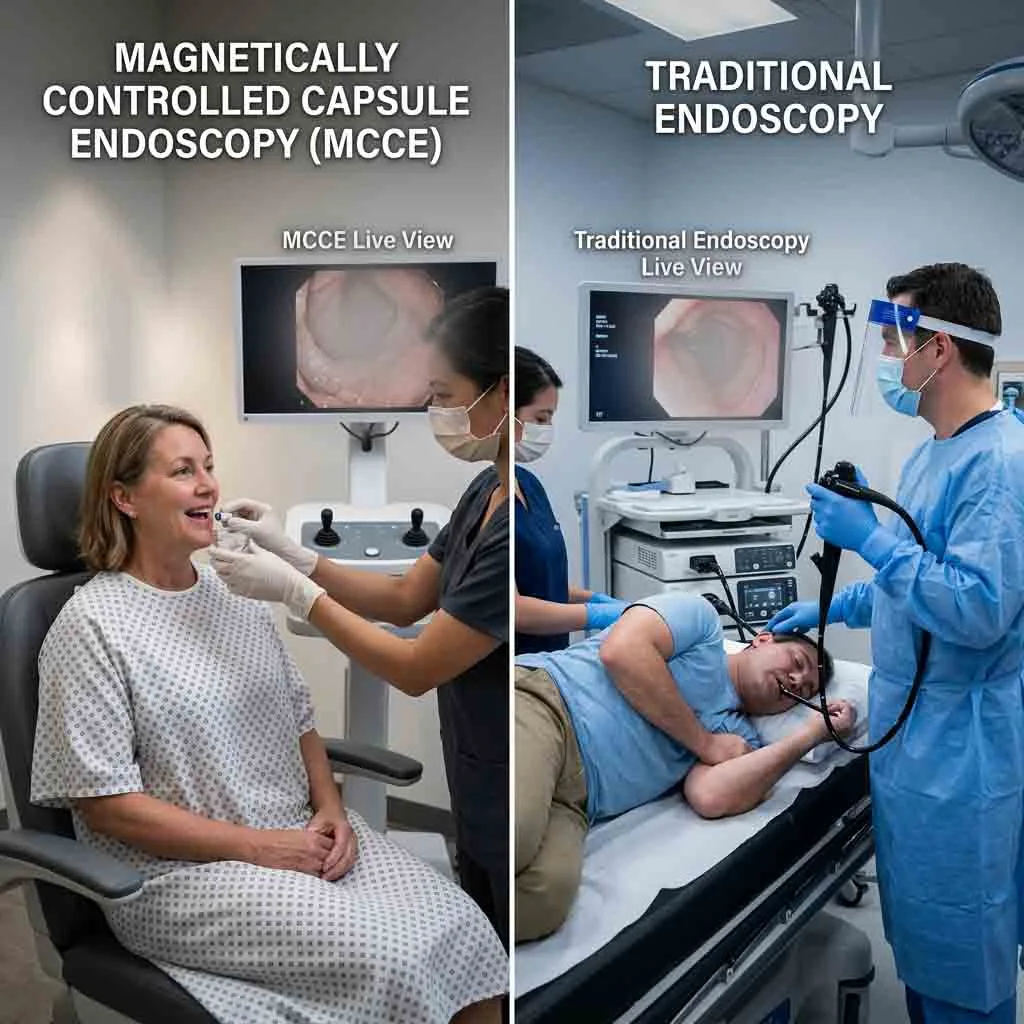
Overcoming the Fear of GI Screening
For decades, traditional endoscopy—specifically gastroscopy (upper GI) and colonoscopy (lower GI)—has been the undisputed gold standard for diagnosing gastrointestinal diseases and screening for gastric and colorectal cancers. However, these procedures come with a significant barrier: patient fear.
The prospect of fasting, swallowing a long flexible tube, or undergoing clinical sedation deters millions of patients from receiving critical early cancer screenings.
To bridge this gap, medical technology introduced Magnetically Controlled Capsule Endoscopy (MCCE). While standard passive capsule endoscopy relies entirely on natural gut movement (peristalsis) to travel through the small intestine, MCCE allows a gastroenterologist to actively “drive” the capsule around the cavernous space of the stomach using precise external magnetic fields.
For healthcare providers, procurement managers, and patients, understanding the pros and cons of MCCE versus traditional endoscopy is crucial for optimizing diagnostic workflows, improving patient compliance, and making sound equipment purchasing decisions.
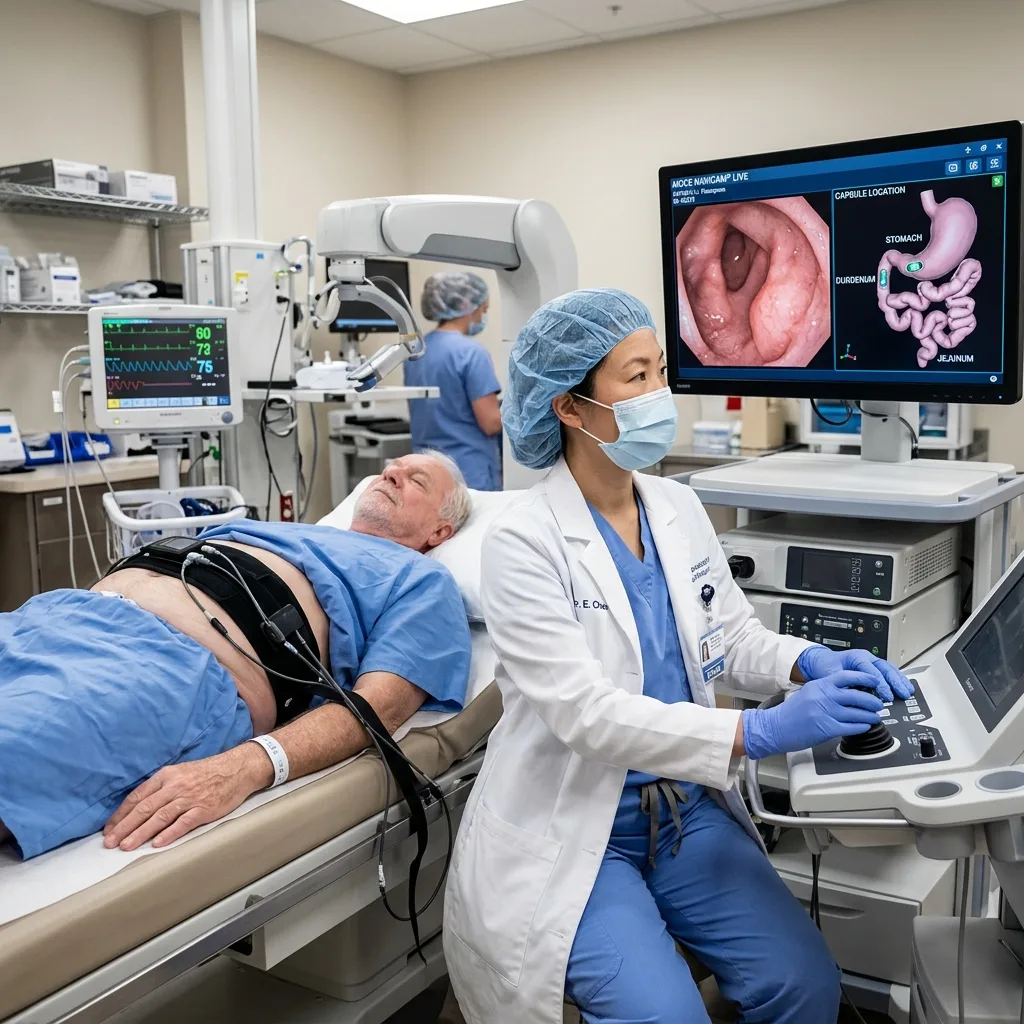
2. How Magnetically Controlled Capsule Endoscopy (MCCE) Works
The human stomach is a large, pouch-like organ. A standard passive capsule endoscope would simply fall to the bottom of the stomach and quickly pass into the small intestine, missing critical areas like the gastric fundus or cardia.
MCCE solves this problem through robotic magnetic navigation.
The Magnetic Navigation System
-
The Magnetic Capsule: The patient swallows a specially designed medical endoscopy capsule that contains a tiny, permanent internal magnet alongside the standard CMOS camera, LEDs, and wireless transmitter.
-
The External Magnetic Controller: The patient lies on an examination bed positioned beneath a large C-arm robotic magnet (or the doctor uses a highly calibrated handheld magnetic controller).
-
Active 360-Degree Piloting: By manipulating the external magnetic field via a joystick and software workstation, the doctor can lift, rotate, tilt, and translate the capsule inside the patient’s stomach. This allows the camera to perform a systematic, point-by-point inspection of all six major gastric regions (cardia, fundus, body, angulus, antrum, and pylorus).
Once the gastric examination (which takes about 15 to 30 minutes) is complete, the magnetic control is turned off. The capsule then transitions into a standard passive small bowel capsule, traveling naturally through the rest of the GI tract.
3. The Unmatched Advantages of MCCE
MCCE is rapidly gaining traction in preventive health centers, premium physical examination clinics, and gastroenterology departments due to its unparalleled patient-centric benefits.
A. Completely Painless & Sedation-Free
Traditional gastroscopy triggers a severe gag reflex, often requiring intravenous conscious sedation or general anesthesia. Anesthesia requires pre-evaluation, constant vital sign monitoring, and a post-procedure recovery room.
MCCE requires zero sedation. The patient remains fully awake, comfortably chatting with the doctor while watching their own stomach on the monitor. They can drive home or return to work immediately after the 20-minute scan.
B. Zero Risk of Cross-Infection
Traditional endoscopes are complex, reusable medical devices with narrow internal working channels (for water, air, and biopsy forceps). They require rigorous, multi-step chemical sterilization between patients. If sterilization protocols are flawed, there is a risk of transmitting pathogens (e.g., Helicobacter pylori, Hepatitis).
MCCE capsules are single-use disposable consumables. Packaged in sterile medical pouches, the capsule is swallowed once and flushed away, completely eliminating patient-to-patient cross-contamination.
C. Cardiovascular Safety for High-Risk Patients
Elderly patients or those with severe cardiovascular and respiratory diseases are often deemed high-risk for clinical sedation and the physical stress of tube insertion. MCCE offers a highly safe, non-invasive alternative for screening frail patients who cannot tolerate traditional endoscopy.
4. The Unreplaceable Strengths of Traditional Endoscopy
Despite the massive leap in comfort provided by MCCE, traditional gastroscopy and colonoscopy remain the absolute gold standard in gastrointestinal medicine for several fundamental reasons.
A. Tissue Biopsy (The Gold Standard for Cancer)
If an MCCE scan detects a suspicious ulcer, a protruding polyp, or an irregular mucosal lesion, the pill camera can only take a photograph. It cannot take a tissue sample.
Traditional endoscopy features a hollow working channel. The doctor can insert microscopic forceps to extract tissue samples (biopsy) for pathology testing. A biopsy is the only definitive way to diagnose gastric or colorectal cancer.
B. Immediate Therapeutic Intervention
Traditional endoscopes are not just diagnostic cameras; they are surgical tools.
-
Polyp Removal (Polypectomy): If a precancerous polyp is found during a colonoscopy, the doctor can immediately snare and remove it.
-
Hemostasis (Stopping Bleeding): If a patient has a bleeding gastric ulcer or esophageal varices, the doctor can use the endoscope to inject epinephrine, apply hemostatic clips, or use argon plasma coagulation to stop the bleeding instantly.
MCCE cannot perform any therapeutic interventions.
C. Air Inflation, Suction & Washing
During a traditional endoscopy, the doctor can pump air to inflate the stomach or colon to flatten out tissue folds and reveal hidden lesions. They can also use water jets to wash away mucus, blood, or leftover food debris, and use suction to remove the dirty fluid.
An MCCE capsule relies entirely on the patient drinking a simethicone (anti-foaming) and water solution beforehand to clear the stomach; it cannot actively wash away debris if the view is obstructed.
5. Head-to-Head Comparison Matrix
For hospital procurement managers and clinical directors deciding how to allocate diagnostic equipment budgets, this matrix highlights the operational differences between the two modalities:
| Feature / Metric | Magnetically Controlled Capsule (MCCE) | Traditional Gastroscopy / Colonoscopy |
| Invasiveness & Pain | Completely non-invasive, painless | Invasive, causes gag reflex / cramping |
| Sedation Requirement | None (Awake procedure) | Usually requires conscious sedation or anesthesia |
| Cross-Infection Risk | Zero (Single-use disposable consumable) | Low, but dependent on strict chemical sterilization |
| Biopsy Capability | No (Visual diagnosis only) | Yes (Gold standard for pathology) |
| Therapeutic Treatment | No (Cannot remove polyps or stop bleeding) | Yes (Polypectomy, clipping, coagulation) |
| Small Bowel Coverage | Excellent (Passes naturally through entire GI tract) | Poor (Cannot reach the deep middle small bowel) |
| Gastric (Stomach) View | Excellent (Via magnetic robotic control) | Excellent (Via flexible tube manipulation) |
| Post-Exam Recovery | Immediate (Patient returns to normal activity) | 1 to 2 hours (Due to sedation grogginess) |
6. Hospital Strategy: Integrating Both Systems for Maximum ROI
Modern, forward-thinking medical institutions do not view MCCE and traditional endoscopy as mutually exclusive competitors. Instead, they deploy them as a stratified diagnostic workflow.
The “First Line of Defense” Screening Strategy
Hospitals and premium health check-up centers utilize MCCE as the primary screening tool for asymptomatic populations. Because MCCE is painless, patient compliance for gastric and bowel screening increases dramatically.
-
Scenario A (Negative Result): A patient undergoes an MCCE scan. The stomach and small bowel are completely healthy. The patient is sent home happy, having avoided an unnecessary invasive procedure.
-
Scenario B (Positive Result): The MCCE detects a suspicious gastric ulcer or bleeding polyp. The doctor then schedules a targeted traditional endoscopy with sedation specifically to perform a biopsy or remove the polyp.
This hybrid approach optimizes hospital resources. It reserves the highly specialized (and time-consuming) traditional endoscopy suites and anesthesiologists for patients who definitively require therapeutic intervention, while moving routine mass screenings to high-throughput capsule endoscopy rooms.
The Role of High-Quality Manufacturing
As the demand for painless screening grows, the reliance on high-quality consumables increases. Industry-leading manufacturers like UMY Medical Equipment Co Ltd are helping global healthcare providers adopt advanced capsule endoscopy technologies. By ensuring ISO 13485 compliance, rigorous sterile packaging, and crystal-clear CMOS optical sensors, UMY Medical provides the high-fidelity imaging required for doctors to confidently use capsule endoscopy as a front-line diagnostic tool.
7. Frequently Asked Questions (FAQ)
Q1: Can a magnetic capsule endoscope replace a colonoscopy?
Not entirely. While capsules can visualize the colon (especially dual-lens colon capsules), traditional colonoscopy remains the primary standard because it allows doctors to immediately remove precancerous polyps. Capsule endoscopy is often used as a colonoscopy alternative for patients who cannot tolerate the invasive procedure or have incomplete colonoscopies due to complex bowel anatomy.
Q2: Is the magnetic control system safe for the patient?
Yes, the magnetic field used to control the capsule is entirely safe and operates at levels well below those of an MRI machine. However, patients with pacemakers, implanted cardiac defibrillators, or magnetic metal implants must inform their doctor, as they may be contraindicated for magnetic manipulation.
Q3: How much does MCCE cost compared to traditional endoscopy?
The equipment cost differs. MCCE requires purchasing the robotic magnetic control system (Capital Expenditure) and the single-use capsules (Operational Expenditure). For the patient, MCCE is often more expensive out-of-pocket than a standard un-sedated gastroscopy, but it saves the additional costs associated with anesthesiologist fees and recovery room time.
Q4: Does the magnetic capsule also check the small intestine?
Yes. The magnetic control is used only in the stomach (for about 15-30 minutes). Once the doctor releases the magnetic hold, natural digestion pushes the capsule into the small intestine, where it functions just like a standard small bowel capsule, capturing images for the next 10 to 12 hours.
Q5: Will insurance cover a magnetically controlled capsule endoscopy?
Insurance coverage varies globally. In many regions, capsule endoscopy for Obscure GI Bleeding (small bowel) is heavily reimbursed. MCCE for gastric (stomach) screening is increasingly being covered by premium health insurance plans and national health systems pushing for higher gastric cancer early-screening compliance rates.
Summary
Magnetically Controlled Capsule Endoscopy (MCCE) and Traditional Endoscopy serve distinctly different, yet highly complementary, roles in modern gastroenterology. MCCE breaks down the fear barrier, offering a painless, sedation-free, and safe method for early gastric and small bowel screening. Meanwhile, traditional endoscopy remains the heavy-lifting surgical tool required for biopsies and treating identified diseases.
By leveraging both technologies, hospitals can deliver a superior patient experience while maximizing diagnostic accuracy and operational efficiency.