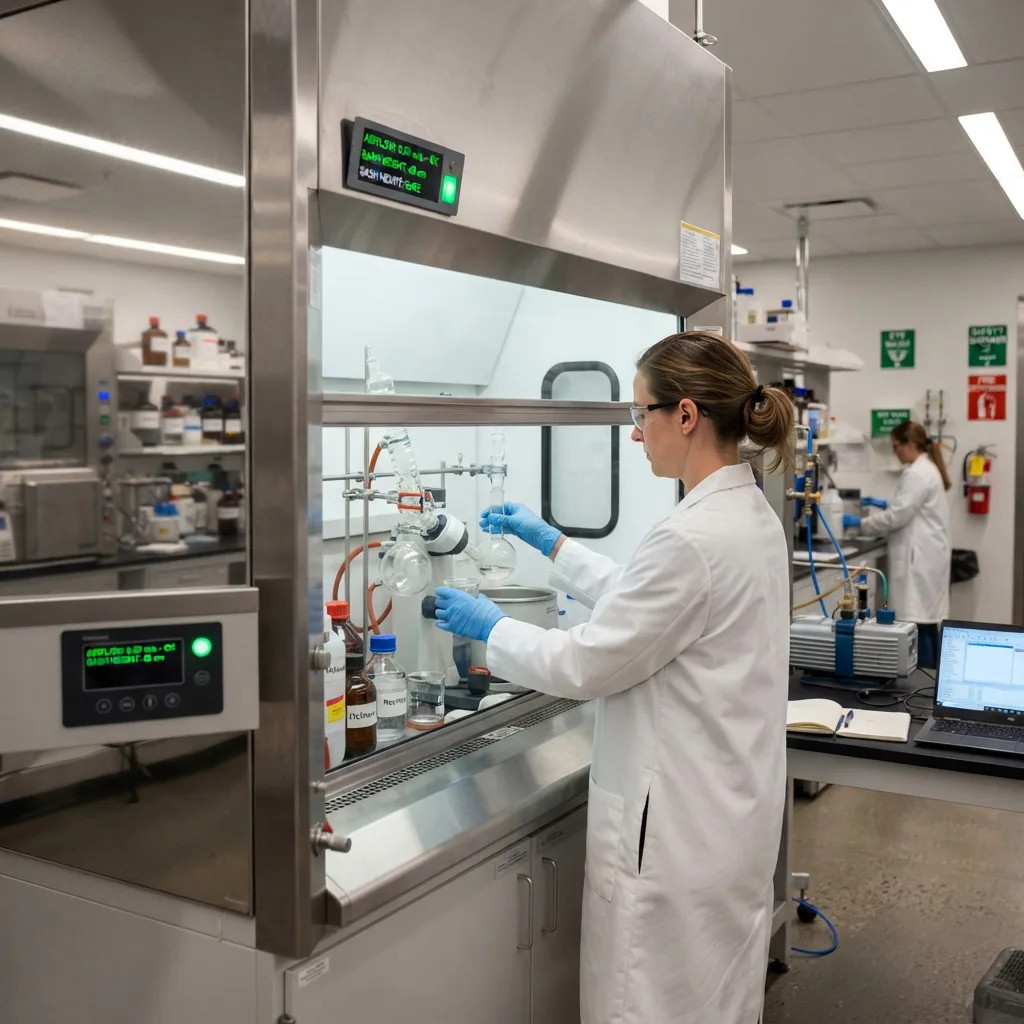
The Hood Is Installed. Is It Actually Performing Properly?
Buying a laboratory fume hood is only the beginning.
A chemical fume hood can look correctly installed and still perform differently from what a buyer expects. Airflow, sash position, room ventilation, equipment placement, user movement, exhaust capacity and maintenance all influence containment.
This is why a laboratory fume hood should be treated as part of a complete laboratory ventilation system rather than as an independent piece of furniture.
For procurement teams, this creates an important distinction:
Buying the hood is a product decision.
Making the hood perform correctly is a system decision.
That difference matters when selecting a laboratory fume hood manufacturer, planning installation, checking performance, arranging annual inspection or evaluating long-term operating costs.
ASHRAE identifies face velocity, sash position, hood geometry, baffles, exhaust arrangement, surrounding airflow and researcher movement among the factors that affect fume hood performance.
How Does a Laboratory Fume Hood Control Airborne Contaminants?
The basic principle is simple.
Air moves into the front opening of the fume hood. The airflow passes through the work area and carries airborne contaminants toward the exhaust system.
The goal is to reduce the chance that chemical fumes, vapors or airborne particulates escape into the laboratory.
This is why the following terms frequently appear together in technical specifications and Google searches:
fume hood airflow
laboratory ventilation
face velocity
airflow containment
fume hood exhaust
chemical fume hood performance
airflow monitoring
fume hood sash
laboratory exhaust system
CDC describes the chemical fume hood as a major protective device for laboratory work involving hazardous chemicals and explains that proper airflow helps capture and exhaust airborne contaminants.
But airflow is not simply a matter of “more is better.”
A properly designed system must provide an appropriate airflow pattern without creating unnecessary turbulence or other conditions that reduce containment.
Face Velocity: One of the Most Important Fume Hood Terms
When buyers compare fume hood specifications, face velocity is one of the terms they are most likely to encounter.
Face velocity describes the air movement measured across the hood opening.
It can be useful for evaluating a hood, but it should not be considered in isolation.
Fume hood performance can also depend on:
- Sash opening
- Hood geometry
- Internal baffles
- Exhaust volume
- Room air movement
- Equipment inside the hood
- Operator movement
- Supply-air arrangement
- Hood location
ASHRAE specifically notes that these factors can influence containment performance.
This means a procurement specification should avoid asking only:
“What is the airflow?”
A better question is:
“What airflow and containment performance is appropriate for the intended application and installation?”
That distinction is especially important when comparing different laboratory fume hood suppliers.
Why Higher Airflow Does Not Always Mean Better Performance
It can be tempting to compare two chemical fume hoods and choose the one with the larger airflow figure.
That approach can be misleading.
Excessive or poorly controlled airflow may increase turbulence, create uncomfortable conditions and increase energy demand without automatically improving containment.
ASHRAE guidance emphasizes the relationship between hood airflow, containment, the surrounding room and the ventilation system.
maximum airflow
but:
appropriate airflow + stable flow pattern + effective containment
This is an important concept for searchers looking for terms such as:
high airflow fume hood
low airflow fume hood
low flow laboratory fume hood
energy efficient fume hood
high performance fume hood
VAV fume hood
laboratory airflow control
Sash Position Can Change Hood Performance
The sash is one of the most visible parts of a laboratory fume hood, but it is also an important part of airflow control.
When the sash is moved, the size and shape of the opening change.
That can affect:
- Air velocity
- Airflow distribution
- Containment
- Operator protection
- Energy consumption
- Working access
CDC safety guidance recommends using the sash at the designated operating height and moving it slowly because rapid movement can disturb airflow.
NIH guidance similarly instructs users to maintain the sash at the appropriate marked position and close it when the hood is not actively being used.
For this reason, when purchasing a fume hood, it is useful to ask about:
sash design
sash operating height
sash alarm
airflow monitor
sash movement
sash stop
automatic sash positioning
Why Equipment Inside the Hood Matters
A laboratory fume hood is not designed to be packed like a storage cabinet.
Large equipment can obstruct airflow, create turbulent areas or change the way air moves through the working chamber.
CDC guidance recommends placing large equipment so that airflow can pass underneath it where appropriate, rather than blocking the lower airflow path.
This creates another important procurement question:
What equipment will actually be used inside the hood?
A buyer should consider:
- Large glassware
- Heating equipment
- Analytical instruments
- Reactors
- Pumps
- Sample preparation equipment
- Laboratory balances
- Chemical processing apparatus
A six-foot laboratory fume hood that looks large enough from the outside may have much less practical working space once laboratory equipment is installed.
Keep the Work Away From the Front Opening
The front edge of the hood is not the ideal place for chemical work.
CDC guidance recommends maintaining work away from the front of the hood because materials positioned too close to the opening are more likely to contribute to loss of containment.
The same principle applies to user movement.
Fast arm movements, rapid sash movement and people walking quickly across the hood opening can disturb airflow.
This may seem like an operator training issue rather than an equipment issue, but it demonstrates an important fact:
Fume hood performance depends on both equipment design and user behavior.
That is why a complete fume hood safety program normally includes both equipment inspection and laboratory personnel training.
Room Airflow Can Affect Fume Hood Performance
One of the most overlooked factors in laboratory ventilation is the air around the hood.
The fume hood does not operate inside a vacuum.
Air entering the hood interacts with the laboratory environment.
Potential disturbances include:
- Supply air diffusers
- Open doors
- Open windows
- Fans
- Pedestrian movement
- Nearby equipment
- Room pressure changes
- Poor HVAC balancing
- Air jets directed toward the hood
ASHRAE identifies nearby air velocities, replacement air outlets, room openings and researcher movement as factors that can affect containment.
This means an excellent laboratory fume hood can still show unexpected behavior if the surrounding room airflow is poorly designed.
For a new laboratory project, the hood, exhaust system and room HVAC should therefore be considered together.
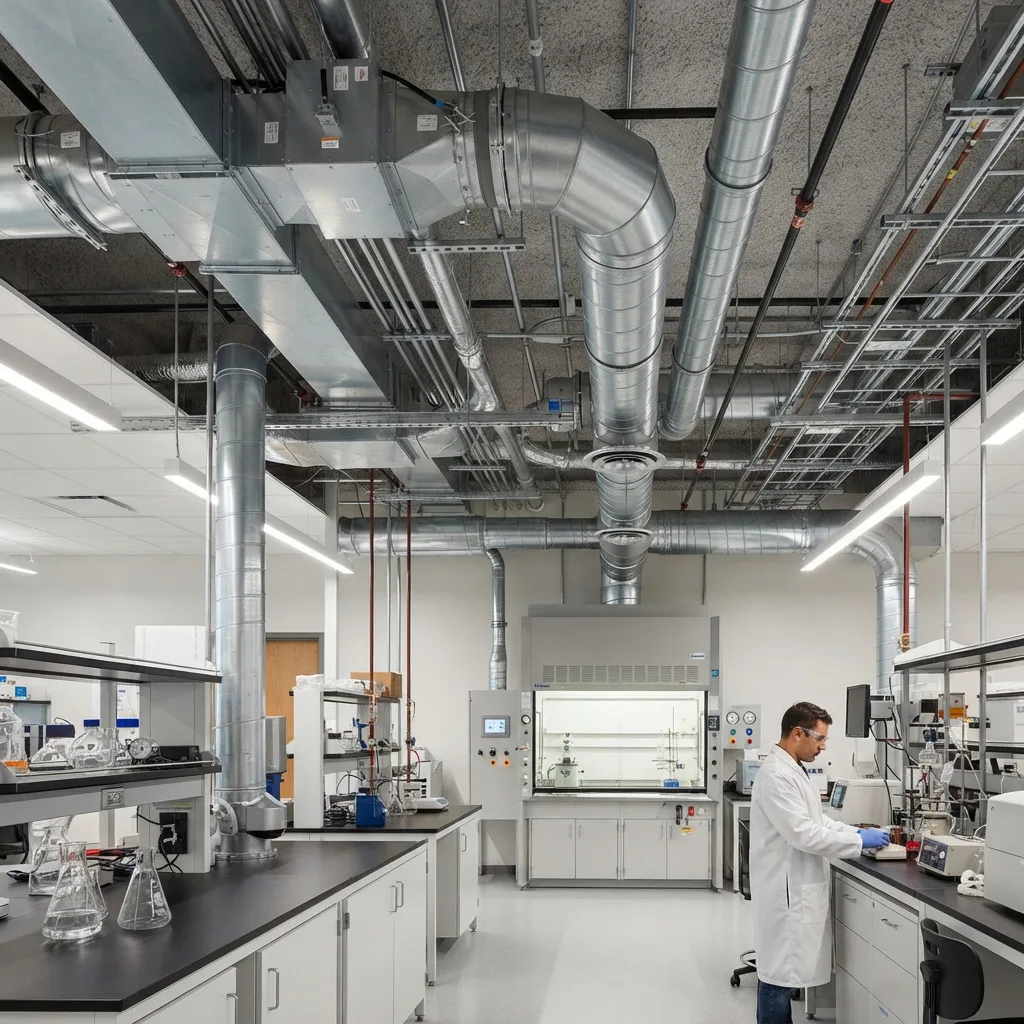
Fume Hood Exhaust and Laboratory HVAC
A ducted fume hood depends on a suitable exhaust system.
The complete ventilation chain can involve:
hood → ductwork → exhaust fan → discharge system
while the room also needs an appropriate supply-air strategy.
The laboratory may need to balance:
- Fume hood exhaust
- General room exhaust
- Supply air
- Temperature
- Humidity
- Pressure relationships
- Energy demand
ASHRAE notes that laboratory airflow requirements can be influenced by exhaust devices, cooling requirements, minimum ventilation requirements and pressure relationships. It also emphasizes that room dilution ventilation is not a replacement for the containment function of a fume hood.
This is especially relevant for architects, laboratory planners, HVAC engineers and medical equipment procurement teams working on new laboratory construction.
What Is VAV Fume Hood Control?
VAV, or variable air volume, systems adjust exhaust airflow according to operating conditions such as sash position or other control inputs.
The idea is to avoid operating the exhaust system at one fixed high airflow rate all the time.
Potential benefits can include:
- Reduced energy use
- Lower exhaust volume during reduced sash openings
- Better integration with laboratory HVAC
- More flexible airflow management
However, VAV systems require proper controls, balancing and commissioning.
The buyer should not evaluate VAV simply as an optional technology. The entire building ventilation design should support it.
Useful commercial search phrases include:
VAV laboratory fume hood
variable air volume fume hood
energy efficient laboratory hood
automatic airflow control fume hood
fume hood energy saving system
laboratory ventilation control system
What Happens When Fume Hood Airflow Becomes Abnormal?
A change in airflow may indicate a problem elsewhere in the system.
Possible causes can include:
Blocked baffles
Internal obstructions can disrupt the intended airflow path.
Exhaust fan problems
Fan performance can affect the hood’s ability to draw air correctly.
Duct restriction
Ductwork problems may reduce exhaust performance.
Damaged sash components
Mechanical problems can change the opening or normal operating position.
Room HVAC changes
Changes to supply air, doors, pressure or nearby ventilation can disturb the hood.
Improperly placed equipment
Large equipment can obstruct airflow.
Dirty components
Accumulated dust or contamination may affect certain components and maintenance areas.
NIH advises users to check inward airflow before work and to stop using a hood when airflow performance is disrupted or an installed airflow alarm indicates a problem.
What Should You Do When the Airflow Alarm Activates?
An airflow alarm should not be treated as a minor inconvenience.
The exact response should follow the laboratory’s safety procedures and the equipment manufacturer’s instructions.
In general, an abnormal airflow condition means the hood’s protective performance should not simply be assumed to continue normally.
NIH guidance instructs users to terminate use and close the sash when fume hood performance is disrupted or an airflow alarm is triggered.
For laboratory managers, this creates another important procurement requirement:
The airflow monitoring system should be understandable, visible and appropriate for the intended users.
When evaluating a supplier, ask about:
- Airflow monitoring
- Visual indicators
- Audible alarms
- Alarm set points
- Control interface
- Sensor maintenance
- Failure indication
- Electrical backup or fail-safe functions where applicable
Fume Hood Cleaning Is Part of Performance Management
Cleaning is not only about appearance.
A fume hood can accumulate chemical residues, dust and other contaminants during normal laboratory work.
NIH emphasizes periodic cleaning because contamination can affect the safe use and maintenance of a chemical fume hood.
Cleaning procedures should be based on the chemicals used and the material of the hood.
For example, the cleaning method suitable for a general laboratory hood may not be appropriate for a hood used with highly corrosive or particularly hazardous substances.
NIH guidance recommends selecting cleaning materials according to the chemicals involved and warns against inappropriate cleaning chemicals that may damage surfaces or create additional hazards. ORS
What Parts of a Fume Hood Need Regular Attention?
A maintenance program may include inspection of:
Sash
Check movement, physical condition and operating position.
Baffles
Look for obstructions or contamination that may interfere with airflow.
Airflow Indicators
Confirm that monitoring equipment is operating correctly.
Interior Surfaces
Check for chemical residues, corrosion or damage.
Work Surface
Inspect for cracks, degradation and chemical damage.
Lighting
Check illumination and electrical components.
Service Fixtures
Inspect outlets, water connections, gas fixtures and other utilities where installed.
Exhaust System
The connected exhaust fan, ductwork and other components should be maintained according to the overall ventilation maintenance program.
Controls and Alarms
Check sensors, alarms and user interfaces.
The exact maintenance interval depends on the equipment, application, institutional safety program and local requirements.
Can a Fume Hood Be Used for Chemical Storage?
A common laboratory management problem is using the hood as a convenient storage area.
That can interfere with airflow and reduce the available working space.
NIH specifically states that chemical fume hoods are intended to exhaust airborne contaminants and are not a substitute for spill containment or chemical storage.
For the same reason, buyers should be cautious about designing a hood around excessive internal storage.
The working chamber should primarily support the process taking place inside the enclosure.
Fume Hood Inspection and Certification
A laboratory fume hood should not be considered permanently safe simply because it passed an inspection several years ago.
Performance can change because of:
- Building modifications
- HVAC changes
- Fan problems
- Duct changes
- Sash damage
- Laboratory remodeling
- Equipment changes
- Air balance adjustments
- Normal wear
ASHRAE’s laboratory guidance recommends annual testing of fume hoods at minimum, while exact certification requirements should be based on the applicable local and institutional program.
NIH similarly operates an annual chemical fume hood certification program and describes certification as including inspection and airflow verification.
For buyers, this means it is useful to distinguish between:
factory testing
and
installed performance testing
and
routine field certification
They are related but not necessarily the same thing.
What Is ASHRAE 110?
One of the most important technical search terms for laboratory fume hood buyers is:
ASHRAE 110
The current ASHRAE listing identifies ASHRAE Standard 110-2016 (RA2025), Method of Testing Performance of Laboratory Fume Hoods.
ASHRAE describes the standard as a method for evaluating fume hood performance and notes that it can be used for hoods as manufactured, as installed and as used.
Common performance evaluation approaches associated with laboratory fume hood testing include:
- Face velocity testing
- Flow visualization
- Tracer gas testing
- Sash movement testing
ASHRAE’s laboratory handbook explains that these methods can be used to evaluate containment under defined conditions.
Factory Testing vs On-Site Testing
A product may be tested before shipment, but the installation environment can change actual performance.
Think about the difference:
Factory
The manufacturer controls the testing environment.
Installation
The hood is connected to a building exhaust system.
Operation
Users work with real laboratory equipment, room airflow and normal working practices.
That is why commissioning and on-site verification are important parts of a laboratory ventilation project.
The National Academies’ laboratory guidance recommends testing after installation and before initial use, routine testing thereafter, and additional testing after significant ventilation changes or when a performance problem is reported.
What Does a Fume Hood Smoke Test Show?
A smoke or flow visualization test can provide a simple visual indication of how air moves around the hood opening.
It can help identify obvious disturbances such as:
- Reverse flow
- Turbulence
- Poor airflow patterns
- Effects of nearby air movement
However, smoke visualization is not identical to a full containment evaluation.
ASHRAE describes both flow visualization and tracer-gas testing as performance evaluation methods, with tracer-gas testing providing quantitative containment information.
For procurement documents, it is therefore better to state the required test method rather than simply writing:
“Fume hood must pass testing.”
How to Troubleshoot Poor Fume Hood Performance
When a hood appears to be underperforming, do not immediately assume the cabinet itself is defective.
Use a broader troubleshooting approach.
Check the airflow indicator
Is the system actually drawing air?
Check the sash
Is it at the correct operating position?
Check the baffles
Are they blocked?
Check the work area
Is large equipment interfering with airflow?
Check nearby air movement
Are doors, windows, fans or diffusers disturbing the opening?
Check the exhaust system
Is the connected fan operating as designed?
Check recent building changes
Has the HVAC system been modified?
Perform formal testing
Where necessary, arrange professional performance testing.
NIH and ASHRAE guidance both emphasize that fume hood performance can be affected by airflow and environmental conditions, not just the physical cabinet.
Fume Hood Maintenance vs Fume Hood Repair
These two terms often appear together in procurement searches, but they describe different activities.
Maintenance is preventive.
It can include:
- Cleaning
- Inspection
- Sensor checks
- Mechanical inspection
- Airflow checks
- Routine servicing
Repair responds to a known problem.
It may involve:
- Fan failure
- Sash mechanism problems
- Control failure
- Damaged panels
- Lighting faults
- Airflow sensor replacement
- Exhaust system components
A good supplier should be able to provide documentation explaining routine maintenance as well as recommendations for common replacement parts.
What Is the Role of the Fume Hood Manufacturer?
For international buyers, the manufacturer’s responsibility does not necessarily stop at shipment.
A capable laboratory equipment supplier can help clarify:
- Product configuration
- Dimensions
- Material selection
- Utility connections
- Exhaust interfaces
- Controls
- Documentation
- Spare parts
- Installation requirements
- Maintenance procedures
This becomes particularly important when a customer is buying from overseas and local engineering support is limited.
UMY Medical Equipment Co., Ltd., for example, can be positioned within an international procurement process as a China-based medical equipment company with broader manufacturing and sourcing experience, giving buyers another supplier profile to evaluate when coordinating laboratory equipment projects.
The key point is that buyers should evaluate technical support capability, not just product appearance or quotation price.
Energy Efficiency: What Should Buyers Consider?
Laboratory fume hoods can have a significant relationship with building ventilation energy use because exhausted air generally needs to be replaced by conditioned supply air.
Energy-related search terms therefore include:
energy efficient fume hood
low energy fume hood
VAV laboratory hood
variable air volume hood
low flow fume hood
laboratory ventilation energy saving
energy efficient laboratory ventilation
However, energy efficiency should never be reduced to simply decreasing airflow.
The system still needs to provide the required containment performance.
A more useful procurement discussion covers:
hood design + airflow control + sash management + room HVAC + exhaust fan + operating schedule
ASHRAE has highlighted the relationship between laboratory fume hood containment, ventilation design and energy performance in its technical work.
What Is a Good Fume Hood Maintenance Schedule?
There is no universal maintenance calendar suitable for every laboratory.
A practical program can separate tasks into different levels.
Daily or Routine User Checks
Users may check:
- Hood appears operational
- Airflow indicator
- Sash position
- Visible contamination
- Obstructions
- Spills
- Excessive materials in the work area
Periodic Maintenance
Facility or laboratory personnel may review:
- Sash hardware
- Baffles
- Lighting
- Service fittings
- Interior surfaces
- Controls
- Alarm functionality
Formal Performance Testing
Qualified personnel may evaluate:
- Face velocity
- Airflow direction
- Flow visualization
- Containment
- Exhaust performance
Annual Certification
Many institutional programs use annual fume hood certification, but the exact interval should follow the applicable regulatory and laboratory safety requirements.
NIH and ASHRAE both provide examples of annual testing and certification approaches.
What Should a Laboratory Fume Hood Service Record Include?
For professional laboratory management, maintenance should be documented.
Useful records can include:
- Equipment identification
- Installation date
- Manufacturer
- Model
- Test dates
- Airflow measurements
- Inspection results
- Repairs
- Replacement components
- Certification status
- Maintenance activities
- Identified problems
- Corrective actions
Good records are particularly helpful for hospitals, universities, pharmaceutical laboratories, research institutes and industrial facilities operating multiple laboratory fume hoods.
They also help procurement teams understand the actual lifecycle cost of equipment.
How to Reduce Common Fume Hood Problems
Many problems can be reduced through a combination of correct equipment selection and proper operation.
Match the hood to the process
A general-purpose chemical fume hood is not automatically suitable for every specialized application.
Avoid excessive storage
Keep the working chamber organized.
Keep airflow paths clear
Do not block baffles or exhaust openings.
Control sash movement
Open and close it gradually.
Consider room layout
Avoid strong airflow directly across the hood opening.
Maintain the exhaust system
A hood depends on the connected ventilation system.
Train users
Good laboratory practice is part of the safety system.
Test after changes
Ventilation modifications can change hood performance.
What Should Buyers Ask a Laboratory Fume Hood Supplier?
Before requesting a quotation, prepare specific questions.
About the Hood
What type of fume hood is recommended for the application?
About Materials
Which interior and worktop materials are available?
About Airflow
How is airflow controlled?
About Monitoring
Is an airflow monitor or alarm included?
About Testing
What factory performance testing is available?
About Installation
What exhaust, electrical and utility connections are required?
About Standards
Which standards or testing methods are referenced?
About Customization
Can dimensions, materials, fixtures or controls be customized?
About Maintenance
Which components require regular maintenance?
About Spare Parts
Which spare parts are available for long-term support?
About Warranty
What does the warranty cover?
About International Projects
Can the manufacturer provide drawings, manuals, packing information and technical support for overseas installation?
These questions are useful whether the buyer is sourcing one laboratory fume hood or planning a complete laboratory project.
Fume Hood Lifecycle: From Purchase to Replacement
A laboratory fume hood has a lifecycle that can be divided into several stages:
Planning
Define the application and laboratory requirements.
Selection
Compare types, materials, dimensions, airflow strategy and supplier capabilities.
Installation
Connect the hood to the laboratory ventilation and utilities.
Commissioning
Verify installed performance before routine use.
Operation
Use correct sash positions, airflow practices and laboratory procedures.
Maintenance
Clean, inspect and service the system.
Certification
Carry out the required performance checks.
Upgrade
Replace controls, sensors or other components when appropriate.
Replacement
Replace the hood when its condition, application or performance no longer meets project requirements.
Thinking in lifecycle terms helps buyers move beyond the simple question of:
“How much does this fume hood cost?”
A better question is:
“What will this laboratory fume hood cost to install, operate, maintain and support over its useful life?”
Final Takeaway: Fume Hood Performance Is a System
A laboratory fume hood is only one part of laboratory safety.
Good performance comes from the relationship between:
hood design
airflow
sash position
baffles
exhaust system
room ventilation
equipment placement
user behavior
maintenance
testing
commissioning
That is why professional procurement should evaluate more than cabinet dimensions and price.
For hospitals, pharmaceutical companies, universities, research institutes, industrial laboratories and diagnostic facilities, the right laboratory fume hood should be selected according to the actual application and then integrated correctly with the laboratory ventilation system.
A reliable maintenance and testing program is equally important. Even a well-designed chemical fume hood needs appropriate operation, inspection and performance verification throughout its working life.
Frequently Asked Questions
What is fume hood airflow?
Fume hood airflow is the movement of air through the hood opening and working chamber toward the exhaust system. It is designed to help capture and contain airborne contaminants.
What is face velocity in a fume hood?
Face velocity is the air velocity measured across the hood opening. It is one factor used when evaluating laboratory fume hood performance.
Does higher fume hood airflow mean better performance?
Not necessarily. Hood performance depends on airflow pattern, containment, sash position, room conditions, equipment placement and other factors.
Why is sash position important?
Changing the sash opening changes the airflow conditions at the front of the hood. Using the appropriate operating position can support more stable performance and safer operation.
What happens when a fume hood airflow alarm activates?
Follow the laboratory’s emergency or operating procedure. NIH guidance advises stopping work and closing the sash when hood performance is disrupted or an airflow alarm is triggered.
How often should a laboratory fume hood be tested?
The required interval depends on the laboratory’s safety program and applicable local requirements. Annual testing or certification is common in institutional programs, and ASHRAE laboratory guidance recommends annual testing at minimum.
What is ASHRAE Standard 110?
ASHRAE Standard 110-2016 (RA2025) is a published method for testing the performance and containment of laboratory fume hoods.
What is a fume hood containment test?
A containment test evaluates how effectively a fume hood prevents contaminants from escaping into the laboratory under defined test conditions.
What is a fume hood smoke test?
A smoke or airflow visualization test uses visible smoke to observe airflow patterns and identify potential disturbances around the hood opening.
What is a tracer gas test for a fume hood?
A tracer gas test provides a quantitative way to evaluate containment by measuring tracer gas behavior under specified test conditions. ASHRAE Standard 110 includes tracer-gas-based performance evaluation.
Why does laboratory room ventilation affect a fume hood?
Air from doors, supply diffusers, fans, windows and nearby movement can disturb airflow around the hood and affect containment.
How should equipment be placed inside a fume hood?
Equipment should be arranged so that it does not unnecessarily obstruct airflow. CDC guidance recommends elevating large equipment when appropriate to allow air movement underneath it.
Can a fume hood be used as chemical storage?
A fume hood should not be treated as general chemical storage. It is designed for controlled laboratory work and local exhaust, not long-term storage.
How do you clean a chemical fume hood?
Cleaning depends on the chemicals used and the hood materials. Spills should be addressed according to the laboratory’s chemical safety procedures, while routine surfaces should be cleaned using compatible materials.
What causes poor fume hood performance?
Possible causes include airflow imbalance, blocked baffles, exhaust problems, improper sash position, equipment obstruction, room airflow disturbances and ventilation system changes.
What is a VAV fume hood?
A VAV, or variable air volume, fume hood system adjusts exhaust airflow according to operating conditions and is commonly integrated with laboratory ventilation control systems.
Are low-flow fume hoods safe?
A low-flow design can be appropriate when it has been properly engineered and tested for the intended application. Lower airflow by itself does not determine containment performance.
What is the difference between factory testing and field certification?
Factory testing evaluates the product under controlled conditions, while field certification evaluates the installed system under its actual laboratory or project conditions.
What should be checked after installing a fume hood?
The installation should be reviewed for airflow, exhaust connection, room air interaction, sash operation, alarms, utilities and other project-specific requirements. Performance testing should be completed before routine use where required.
What should I look for in a laboratory fume hood manufacturer?
Consider product design, manufacturing capability, customization, technical documentation, testing support, spare parts, installation guidance, warranty and after-sales service.
How much does fume hood maintenance cost?
Maintenance cost varies according to hood design, usage, airflow system, testing schedule, replacement parts, laboratory environment and local service costs.
When should a fume hood be replaced?
Replacement may be appropriate when the hood has significant structural damage, persistent performance problems, outdated controls, unsuitable materials or no longer meets the laboratory’s application and safety requirements.