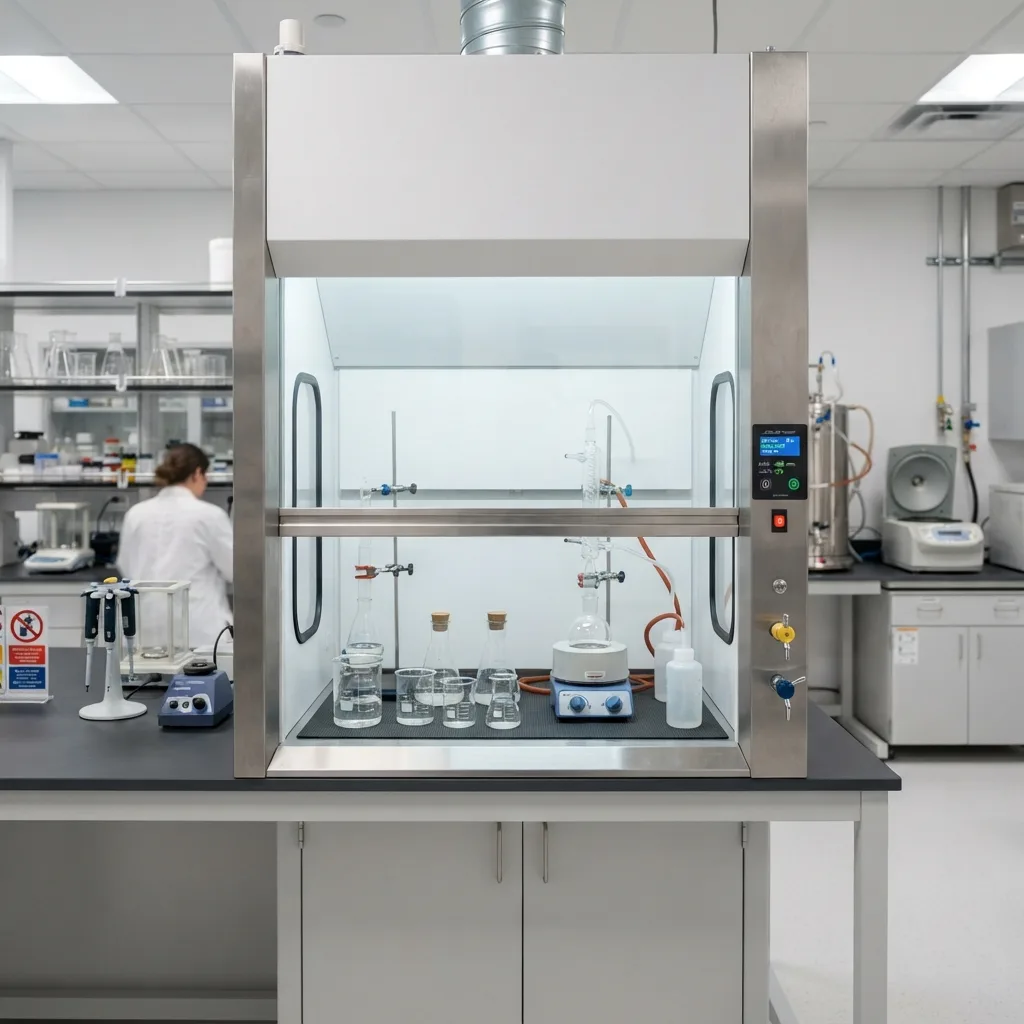
A laboratory fume hood is not simply a cabinet with a fan. The right system depends on the chemicals being used, the type of laboratory work, the room ventilation design, the hood configuration, the available space and the level of protection required.
For a laboratory manager or medical equipment buyer, the more useful question is not:
“Which fume hood looks suitable?”
It is:
“Which laboratory fume hood matches the work, the hazards, the room and the operating conditions?”
That question changes everything.
A chemistry laboratory may need a chemical fume hood for corrosive or volatile substances. A university laboratory may have different requirements from a pharmaceutical research facility. A small laboratory may consider a benchtop fume hood, while a larger project may require a floor-mounted or walk-in fume hood.
The following guide brings together the main product types, applications, airflow considerations, material choices, installation questions and purchasing factors in one place.
Start With the Work, Not the Hood
Before comparing laboratory fume hood manufacturers or asking for a fume hood quotation, define the work that will take place inside the hood.
Start with five practical questions:
What substances will be handled?
Think about solvents, acids, bases, powders, gases, reaction mixtures and other chemicals used during normal laboratory work.
What type of hazard is expected?
The required containment approach can be different for chemical vapors, dust, corrosive substances or other airborne contaminants.
How frequently will the hood be used?
An occasional-use laboratory and a high-throughput research facility may have very different operational requirements.
How much equipment must fit inside?
Large glassware, analytical equipment, heating devices and laboratory instruments can affect the required hood width and interior work area.
What ventilation infrastructure is available?
A ducted laboratory exhaust hood needs to work as part of the building’s ventilation system. The hood cannot be evaluated separately from the room.
This is why a laboratory fume hood buying decision should begin with the application rather than the product catalog.
What Is a Laboratory Fume Hood Used For?
A laboratory fume hood is a primary local exhaust device used to control airborne contaminants generated during laboratory work.
The basic principle is straightforward: air is drawn into the hood opening, contaminants are captured within the controlled airflow, and the contaminated air is exhausted or otherwise treated according to the hood design.
Chemical fume hoods are commonly used for activities involving chemical fumes, vapors and particulates. NIH guidance notes that properly functioning and maintained chemical fume hoods are important for reducing user exposure to these airborne hazards. ORS
Typical applications include:
- Chemical preparation
- Solvent handling
- Acid and alkali work
- Chemical synthesis
- Analytical chemistry
- Sample preparation
- Pharmaceutical research
- University laboratory experiments
- Industrial laboratory testing
- Research and development
- Quality control laboratories
- Material testing
- Environmental analysis
A fume hood should not be treated as general chemical storage. Its purpose is controlled laboratory work, not permanent storage of chemicals and waste.
Common Types of Laboratory Fume Hoods
There is no single laboratory fume hood that fits every laboratory.
The most common categories are distinguished by installation method, ventilation arrangement, work area and application.
Ducted Fume Hood
A ducted fume hood is connected to a building exhaust system. Contaminated air is removed from the laboratory through ductwork and an exhaust system.
This is a common configuration for permanent laboratory installations.
Typical search terms include:
- ducted laboratory fume hood
- ducted chemical fume hood
- laboratory exhaust hood
- ducted fume hood system
- laboratory ventilation hood
- fixed chemical fume hood
- ducted laboratory hood
For new laboratory construction, the hood should be considered together with the exhaust fan, ductwork, room air supply and overall HVAC design.
Ductless Fume Hood
A ductless fume hood generally uses filtration to treat air before it is returned to the laboratory environment, depending on the system and the substances being handled.
This configuration can be attractive where conventional exhaust ductwork is difficult or where flexible installation is important.
However, ductless systems require careful evaluation of:
- Filter type
- Chemical compatibility
- Filter capacity
- Monitoring requirements
- Replacement schedule
- Intended applications
A ductless fume hood should never be selected simply because installation appears easier. The filtration technology must be appropriate for the actual work.
Useful search terms include:
- ductless fume hood
- ductless chemical hood
- filtered fume hood
- recirculating fume hood
- portable ductless fume hood
- ductless laboratory exhaust hood
Benchtop Fume Hood
A benchtop fume hood is designed to sit on or integrate with a laboratory work surface.
It is often considered when the laboratory needs local exhaust for smaller-scale work but does not require a large floor-mounted enclosure.
Typical applications may include:
- Small chemical procedures
- Sample preparation
- Education laboratories
- Research laboratories
- Quality control work
- Analytical procedures
Before purchasing, check the usable internal work area rather than judging the hood by its external dimensions.
Floor-Mounted Fume Hood
A floor-mounted fume hood is designed for larger equipment or processes that cannot easily fit in a standard benchtop configuration.
This type of laboratory hood can be suitable for:
- Large laboratory apparatus
- Industrial research
- Pilot-scale procedures
- Chemical processing research
- Specialized testing
The buyer should pay close attention to internal working height, loading method, sash arrangement and exhaust capacity.
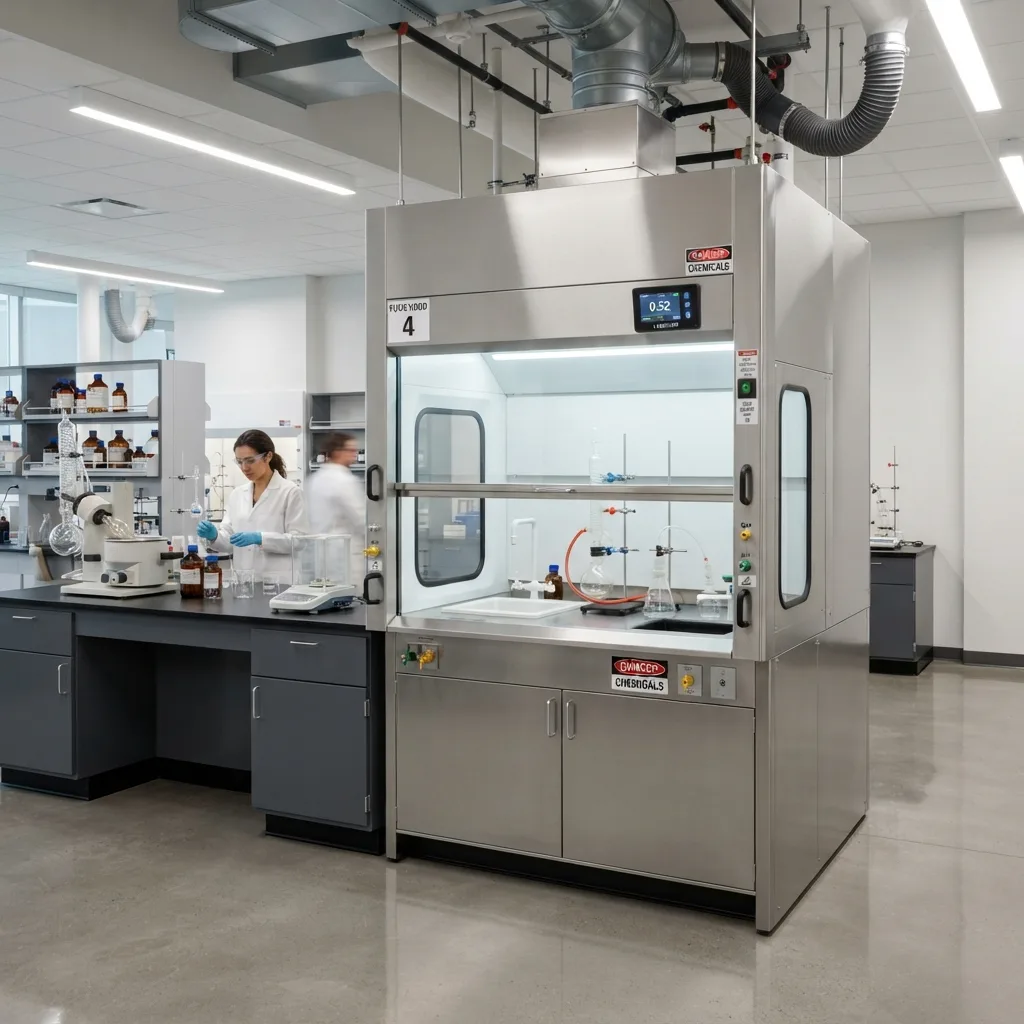
Walk-In Fume Hood
A walk-in fume hood provides a larger enclosed working area for equipment and processes that exceed normal bench-level dimensions.
It may be used in research, industrial and specialized laboratory environments.
A walk-in fume hood is a project-level decision. Room planning, airflow design, equipment access, exhaust capacity and safety procedures become especially important.
For international laboratory projects, buyers should provide the supplier with drawings, equipment dimensions and process information before finalizing the specification.
Chemical Fume Hood for Specialized Applications
Not all chemical laboratory work has the same requirements.
Depending on the process, buyers may encounter specialized designs such as:
- Acid digestion fume hood
- Perchloric acid hood
- Radioisotope fume hood
- High-temperature fume hood
- Low-flow fume hood
- High-performance chemical hood
- Industrial fume hood
- Heavy-duty laboratory fume hood
The internal materials, exhaust configuration and cleaning requirements may differ according to the application.
For particularly hazardous or specialized processes, the laboratory should involve an appropriate safety professional or engineering team rather than relying on a general-purpose product description.
Ducted or Ductless: Which Fume Hood Should You Choose?
This is one of the most common laboratory fume hood purchasing questions.
The answer depends on the application and building.
Ducted fume hood
Usually considered when:
- The laboratory has suitable exhaust infrastructure
- Chemicals require exhaust to a controlled discharge point
- Permanent installation is preferred
- The project has an engineered HVAC design
Ductless fume hood
May be considered when:
- Ductwork is impractical
- Laboratory layouts change frequently
- The chemicals are compatible with the selected filtration system
- Filter management can be maintained correctly
A buyer should compare more than the initial equipment price.
Also consider:
installation cost + ventilation requirements + filters + maintenance + replacement parts + energy use + long-term operating conditions
ASHRAE’s laboratory guidance treats laboratory exhaust, airflow patterns, system balancing, commissioning and lifecycle cost as interconnected design issues rather than isolated equipment decisions.
How Laboratory Fume Hood Airflow Works
Airflow is the heart of fume hood performance.
A chemical fume hood needs an appropriate airflow pattern to help capture contaminants and reduce escape into the laboratory.
Several terms frequently appear when researching laboratory fume hoods:
- Airflow
- Face velocity
- Containment
- Sash position
- Cross drafts
- Turbulence
- Exhaust volume
- Air balance
- Airflow monitor
- Baffle
- Room ventilation
These terms are related, but they are not identical.
Face Velocity
Face velocity refers to air movement measured at the hood opening.
It is an important performance parameter, but higher airflow does not automatically mean better containment.
Excessive airflow can create turbulence and may negatively affect containment in certain conditions. ASHRAE’s laboratory guidance notes that airflow must be sufficient for capture and containment while excessive velocities should be avoided.
This is why buyers should avoid choosing a hood based only on the largest fan or highest airflow number.
Sash Design Matters
The sash is the movable front panel of many fume hoods.
Sash design affects:
- Working access
- Operator protection
- Airflow behavior
- Energy consumption
- Ergonomics
- Visibility
- Routine operation
The sash should be used according to the hood manufacturer’s operating instructions and the laboratory’s safety procedures.
NIH guidance recommends keeping the user’s face outside the plane of the hood and maintaining the sash at the appropriate operating height. It also warns that rapid movement near the hood opening can disturb airflow.
For buyers, useful questions include:
Is the sash vertical, horizontal or a combination design?
What is the normal working position?
Is there an airflow monitor?
Is there an alarm for abnormal airflow?
What Are Baffles in a Fume Hood?
Baffles help shape and distribute airflow inside the hood.
They are not simply decorative panels.
A well-designed airflow path helps different areas of the working chamber participate in contaminant capture.
When selecting a laboratory exhaust hood, buyers can ask about:
- Baffle design
- Number and arrangement of baffles
- Cleaning access
- Adjustability
- Maintenance requirements
NIH safety guidance also recommends checking baffles for obstruction before work begins because blocked airflow paths can affect hood performance.
Choosing the Right Fume Hood Material
Material selection is another important procurement issue.
A laboratory fume hood may be constructed using combinations of materials such as:
- Powder-coated steel
- Stainless steel
- Polypropylene
- Chemical-resistant composite materials
- Chemical-resistant liners
- Specialized work surfaces
The correct choice depends on the chemicals, temperature, cleaning agents and laboratory process.
Steel Fume Hood
Steel is widely used in laboratory furniture and enclosure construction.
It may be suitable for many general laboratory environments when the surface finish and interior materials match the intended application.
Stainless Steel Fume Hood
Stainless steel can be useful where corrosion resistance, cleaning and durability are important considerations.
However, the correct grade and overall construction should still be evaluated against the chemicals being handled.
Polypropylene Fume Hood
Polypropylene and other chemically resistant materials can be considered for applications involving aggressive corrosive chemicals.
For an acid laboratory, material compatibility should be confirmed rather than assumed.
Think About the Work Surface
The work surface is directly exposed to laboratory activity.
When evaluating a laboratory fume hood, consider:
- Chemical resistance
- Heat resistance
- Impact resistance
- Cleaning
- Spill management
- Maintenance
- Replacement options
The correct work surface for a general chemistry laboratory may not be the best choice for a highly corrosive process.
Procurement documents should therefore specify the actual application instead of simply requesting a “standard laboratory fume hood.”
What Size Laboratory Fume Hood Do You Need?
Size is not just about the width of the exterior cabinet.
The important question is:
How much usable working space is needed inside?
Consider:
- Equipment dimensions
- Number of users
- Sample size
- Glassware
- Instrument placement
- Sash opening
- Access requirements
- Cleaning space
- Future equipment
Common commercial search phrases include:
- 4 ft fume hood
- 5 ft fume hood
- 6 ft fume hood
- laboratory fume hood 1200 mm
- laboratory fume hood 1500 mm
- laboratory fume hood 1800 mm
- custom size fume hood
However, the largest hood is not automatically the right hood.
Oversizing can increase space requirements, ventilation demand and operating cost.
Fume Hood Installation: What Should Buyers Check?
A fume hood works as part of a laboratory system.
Before installation, review:
Room dimensions
Is there enough space for the cabinet, users and service access?
Exhaust route
Can the duct system reach the appropriate exhaust point?
HVAC balance
Can room supply air support the exhaust system without creating problematic pressure or airflow conditions?
Electrical requirements
Does the project have the correct electrical supply for controls, lighting, fans or accessories?
Utilities
Will the process require water, gas, vacuum, compressed air or electrical outlets?
Floor and wall conditions
Can the installation structure support the selected system?
Maintenance access
Can filters, fans, controls and other service components be reached later?
These questions should be answered before the purchase order is finalized.
Why Room Airflow Matters
A common purchasing mistake is treating the fume hood as an isolated cabinet.
In reality, room conditions can affect hood performance.
Potential airflow disturbances include:
- Doors opening and closing
- Windows
- Supply air diffusers
- Fans
- Heavy pedestrian traffic
- Rapid movement
- Poor room air balance
- Improper equipment placement
ASHRAE guidance discusses room air balance and surrounding airflow conditions as part of fume hood performance evaluation.
That means a technically capable hood can still have poor installed performance if the surrounding laboratory environment is not designed correctly.
Fume Hood Performance Testing
When comparing laboratory fume hood manufacturers, buyers should ask how performance is evaluated.
A frequently referenced industry standard is ASHRAE Standard 110-2016 (RA 2025), Method of Testing Performance of Laboratory Fume Hoods.
ASHRAE states that this standard provides quantitative and qualitative methods for evaluating fume hood containment and applies to conventional, bypass, auxiliary-air and VAV laboratory fume hoods.
ASHRAE also explains that it develops testing standards rather than directly certifying individual fume hoods. Owners commonly establish inspection and certification programs based on applicable regulations, standards and project requirements.
This distinction is useful for international buyers:
A product being designed according to a standard is not necessarily the same thing as an individual installed hood being certified for your laboratory.
For a project purchase, ask what documentation and testing can be provided by the manufacturer, installer or commissioning team.
What Should Be Included in a Fume Hood Specification?
A professional purchasing request should contain more than:
“Please quote one laboratory fume hood.”
A better RFQ can include:
Product type
Ducted, ductless, benchtop, floor-mounted or specialized configuration.
Nominal size
External dimensions and internal working dimensions.
Application
Chemistry, pharmaceutical research, analytical laboratory, education laboratory, industrial testing and so on.
Chemical compatibility
The supplier should know what type of materials will be handled.
Airflow and control
Specify the expected design basis rather than relying only on a generic catalog value.
Sash type
Vertical, horizontal or another configuration.
Work surface
Specify the required chemical and heat resistance.
Lighting
Ask about internal illumination and maintenance.
Utilities
Water, gas, electrical sockets or other services if required.
Exhaust connection
Duct size, connection requirements and building interface.
Monitoring
Airflow monitoring, alarms and control options.
Accessories
Base cabinets, service fixtures, sinks, shelves, supports and other options.
Documentation
Installation drawings, manuals, test records and maintenance instructions.
What Laboratory Fume Hood Buyers Often Get Wrong
Choosing by Price Alone
The lowest quotation may not represent the lowest total cost of ownership.
A lower purchase price can be offset by unsuitable materials, poor ventilation integration, difficult maintenance or limited technical support.
Choosing by Fan Power Alone
More airflow does not automatically mean better containment.
The airflow pattern, room environment, hood design and operating conditions all matter. ASHRAE 手册在线
Ignoring the Laboratory Room
A hood should be evaluated together with the surrounding HVAC and exhaust system.
Selecting Materials Without Checking Chemicals
The same material cannot be assumed to work for every chemical process.
Forgetting Future Equipment
A hood that is adequate today may become difficult to use after new instruments are added.
Confusing Fume Hoods With Biosafety Cabinets
A chemical fume hood and a microbiological safety cabinet have different protection purposes.
NIH specifically notes that biological safety cabinets are not suitable for work involving hazardous chemicals. ORS
This difference becomes especially important when a laboratory handles both chemical and biological processes.
How Much Does a Laboratory Fume Hood Cost?
There is no single universal laboratory fume hood price.
The total price can vary according to:
- Hood size
- Ducted or ductless design
- Construction materials
- Chemical resistance
- Airflow control
- Fan system
- Filtration
- Sash configuration
- Worktop
- Utilities
- Monitoring
- Accessories
- Automation
- Installation
- Shipping
- Local certification and commissioning
A buyer requesting a quotation should therefore provide as much project information as possible.
A meaningful quotation should compare equivalent configurations, not simply compare two headline prices.
When Should You Choose a Custom Laboratory Fume Hood?
Standard laboratory fume hoods are often sufficient for routine laboratory work.
Custom engineering may become useful when:
- The laboratory has unusual dimensions
- Large instruments must be enclosed
- Highly corrosive substances are used
- Special materials are required
- Multiple utilities are needed
- The hood must integrate with an existing laboratory system
- The project requires coordinated laboratory furniture
For international projects, customized laboratory equipment should be discussed early because changes to dimensions and utilities can affect room layout, shipping and installation.
Final Buying Advice
A good laboratory fume hood is not defined by one specification.
The right choice comes from matching:
application + chemical hazard + hood design + airflow + material + room ventilation + installation + maintenance + compliance
For general chemistry, pharmaceutical research, analytical laboratories, university laboratories and industrial testing facilities, the purchasing process should begin with the actual work that will take place inside the hood.
Then compare ducted and ductless systems, select the appropriate size and materials, review ventilation conditions, and confirm how performance will be tested after installation.
This approach is more useful than choosing a product only because it has a low price, a large work area or a high airflow number.
Frequently Asked Questions
What is a laboratory fume hood?
A laboratory fume hood is a local exhaust device designed to help control airborne contaminants generated during laboratory work, especially chemical fumes, vapors and particulates.
What is a chemical fume hood used for?
A chemical fume hood is used for laboratory procedures that may generate hazardous or irritating airborne chemical contaminants, including fumes and vapors.
What is the difference between a fume hood and a laboratory exhaust hood?
In many contexts, the terms are used interchangeably for laboratory local exhaust equipment. The exact terminology can vary between manufacturers, engineering documents and regional markets.
What is a ducted fume hood?
A ducted fume hood connects to a building exhaust system and removes contaminated air through ductwork.
What is a ductless fume hood?
A ductless fume hood uses an internal filtration system for applications that are compatible with the selected filter technology and operating conditions.
Which is better, ducted or ductless fume hood?
Neither is universally better. The correct selection depends on the chemicals, process, building design, exhaust infrastructure, filtration requirements and laboratory operating model.
What is a benchtop fume hood?
A benchtop fume hood is a smaller laboratory enclosure designed for installation on or as part of a laboratory bench.
What is a floor-mounted fume hood?
A floor-mounted fume hood is a larger enclosure designed to accommodate equipment or processes that require more vertical or internal working space.
What is a walk-in fume hood?
A walk-in fume hood is a large enclosure designed for applications involving larger equipment and laboratory processes that cannot be accommodated in a standard bench-height hood.
How do I choose a laboratory fume hood?
Start with the chemical process, expected hazards, required working space, hood type, materials, airflow strategy, room ventilation, utilities, installation requirements and applicable standards.
What materials are used for laboratory fume hoods?
Common materials include coated steel, stainless steel, polypropylene and other chemical-resistant materials. The appropriate material depends on the laboratory application.
Does a fume hood need an exhaust system?
Ducted fume hoods require suitable exhaust infrastructure. Ductless systems operate differently and rely on filtration that must be appropriate for the intended application.
How does fume hood airflow work?
Air enters through the hood opening and is controlled to help capture airborne contaminants. Hood geometry, baffles, sash position, room airflow and exhaust conditions all influence performance.
What is fume hood containment?
Containment refers to the ability of the hood to keep contaminants from escaping into the laboratory environment under defined operating conditions.
What is ASHRAE 110?
ASHRAE Standard 110-2016 (RA 2025) is a published test method for evaluating laboratory fume hood containment performance.
How often should a laboratory fume hood be inspected?
Inspection and certification schedules depend on applicable regulations, institutional requirements and the laboratory’s safety program. NIH, for example, recommends routine maintenance and annual inspection for its chemical fume hoods.
Can a fume hood be used for chemical storage?
A chemical fume hood should not be used as general chemical storage. Its purpose is controlled laboratory work and local exhaust protection.
Can a biosafety cabinet replace a chemical fume hood?
Not generally. Biosafety cabinets and chemical fume hoods have different protection purposes. Hazardous chemical work may require a suitable chemical fume hood rather than a biosafety cabinet.
How much does a laboratory fume hood cost?
The price depends on size, construction, material, airflow system, filtration, utilities, controls, accessories, installation and project requirements.
What should I ask a laboratory fume hood supplier?
Ask about the intended application, materials, hood dimensions, airflow design, exhaust requirements, testing, certifications or documentation, installation, warranty, spare parts and technical support.
Recommended SEO Keyword Coverage for This Article
The article is intentionally written to cover a broad semantic keyword set rather than repeat exact-match phrases unnaturally. Important search clusters include:
Core product terms
laboratory fume hood, chemical fume hood, laboratory hood, lab fume hood, fume hood, laboratory exhaust hood, chemical laboratory hood, laboratory ventilation hood
Product types
ducted fume hood, ductless fume hood, benchtop fume hood, floor mounted fume hood, walk in fume hood, acid digestion hood, low flow fume hood, VAV fume hood, industrial fume hood, heavy duty fume hood
Application terms
chemistry laboratory fume hood, pharmaceutical laboratory fume hood, research laboratory fume hood, analytical laboratory hood, university laboratory fume hood, industrial laboratory exhaust hood, chemical research hood, laboratory sample preparation hood
Technical terms
fume hood airflow, face velocity, fume hood containment, fume hood sash, airflow monitor, airflow alarm, hood baffle, exhaust system, laboratory ventilation, room air balance, fume hood performance testing
Material terms
stainless steel fume hood, steel laboratory fume hood, polypropylene fume hood, chemical resistant fume hood, corrosion resistant laboratory hood, chemical resistant work surface
Commercial terms
laboratory fume hood manufacturer, laboratory fume hood supplier, chemical fume hood manufacturer, chemical fume hood supplier, laboratory equipment supplier, laboratory equipment manufacturer, fume hood manufacturer China, laboratory equipment supplier China, custom laboratory fume hood manufacturer
Buyer-intent searches
laboratory fume hood price, fume hood quotation, laboratory fume hood cost, fume hood buying guide, how to choose a fume hood, laboratory fume hood procurement, laboratory fume hood specification, laboratory exhaust hood supplier, fume hood purchasing guide
Comparison searches
ducted vs ductless fume hood, ductless or ducted fume hood, benchtop vs floor mounted fume hood, fume hood vs biosafety cabinet, chemical fume hood vs BSC, laboratory fume hood types
Question-based searches
what is a laboratory fume hood, what is a chemical fume hood used for, how does a fume hood work, how does laboratory fume hood airflow work, what size fume hood do I need, what material is best for a chemical fume hood, does a fume hood need ducting, how often should a fume hood be tested, what is ASHRAE 110, how to choose a laboratory fume hood