AI in Medical Imaging & Radiology
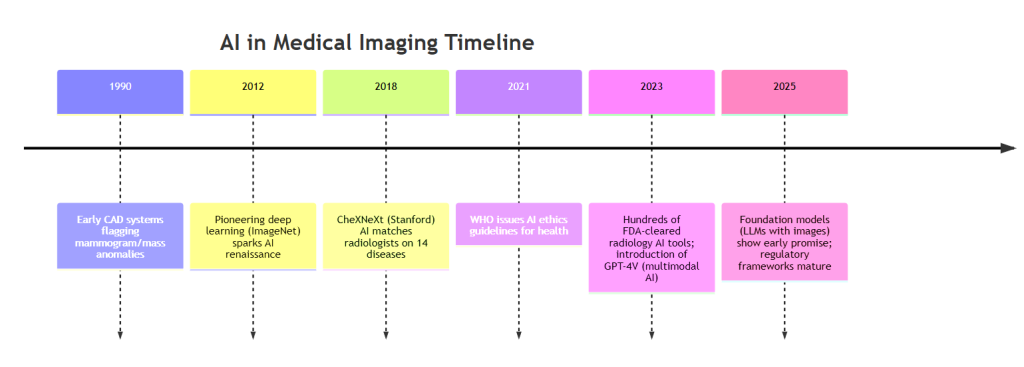
Medical imaging generates vast amounts of data, making it a natural fit for AI. Modern AI algorithms can analyze scans (X-rays, MRIs, CTs, etc.) in milliseconds. For example, convolutional neural networks (CNNs) now reliably detect lung nodules, fractures, or other pathologies on chest X-rays at or above human accuracy. One landmark study (Stanford’s “CheXNeXt”) had an AI model screen 420 X‑rays for 14 diseases – matching radiologist accuracy on most diseases – in 1.5 minutes (versus 240 minutes for humans). In practice, this means an AI can automatically triage dozens of scans, flagging critical cases and ruling out normals almost instantly.
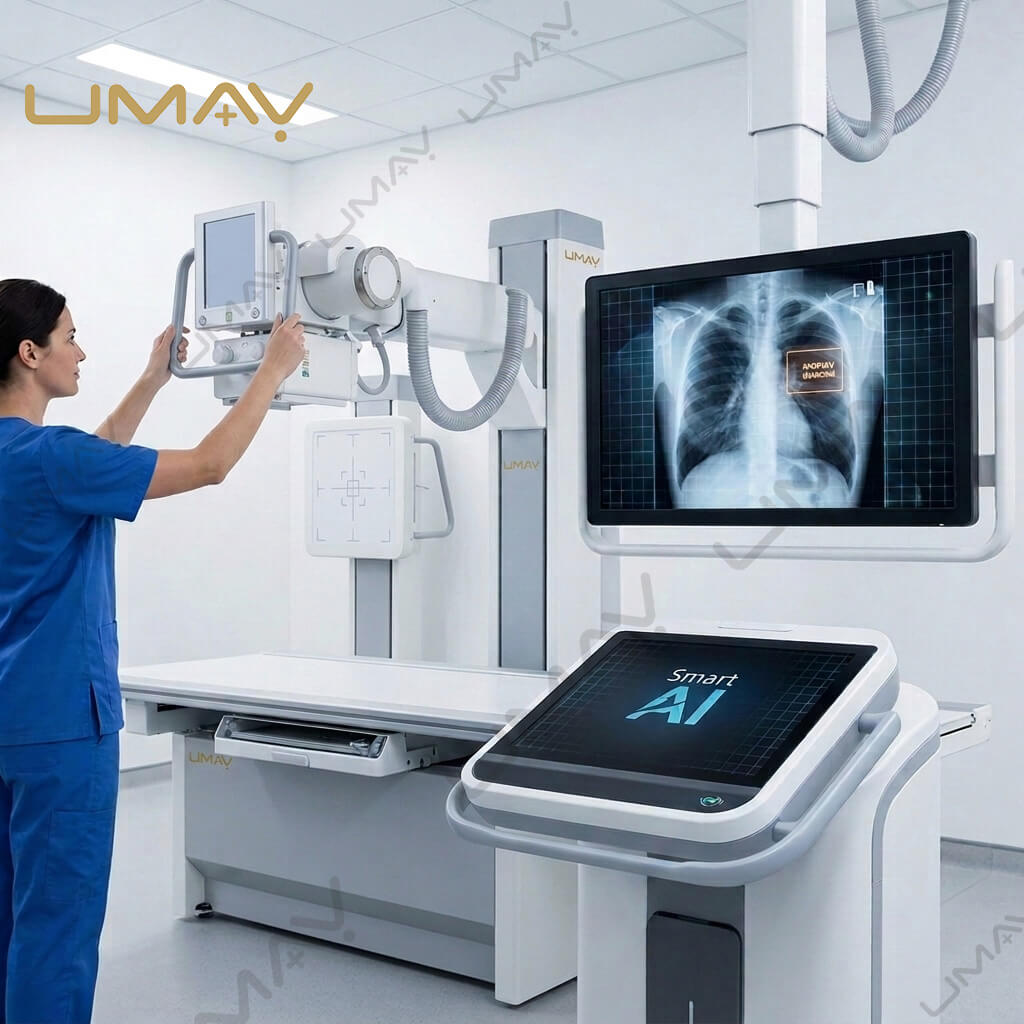
The workflow is changing: immediately after an X-ray is taken, AI software can compute a probability score for various conditions (e.g., pneumonia, fracture). Radiologists review the AI’s annotated images and probability assessments alongside their own interpretation. The AI highlights subtle findings and assigns confidence levels (e.g. “0–5% fracture risk” or “85% likelihood of mass”), helping doctors prioritize attention. This post-scan analysis greatly reduces turnaround time (one study saw a 77% faster report turnaround with AI triage) and can improve overall accuracy by catching findings that might otherwise be overlooked. Crucially, any AI output is reviewed by a physician – the final diagnosis and treatment plan always involve human oversight.

Cutting-Edge AI Applications in Imaging
Beyond chest X-rays, AI is revolutionizing all imaging modalities. Mammography AIs help triage urgent oncology cases; retinal imaging AIs screen for diabetic eye disease; and advanced tools like Google’s DeepMind can identify fractures on X-ray films. A 2025 Radiology review notes AI’s advantages in “pattern detection and classification” across modalities, enhancing accuracy and efficiency. New foundation models (like GPT-4V) even link text and image data: for example, GPT-4V achieved 61% accuracy on a broad radiology quiz (vs. 49% for doctors), showing the potential of multimodal AI to assist clinicians.
At major radiology conferences, surveys show growing adoption: nearly half of European radiologists report using AI tools actively (up from 20% in 2018). In practice, AI handles routine cases (e.g., excluding normal scans) so radiologists focus on complex cases. One study found an AI could correctly mark over half of normal chest X-rays as definitely normal with >98% sensitivity, allowing those scans to auto-report without a human in the loop. In our products, we integrate such AI triage capabilities: routine scans can be auto-flagged “normal” or tagged with a high-priority alert for any abnormalities, streamlining workflow for busy hospitals.
Nonetheless, experienced radiologists emphasize vigilance. AI can occasionally miss findings, and algorithms must be validated in diverse populations. Regulatory agencies (FDA, EU) are actively refining oversight of AI devices. For example, as of mid-2025 the FDA has cleared 950 AI/ML medical devices, ~76% in radiology. These clearances ensure AI tools meet safety and performance standards. In the EU, the new AI Act classifies AI medical devices as high-risk (Article 6(1)). Our company’s X-ray systems are designed to comply with international regulations (FDA, CE, NMPA, etc.) and incorporate AI only in ways that enhance care under physician control.
Our Export-Grade Imaging Solutions
X‑Ray Systems: We manufacture high-resolution digital and DR (flat-panel) X-ray machines in our China factory. Leveraging rapid innovations in China’s medtech sector, our X-ray detectors and tube technology match global quality standards. In China’s domestic market, local companies now hold 50% share of digital X-ray, up from 0% in 2004 – a testament to dramatic quality gains. Thanks to scale and lean production, our X-ray units are 30–60% cheaper than comparable Western brands, without cutting corners on image quality. For example, Chinese firms typically omit nonessential frills (e.g. black-and-white vs color display) to cut costs, yielding affordable devices. Our machines include built-in AI compatibility: they output DICOM images directly into AI software (either our proprietary or third-party) so that post-scan analysis and reporting can begin instantly. Features like adjustable automatic exposure control and low-dose imaging further enhance value.
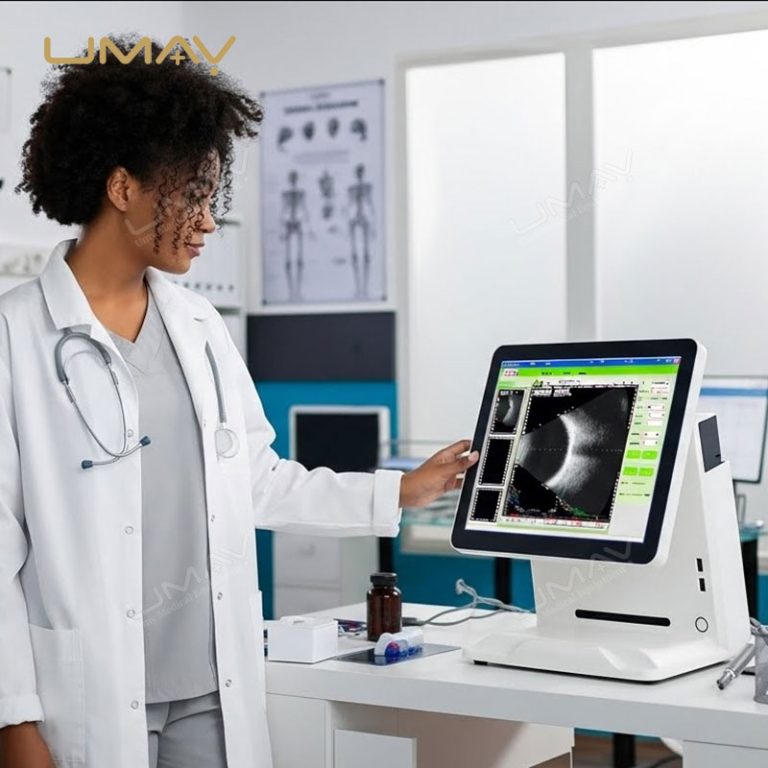
Ultrasound & Sonography: Our ultrasound portfolio ranges from portable to cart-based systems. Modern ultrasound AI (as adopted by leaders like Siemens) can automatically recognize organs (e.g. 17 abdominal structures in ms) and quantify measures (like liver fat) to speed exams. In our models, we support such AI-assisted features: e.g., quick organ segmentation, automated calculations (heart ejection fraction, fetal measurements), and smart scanning guides. This reduces exam time and improves consistency. AI-based image enhancement also yields clearer visuals from our transducers.
Laboratory Analyzers: In blood and clinical chemistry analyzers, AI/ML methods improve throughput and predictive diagnostics. For example, advanced algorithms in hematology can flag abnormal cell counts or even predict sepsis risk from routine blood tests. Our lab equipment interfaces with middleware that can run AI models on lab data, aiding clinicians in early warning and diagnosis. The result: faster lab reports and fewer manual checks.
Surgical Equipment: In the OR, we offer electrosurgery and procedure tables. While still an emerging field, AI-powered robotics are beginning to augment surgery (offering better precision and planning). We position our surgical tools to integrate with surgical navigation systems and future robotic platforms. For now, safety features (anti-shock, fail-safes) and ergonomic design lead – and we continually monitor AI advances (e.g. surgery-assist robots) to plan next-gen offerings.
Quality and Price Advantages of Our Chinese Manufacturing
China’s medical device industry has leapfrogged from low-end goods to cutting-edge exports. Government initiatives (e.g. “Made in China 2025”) have spurred local innovation. Today Chinese companies sell tens of billions in devices internationally, especially to price-sensitive emerging markets. Our company exemplifies this: by leveraging China’s supply chain and manufacturing efficiency, we undercut many competitors. Independent analysis shows Chinese-made devices often cost 10–70% of Western prices for equivalent tech. For example, Chinese X-ray detector units and tube assemblies are nearly identical in specs but ~40% cheaper than import equivalents.
Our quality control follows international standards (ISO 13485, GMP, etc.) and we hold certifications for CE, FDA (where applicable), and NMPA. We audit suppliers rigorously. At the same time, our lean operations – high automation, strategic sourcing – keep costs low. The net benefit to our B2B customers is clear: you get advanced imaging devices (with AI-readiness) that match or exceed global benchmarks, at a fraction of the cost. This gives hospital networks and distributors competitive pricing power in their markets.
Why Choose Us (CTAs)
- Request a Customized Quote or Consultation: Our team is ready to discuss your needs for AI-enhanced X-ray, ultrasound, lab, or surgical equipment. We’ll match you with the right solution and pricing. CTA: Contact our sales office or global distributor for more information.
- Schedule a Product Demo: See our imaging systems and AI tools in action. We offer virtual demos and onsite trials (subject to location). Experience the image quality and speed yourself. CTA: Book a demo session with our experts.
- Download Product Specifications: Access detailed brochures and technical sheets for our X-ray systems, ultrasound machines, and lab analyzers. Compare features and compliance data. CTA: Download spec sheets and white papers from our resources page.
Each of the above CTAs should link to placeholders or contact pages (e.g. Contact us, Request a demo, Download brochure).
Responsible AI and Future Trends
Looking ahead, AI’s trajectory in radiology is up: tools for automating report writing and synthesizing patient data (multimodal AI) are in development. However, trustworthy deployment is key. We follow international guidance on AI ethics (WHO, FDA). For instance, all our AI modules output confidence scores, and we ensure radiologists can easily review or override AI findings. We also provide training and documentation so clinical users understand AI limitations. This “human-in-the-loop” approach aligns with expert recommendations.
Moreover, as generative models evolve, we monitor regulatory landscapes (FDA’s AI device list, EU AI Act) and adapt. Our product roadmap includes on-device AI (edge computing) to allow offline facilities to benefit from instant analysis. We continue investing in R&D with partners to refine algorithms on diverse global data sets – our goal is to maximize the benefit to patient care while minimizing risk.
Conclusion
AI is driving a new era in B2B healthcare technology. By harnessing AI in imaging, labs and beyond, providers can diagnose faster and more accurately. Our export-focused medical device line – X-ray systems, ultrasound, lab analyzers, and surgical equipment – is built for this future. We combine advanced AI compatibility and imaging performance with China’s manufacturing efficiency to deliver unmatched value. In choosing our solutions, OEM and hospital buyers gain cutting-edge tools plus the cost and quality advantages of Chinese engineering. We welcome you to engage with us and join the AI-powered transformation of medical diagnostics.
Suggested Internal Links: Our X‑ray Systems, Ultrasound Machines, Laboratory Analyzers, Surgical Devices, Contact Us, About Company.
Suggested External Links: Radiology Society (RSNA) publications, Radiology journal, WHO AI guidance, FDA AI device info, and authoritative news (e.g. AP News on AI, JAMA study on AI devices).